

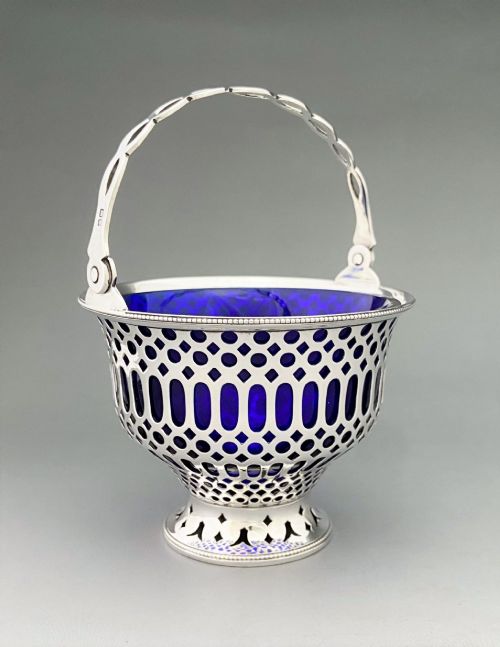


Georgian Silver Pail
A georgian silver pail brings elegance to a table, offering small-scale silverwork designed for cream or sugar.
Georgian Silver Pail
A georgian silver pail comprises small vessels designed for cream or sugar, alongside larger wine coolers and swing-handled baskets that populate this page.
The versions most commonly met span the eighteenth century and the regency period, taking forms such as pierced cream pails and wirework sugar baskets.
Makers shaped these items in sterling silver and old sheffield plate, frequently incorporating cobalt or blue glass liners.
Materials and methods
Silversmiths constructed pieces in sterling silver and old sheffield plate, employing piercing and wirework techniques to create openwork patterns.
Many designs integrate contrasting glass inserts, notably blue glass and cobalt glass, held securely within pierced or wire frames.
Listings feature items in sterling silver, old sheffield plate, and copper, paired with blue glass liners.
Judging quality
Quality rests upon the crispness of pierced decoration and the integrity of delicate wirework structures across the body of the pail.
The presence of an original blue glass liner and clear maker marks elevates the standing of a piece within its period.
Aldridge & Green·John Mackfarlan·Matthew Boulton & Co
The Georgian Silver Pail Glossary
- Cream pail
- A small vessel used for serving cream at the tea table, often matching larger sugar baskets.
- Wirework
- Openwork construction formed from soldered silver wires, creating a basketry effect popular in the georgian era.
- Old sheffield plate
- A method of fusing a thin sheet of silver onto a copper base, visible in nineteenth-century coolers and baskets.
- Pierced
- Metal decorated by cutting through the surface to form geometric or floral patterns.
- Wine cooler
- A large vessel designed for chilling wine at the table, produced in plated metals during the nineteenth century.
Georgian Silver Pail: Frequently Asked Questions
What is a georgian silver pail used for?
These vessels served to hold cream or sugar on tea tables during the eighteenth and nineteenth centuries.
Their small scale made them central accessories for formal hospitality and dining.
How do I spot old sheffield plate?
Old sheffield plate involves fusing silver to copper, which sometimes reveals thin copper lines where wear occurs.
Items utilising this technique date largely to the nineteenth century on this page.
Are glass liners original?
Many pierced and wirework pails require glass liners to hold contents safely inside the open metalwork.
Cobalt glass inserts frequently accompany these pieces, adding rich colour beneath the silver frame.
How do I date a silver pail?
Dating relies on stylistic markers such as neoclassical pierced designs or regency forms, alongside maker marks.
Records show pieces spanning the eighteenth century through to the edwardian period.