


Georgian Silver Cooler
A georgian silver cooler commands the dining table with monumental scale, offering the serious host an authentic vessel to chill fine wine.
Georgian Silver Cooler
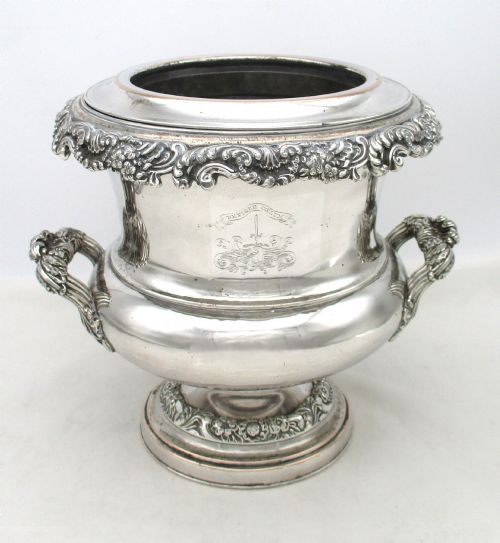
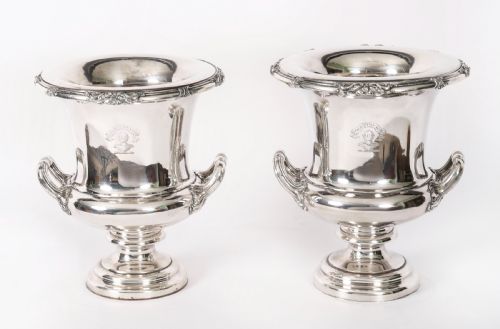
When you search for a georgian silver cooler, you encounter substantial vessels designed to hold bottles at the table, spanning the eighteenth and nineteenth centuries. The majority of surviving pieces belong to the Regency period and the early decades of the nineteenth century, taking the form of campana urns or multi-bottle holders.
Makers produced these pieces in solid silver and Old Sheffield Plate, often incorporating heraldic crests or coats of arms. Surviving examples frequently appear as matched pairs, reflecting the formal dining habits of the Georgian era.
Materials and construction methods
Silversmiths constructed solid silver coolers by hammering and casting precious metal into heavy, footed vessels, sometimes applying heavy gilding to the interior. Workshops also utilised Old Sheffield Plate, fusing a thin layer of silver onto a copper core to achieve the lustre of solid metal at a greater scale.
Craftsmen enriched the surfaces with cast handles, applied borders, and detailed chasing featuring floral or grapevine motifs. These techniques required exceptional skill to shape heavy metal sheets and decorative mounts without compromising structural integrity.
Several coolers feature detailed grapevine handles, reminding modern diners that nineteenth-century hosts took their temperature control very seriously indeed.
Judging quality in early cooling vessels
Quality rests upon the crispness of the cast mounts and the depth of the chased decoration, where sharper botanical or figural detail distinguishes superior workshops. The retention of original plating on Old Sheffield pieces, without excessive copper show-through from polishing, marks a well-preserved survivor.
Proportion and weight dictate the distinction between standard production and masterworks by notable silversmiths. Heavy-gauge metalwork, robust handles, and fully legible hallmarks or crisp crests elevate a piece above ordinary domestic wares.
Matthew Boulton & Co·William Burwash·Paul Storr London·Barnards·J W Story & W Elliott
The Georgian Silver Cooler Glossary
- Old Sheffield Plate
- A composite material made by fusing a sheet of silver to a copper ingot, developed in the eighteenth century. This technique allowed makers to create large dining vessels with the appearance of solid silver.
- Campana
- A bell-shaped vessel profile favoured for wine coolers during the Regency period. This classical form provides stability and generous capacity for ice and bottles.
- Gilt
- A thin layer of gold applied to the interior surface of a silver vessel. This protected the metal from the corrosive effects of wine and ice.
- Crest
- A heraldic device engraved or applied to the body of a cooler. It identified the noble or gentry family who originally commissioned the piece.
Georgian Silver Cooler: Frequently Asked Questions
How were these coolers used?
These vessels stood upon the dining table or sideboard, filled with ice and water to chill wine and champagne during formal meals.
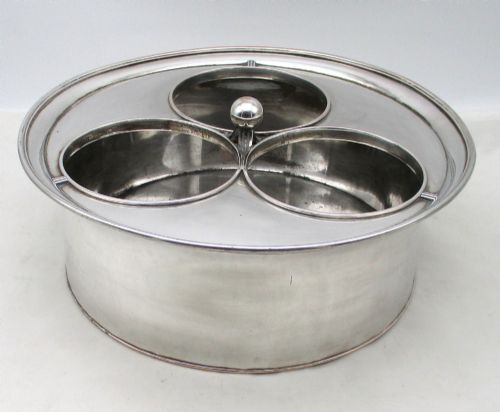
Servants placed bottles within the main chamber or divided inserts to maintain low temperatures throughout the course of a dinner.
Are these pieces solid silver?
The evidence shows a division between solid silver items bearing town hallmarks and those made from Old Sheffield Plate. Both materials served the affluent dining room of the period.
Old Sheffield Plate items feature a fused silver layer over copper, which distinguishes them from solid sterling equivalents.
How do I date a cooler?
Stylistic cues such as the campana silhouette and classical handles point towards the Regency era, while engraved armorials and specific crests help tie pieces to documented commissions.
Assay office marks and maker's stamps on solid silver examples provide precise year ciphers for accurate dating.
How should I display a cooler?
A cooler functions well as a focal point on a large sideboard, dining table, or serving console. Their significant weight and substantial volume demand a sturdy surface.
Many collectors exhibit pairs symmetrically to maintain the formal aesthetic of the period in which they were manufactured.