
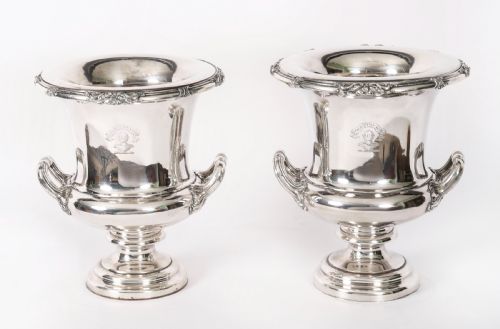
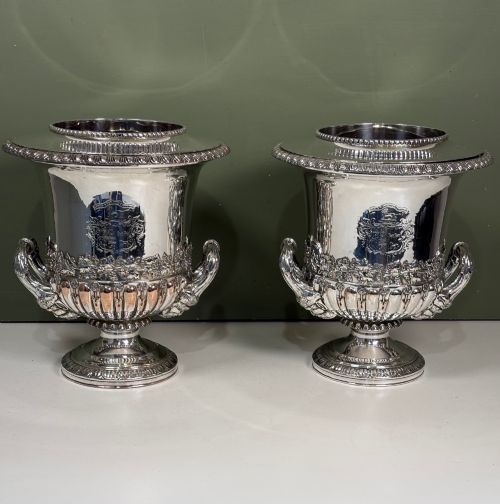


Antique Silver Champagne Urn
An antique silver champagne urn delivers commanding presence to a dining table, holding ice and bottles within heavy, lustrous metal vessels shaped by master silversmiths.
Antique Silver Champagne Urn
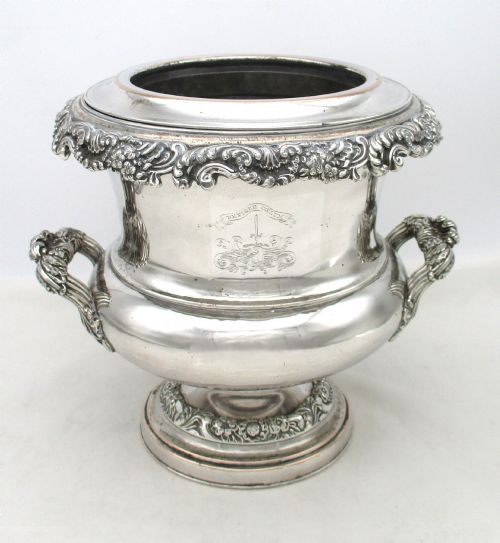
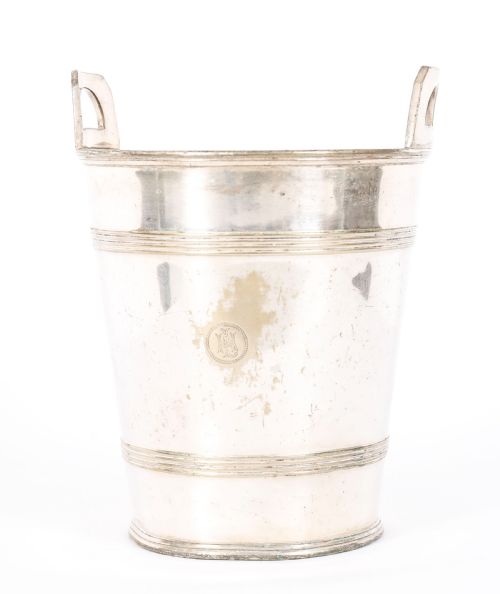
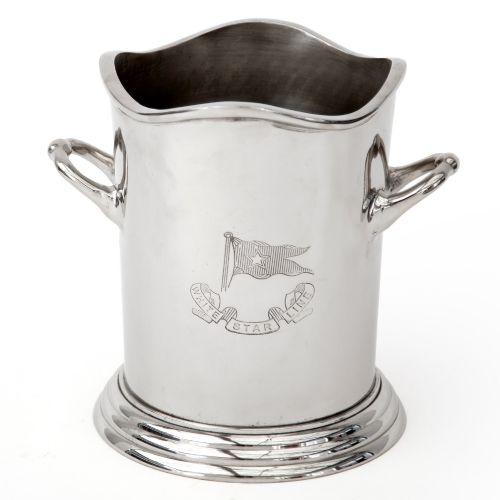
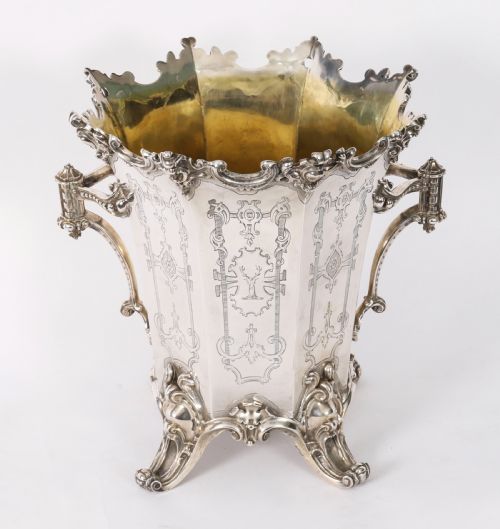
An antique silver champagne urn encompasses substantial wine coolers, ice buckets, and champagne buckets spanning the eighteenth, nineteenth, and twentieth centuries. These vessels appear in forms ranging from neoclassical campana shapes to robust Victorian designs and sleek Art Deco profiles.
Buyers meet Old Sheffield Plate examples very frequently alongside silver plate, electroplated nickel silver, and solid sterling silver pieces. Originating across Georgian, Regency, and Victorian periods, these urns frequently feature twin handles, cast crests, and classical motifs.
Materials and construction
Old Sheffield Plate utilises a thin sheet of silver fused to a copper base, often revealing subtle copper bleed along exposed rims and high points. Solid sterling silver and silver plate provide alternative bright metallic surfaces shaped through hammering, casting, and soldering.
Gilt highlights and applied metal mounts add decorative contrast to the primary silver or copper bodies. Workshops employed skilled techniques to form deep campana vessels and sturdy twin-handled mounts designed to hold substantial weight.
Listings feature pieces spanning the Georgian, Regency, and Victorian periods alongside twentieth-century Art Deco examples.
Evaluating the range
The distinction between ordinary and exceptional pieces rests on the crispness of cast decorative details such as handles, rims, and heraldic crests. Finer examples retain heavier gauge metal and balanced proportions that demonstrate superior workshop execution.
Surface preservation and the integrity of applied mounts differentiate the top tier from standard utility vessels. Pieces retaining clear maker marks and original Old Sheffield fusion layers command greater attention from discerning collectors.
Hutton Sheffield·Elkington Mason And Co·Matthew Boulton And Co·James Dixon And Sons
The Antique Silver Champagne Urn Glossary
- Old Sheffield Plate
- A composite material formed by fusing a sheet of silver to a copper ingot, developed in the eighteenth century before electroplating became common.
- Campana
- A bell-shaped vessel design popular in classical antiquity and revived during the Georgian and Regency periods for wine cooling.
- Electroplated Nickel Silver
- A base metal alloy of copper, nickel, and zinc coated with a layer of pure silver using an electrical current.
- Sterling Silver
- An alloy consisting of silver and other metals, usually copper, containing a specific high proportion of pure silver by weight.
Antique Silver Champagne Urn: Frequently Asked Questions
How do I date an old champagne urn?
Examine the manufacturing technique, structural form, and any visible hallmarks or maker stamps stamped into the metal.
Old Sheffield Plate construction often points toward the late eighteenth or early nineteenth century, while electroplated nickel silver generally indicates mid-nineteenth century production or later.
Were these urns originally used for champagne?
Historical dining practices employed these large vessels to cool wine bottles and champagne in ice water during formal meals.
Many examples double as wine coolers or ice buckets, reflecting versatile usage across dining rooms and banquets.
What is the difference between silver plate and Old Sheffield Plate?
Old Sheffield Plate involves physically fusing a layer of silver to copper before rolling them into sheets, creating a distinct dual-metal structure.
Standard silver plate utilises an electrochemical process to deposit a thin layer of silver over a base metal such as nickel silver or copper.
How should I clean a silver plated wine cooler?
Maintain the surface using a soft cloth and a specialised silver polish designed to remove tarnish without abrading the underlying metal.
Avoid harsh scrubbing on Old Sheffield Plate pieces to prevent exposing the underlying copper base layer.