
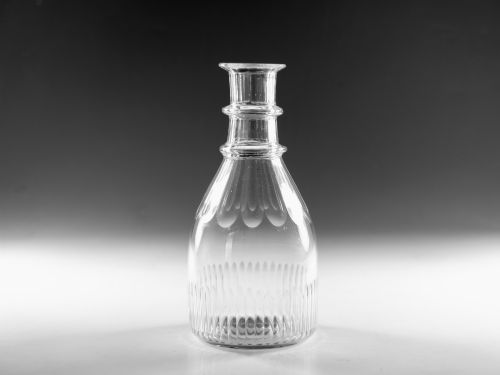
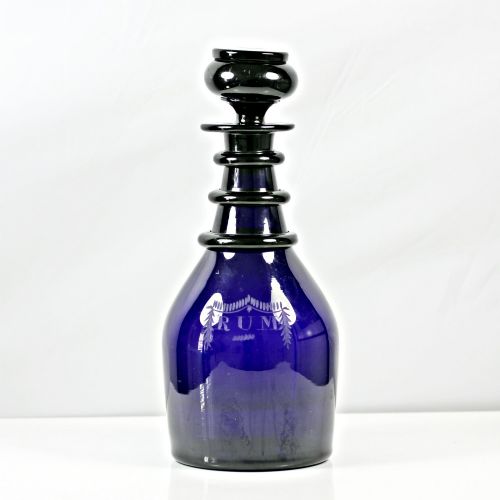
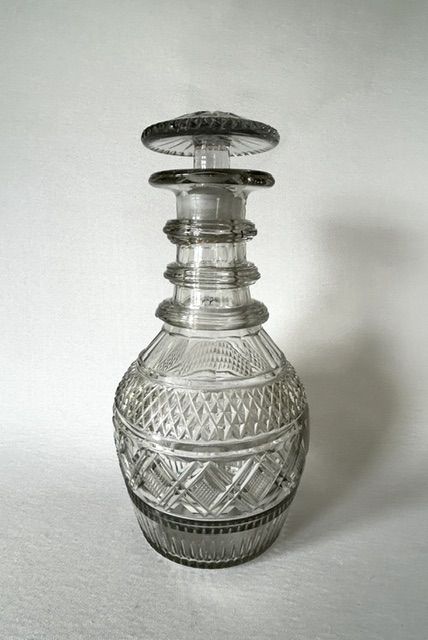


Georgian Ring Neck Decanter
A Georgian ring neck decanter is a practical and tactile piece of early glassware, prized for its distinct concentric glass rings that offer a secure grip for pouring.
Georgian Ring Neck Decanter
A georgian ring neck decanter is a functional vessel designed for holding and serving wine or spirits, originating mainly from the Georgian and Regency periods. These pieces often feature prominent horizontal rings encircling the neck, which originally helped servants maintain a firm hold with damp hands.
Most examples encountered on this page date from the late eighteenth century through to the nineteenth century, including specific regional styles such as Irish cut glass and Bristol blue spirit decanters. Forms range from standard three-ring shapes to heavy pillar-cut designs and ship's decanters intended for stability at sea.
How they were made
These vessels are formed from lead glass, lead crystal, or cut crystal, materials chosen for their heavy weight and clarity. Artisans shaped the hot metal by blowing and moulding before applying decorative techniques.
Cut glass and pillar cut surfaces are achieved through cold-working, where wheels grind precise geometric patterns and facets into the hardened body. Some examples also incorporate delicate gold leaf detailing to enhance the visual depth of the crystal.
Listings feature lead glass and cut crystal vessels spanning the Georgian, Regency, and Victorian periods, including specialised spirit and rum decanters.
What varies in quality
Quality in these decanters rests upon the weight of the metal and the crispness of the cutting. Heavy lead crystal provides a substantial feel in the hand, while sharp, deep facet cutting demonstrates superior craftsmanship compared to softer, shallower work.
The precision with which the neck rings are formed and finished distinguishes finer examples. Uniformity in the glass body and clarity free from excessive clouding or heavy internal impurities separate standard production from superior pieces.
The Georgian Ring Neck Decanter Glossary
- Ring neck
- A decanter neck featuring one or more horizontal glass bands formed during manufacture or applied separately. These rings provided a secure grip for pouring at the dining table.
- Ship's decanter
- A style with a broad, flat base and a conical body designed to prevent tipping aboard a vessel. This form remains stable on rolling surfaces.
- Lead glass
- Glass containing lead oxide, which increases the weight, refractive index, and working time of the material. It forms the basis of heavy crystal decanters.
- Pillar cut
- A decorative cutting style characterised by wide, vertical flutes or pillars running down the body of the vessel. This technique creates strong light reflection.
- Bristol blue
- A deep cobalt blue glass traditionally associated with production in Bristol during the eighteenth and nineteenth centuries. It was frequently utilised for spirit decanters.
Georgian Ring Neck Decanter: Frequently Asked Questions
What is a ring neck decanter?
A ring neck decanter is a glass bottle featuring raised concentric rings around its neck, designed during the Georgian and Regency eras to ensure a secure grip when pouring.
These pieces were made to hold wine or spirits on the dining table and often accompanied matching drinking glasses.
How do I date a Georgian decanter?
Dating relies on observing the silhouette, the style of cutting, and the formation of the neck rings. Earlier pieces often display pontil marks on the base and simpler ring configurations compared to later nineteenth-century examples.
Materials also shift from standard lead glass to heavier cut crystal as manufacturing techniques evolved through the period.
Can I use an antique decanter today?
These vessels remain entirely functional for serving wine and spirits at the table today. Hand washing in lukewarm water preserves the historic glass safely.
Avoid thermal shock by keeping temperature changes gradual when filling the vessel.
Why do some decanters have wide bases?
Wide bases, particularly seen on ship's decanters, were engineered to lower the centre of gravity. This prevented the vessel from tipping over during movement.
Such forms adapted practical maritime needs into desirable dining table accessories.