

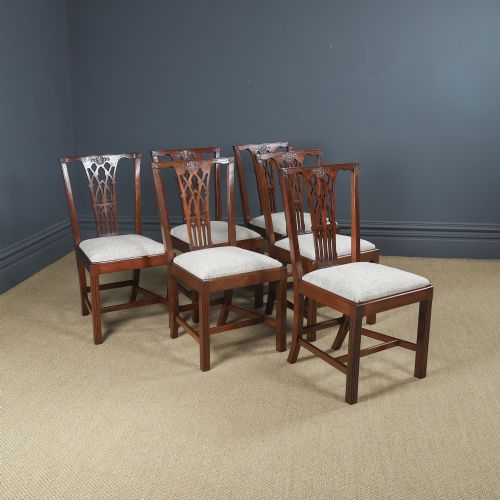


Georgian Revival Dining Set
These mahogany and oak sets built for the dining room echo eighteenth-century elegance through revival design.
Georgian Revival Dining Set
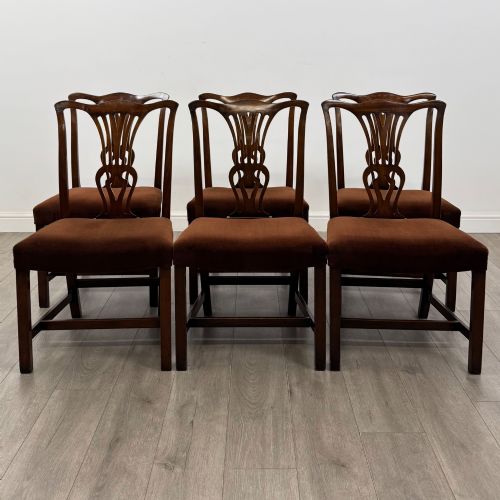
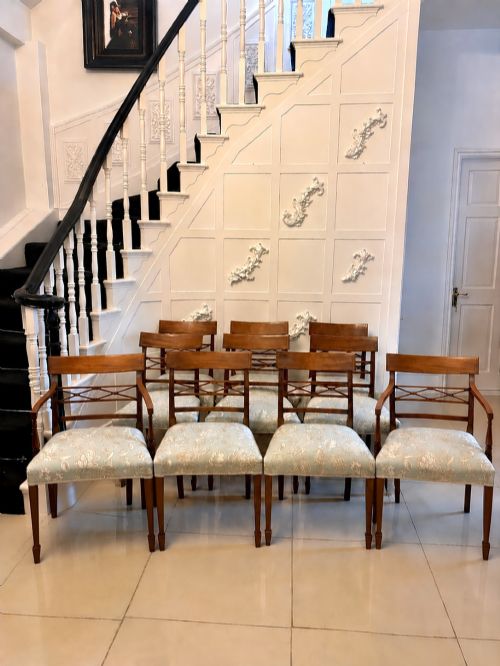
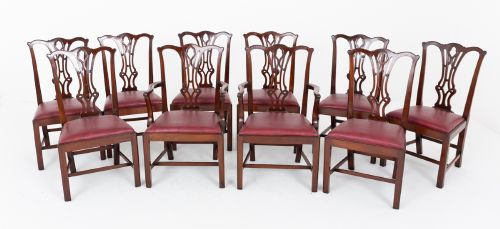
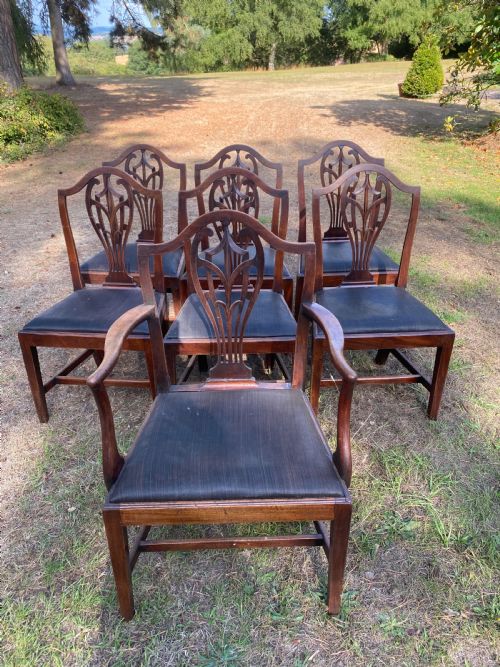
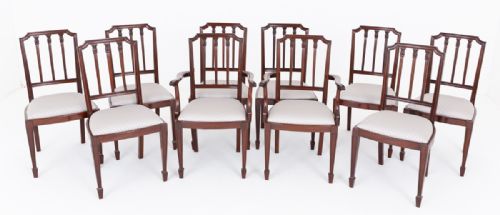
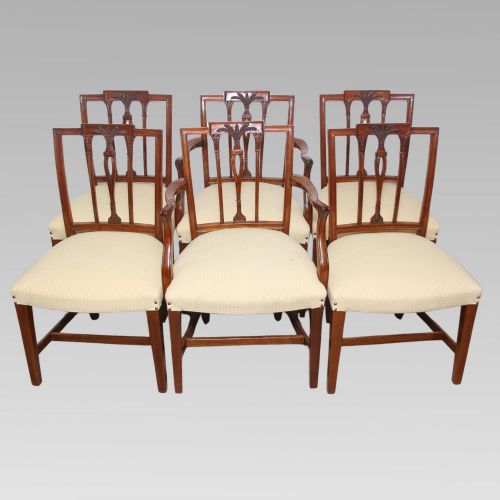
A georgian revival dining set brings together matching or harmonised groups of dining chairs fashioned in imitation of eighteenth-century forms. The sets appearing here span periods from the nineteenth century through the 1930s, reflecting Victorian and Edwardian interpretations of earlier aesthetics. You are most likely to encounter substantial sets of eight or ten chairs, often combining carver armchairs with side chairs.
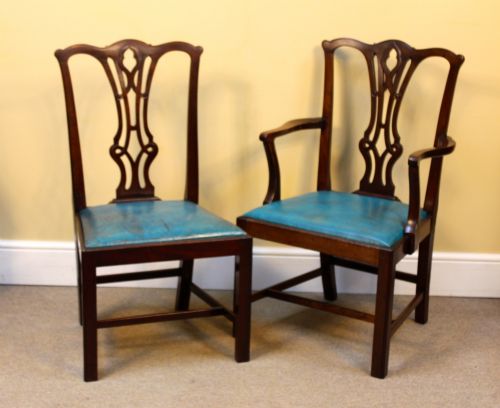
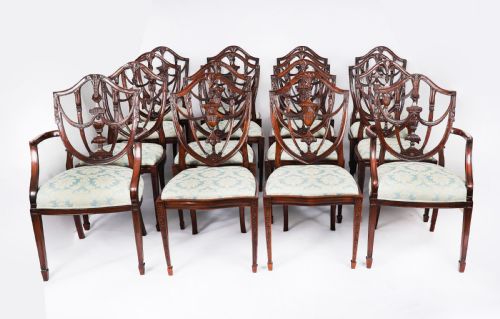
The silhouettes draw heavily on the celebrated designs of Chippendale, Hepplewhite, and Sheraton. This includes ladderbacks, shield backs, and ribbon backs executed in mahogany, oak, ash, and elm. These groupings provide the scale required for large dining tables while channelling historical British cabinetmaking traditions.
How they were made
Makers relied primarily on solid mahogany and oak for the frames, occasionally incorporating satinwood for contrast and inlay work. Ash and elm appear in specific regional vernacular chair forms such as Windsor styles. Timber selection prioritised dense grain capable of supporting intricate carving along the top rails and splats.
Upholstered elements utilise fabric, leather, and textile coverings secured over padding. The joinery combines traditional mortise and tenon construction with hand-carved details like interlaced ribbons and pierced splats. Carved motifs are integrated directly into the chair stiles and legs rather than applied as separate ornamentation.
Listings feature mahogany, oak, ash, and elm timbers, with styles spanning Chippendale, Sheraton, Hepplewhite, and Federal revivals across several centuries.
What varies in quality
The standard of a set rests upon the crispness of the carving and the uniformity of the timber selection across all pieces. Superior examples exhibit deep, well-defined relief work on the splats and rails, whereas lesser sets display softer, shallower tooling. Consistency in the grain pattern and colour matching among a large group of chairs elevates the standing of the furniture.
Structural integrity and the retention of original upholstery configurations also differentiate groups. Sets that maintain tight joints without excessive reinforcement command greater regard. The inclusion of matching carver armchairs alongside single side chairs completes the intended suite with greater cohesion.
Robert Strahan Dublin·Waring·Brights of Nettlebed
The Georgian Revival Dining Set Glossary
- Carver armchair
- A dining chair fitted with armrests, traditionally placed at the heads of the table. These are frequently found paired with larger sets of single side chairs.
- Shield back
- A chair back shaped in the outline of a heraldic shield, popularized by George Hepplewhite. This design often incorporates carved splats or drapery motifs within the frame.
- Ribbon back
- A chair back featuring an openwork splat carved to resemble intertwined ribbons or silk drapery. This intricate style is heavily associated with Thomas Chippendale designs.
- Splat
- The vertical wooden slat placed in the middle of a chair back, frequently pierced, carved, or shaped. It provides both structural support and the primary decorative focus of the seat.
- Inlay
- A technique where contrasting woods or materials are fitted into recesses cut into the primary surface. Satinwood is commonly utilised for this decorative detailing on Sheraton-style pieces.
Georgian Revival Dining Set: Frequently Asked Questions
How do I care for antique dining chairs?
Keep wooden surfaces nourished with appropriate wax polishes and protect leather or fabric upholstery from direct sunlight. Avoid placing sets near heat sources that might dry out the timber and loosen the joinery.
Regularly check the stability of the legs and arm joints, tightening fixings gently if movement occurs. Use suitable cleaners intended specifically for historic textiles when managing upholstered seat pads.
Were these sets made for everyday dining?
Makers constructed these revival suites to serve the formal and domestic dining requirements of Victorian and Edwardian households. They provided durable seating designed to withstand daily family meals while maintaining a refined aesthetic.
The inclusion of robust hardwoods like mahogany and oak ensured the chairs could endure regular use over generations. Large sets with multiple carvers accommodated extended families and dinner parties.
What is the difference between Chippendale and Hepplewhite styles?
Chippendale styles typically feature bolder carved details, ball and claw feet, and pierced ladder or ribbon backs. The silhouette tends to be robust with a distinct architectural presence.
Hepplewhite designs favour lighter proportions, often displaying tapered legs and shield or heart-shaped backs. The ornamentation relies more on delicate inlay and painted or subtle carved motifs rather than heavy relief.