

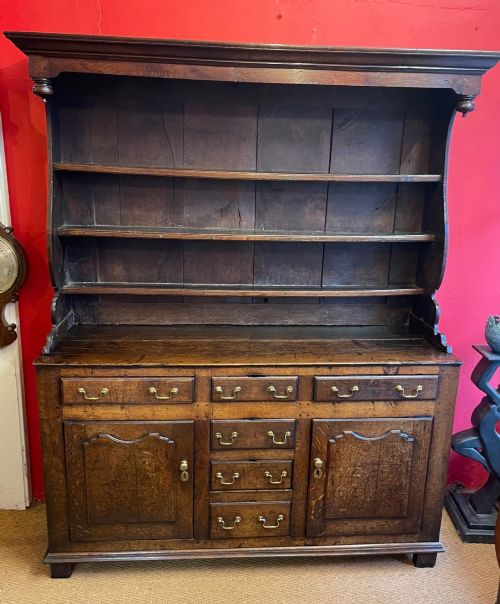
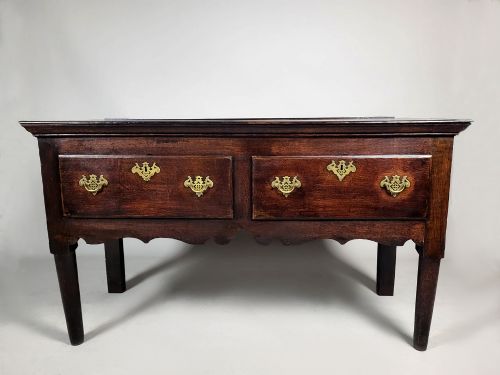
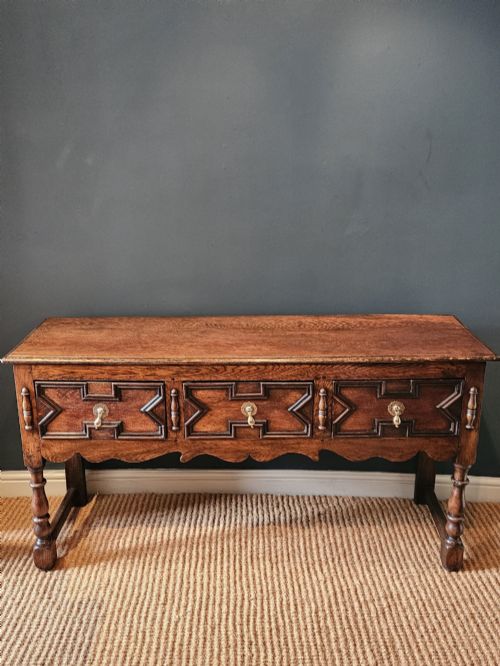
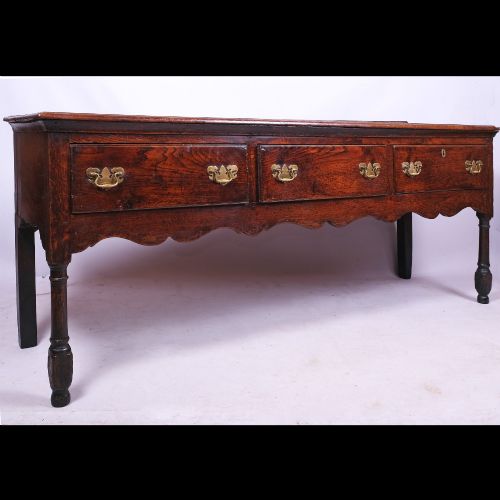
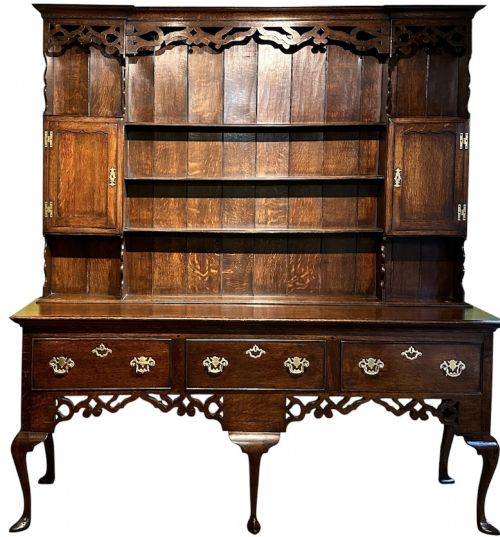


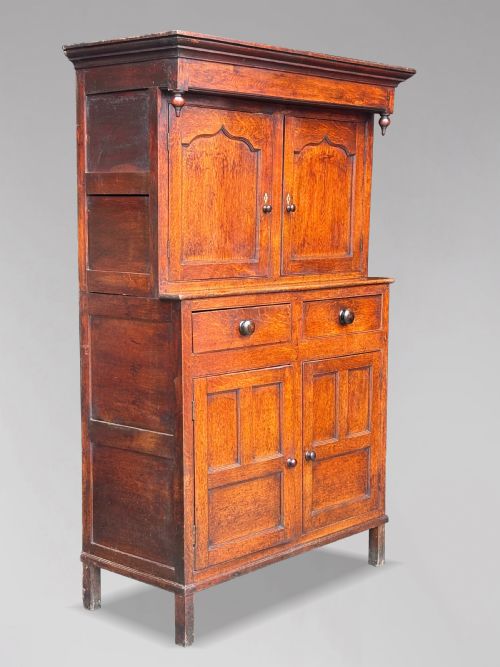


Georgian Period Oak Sideboard
A georgian period oak sideboard gives you solid timber construction and honest vernacular proportion for serious storage.
Georgian Period Oak Sideboard
When you search for a georgian period oak sideboard, you are looking at sturdy timber furniture designed for practical service in dining rooms and halls. The pieces on this page span the eighteenth century, including George I, Queen Anne, and George III periods, alongside vernacular and regional variations.
You will most commonly meet dresser bases, potboard dressers, and enclosed cupboards rather than formal dining sideboards. These forms utilise solid oak boards, often supplemented with pine or fruitwood in secondary areas.
Makers built these pieces for daily use rather than display, resulting in honest construction with panelled doors, geometric mouldings, and simple drawer arrangements. The origins remain predominantly English country, with occasional French provincial commodes and court cupboards appearing alongside standard dresser forms.
How they were made
Carpenters constructed these pieces using solid oak planks joined with traditional pegged mortise and tenon framing. Timber preparation relied on quarter-sawing methods to reveal strong grain figures while ensuring structural stability across large panels.
Secondary framing frequently incorporates pine and fruitwood for drawer linings and internal shelving. Surface finishing involved hand planing and polishing, which allowed the natural grain of the oak to darken organically over centuries.
Hardware such as brass handles and escutcheons were fitted by hand, often accompanying original geometric mouldings and carved details. Joiners built potboard bases and breakfront drawers to handle heavy domestic loads without modern mechanical fasteners.
Georgian Period Oak Sideboard Retail Price Guide 2026
Typical asking prices for georgian period oak sideboard among the pieces listed under this phrase on Sellingantiques today, from the lower quarter to the upper quarter. They describe what is for sale here now, not the wider market.
Listings span the eighteenth century and Victorian eras, utilising oak, brass, pine, mahogany, and fruitwood across regional English and French styles.
What varies in quality
Quality in these pieces depends on the integrity of the timber and the retention of original structural elements. Superior examples display undisturbed surface patination and tight joinery that has survived centuries of use.
The sophistication of the timber selection dictates the visual hierarchy, from plain utility boards to finely figured oak with geometric mouldings. Original brasses and untouched backboards elevate a piece far above one with replaced components or altered bases.
The Georgian Period Oak Sideboard Glossary
- Potboard dresser
- A sideboard form featuring an open lower shelf designed for storing pots and heavy ceramics. This lower platform sits raised above the floor on sturdy stiles.
- Geometric moulding
- Raised wooden profiling applied in repeating rectangular or panelled patterns onto drawer fronts and doors. This decorative technique adds depth and shadow to seventeenth and eighteenth-century facades.
- Breakfront
- A cabinetry design where the central section projects forward from the flanking outer wings. This arrangement creates architectural rhythm and additional interior depth.
- Court cupboard
- An enclosed upper and lower storage piece used for displaying plate and storing provisions. These heavy structures often feature panelled doors and carved friezes.
- Joined oak
- Furniture constructed primarily through pegged mortise and tenon joints rather than nailed or glued assembly. This technique defines the sturdy vernacular building tradition.
Georgian Period Oak Sideboard: Frequently Asked Questions
What is a potboard dresser?
A potboard dresser is a low storage base featuring an open bottom shelf beneath the drawers. It served as a practical surface for keeping heavy kitchen earthenware close to hand.
Over time, these open lower shelves developed rich patination from centuries of wear and atmospheric exposure in country houses.
How do I date an oak sideboard?
Dating relies on observing construction methods, timber preparation marks, and stylistic indicators such as geometric mouldings or bracket feet. Eighteenth-century pieces typically display hand-planed surfaces and pegged joinery rather than machine cutting.
Hardware placement and the presence of secondary woods like pine also help narrow down the period of manufacture.
Where were these pieces used?
These pieces originated in domestic settings ranging from farmhouse kitchens to estate housekeeper rooms. They provided heavy-duty storage for table linen, dry goods, and serving vessels.
Today, they transition easily into modern dining rooms and hallways as practical surface units.
Are original brasses important?
Original brass handles and escutcheons contribute significantly to the historical integrity of an eighteenth-century piece. They show matching patination and fit precisely into existing fixing holes.
Replacements are common due to centuries of heavy use, though untouched hardware remains highly prized.