
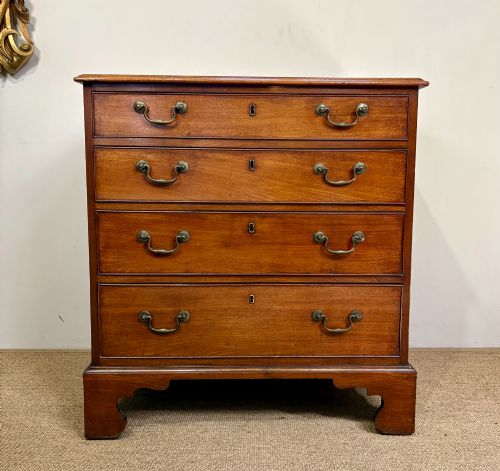
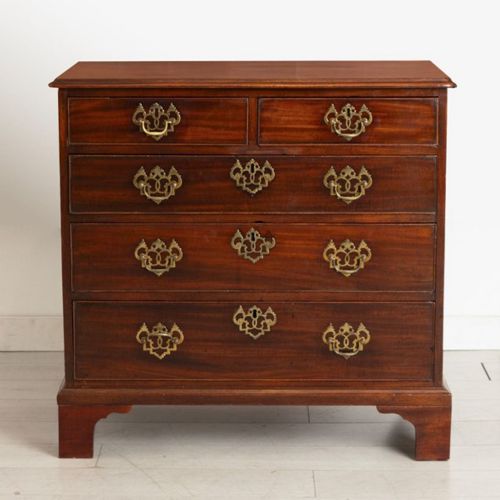
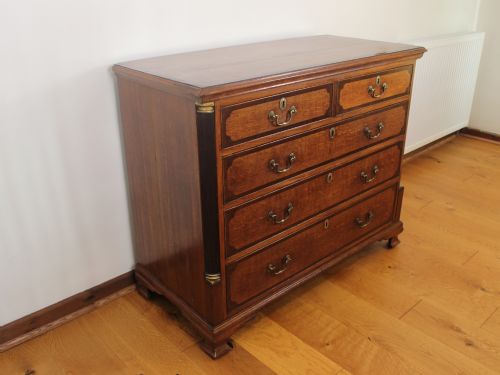


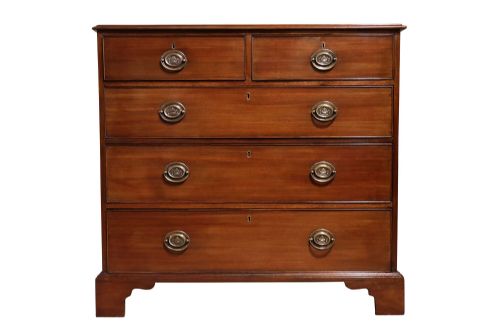


Georgian Oak and Mahogany Chest
A georgian oak and mahogany chest brings together sturdy local timber and rich imported grain, offering practical storage with enduring eighteenth-century design.
Georgian Oak and Mahogany Chest
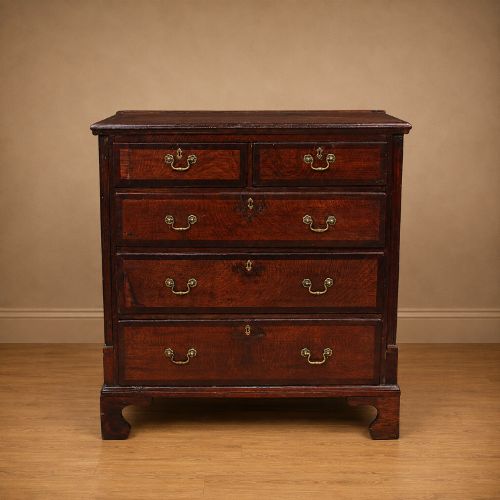
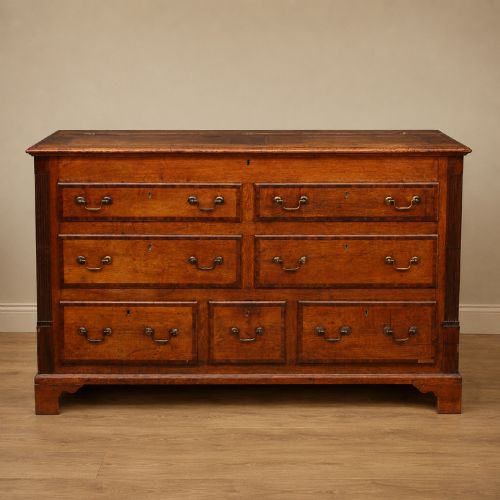
A georgian oak and mahogany chest is fundamentally a sturdy storage piece defined by solid timber construction and contrasting grain work. The primary form met here is the chest of drawers, alongside larger Lancashire mule chests and tall chest on chest variants.
Most examples hail from the eighteenth century or the Regency period, displaying structural oak carcases paired with decorative mahogany drawer fronts. Crossbanding in mahogany often frames the lighter oak boards, creating a distinct visual border.
Proportions vary from small bachelor units with pull-out slides to large four-height storage furniture. Interiors consistently rely on oak linings for the drawer boxes, confirming period construction methods.
Materials and construction
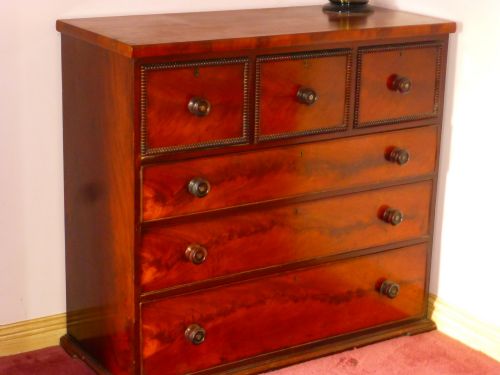
Cabinet makers utilised native oak for structural integrity and concealed framing, while importing mahogany for visible surfaces and decorative crossbanding. Wood veneer and flame mahogany figure heavily on drawer fronts, applied over stable secondary woods.
Brass hardware, including swan neck handles, drop handles, and oval plates, secures the drawer fronts alongside bracket feet or ogee feet supporting the base. Oak-lined drawers utilise hand-cut dovetail joints to ensure durability across centuries of use.
Form variations range from compact bachelor chests and miniature boxes to tall chest on chest units and mule chests.
Evaluating craftsmanship
The division between standard and superior pieces rests on the precision of the crossbanding and the choice of mahogany veneers. Golden oak paired with figured flame mahogany indicates careful selection by the cabinet maker.
Original brass fittings and untouched bracket or ogee feet elevate a piece significantly above examples with later replacements. The tightness of the oak dovetailing and the retention of original oak linings preserve structural integrity.
The Georgian Oak and Mahogany Chest Glossary
- Crossbanding
- A strip of veneer applied to the border of a drawer front, running perpendicular to the grain of the central wood. This technique creates a neat framed effect.
- Oak lined
- A drawer box constructed internally using solid oak boards rather than deal or softer secondary woods. This detail marks better quality eighteenth-century cabinet work.
- Ogee bracket foot
- A moulding style featuring an S-curve shape that flows outwards and then back in towards the base. It provides a stable yet elegant support for large chests.
- Bachelor's chest
- A small compact chest of drawers incorporating a pull-out writing slide above the top drawers. These pieces served dual purposes in smaller Georgian chambers.
- Mule chest
- A storage chest fitted with one or two functional drawers at the base beneath the main lift-top compartment. They bridge the gap between traditional coffers and modern chests of drawers.
Georgian Oak and Mahogany Chest: Frequently Asked Questions
How do I date a Georgian chest?
Dating relies on examining the timber species, handle hardware, and construction methods. Earlier pieces often feature quarter-sawn oak frames and solid walnut or mahogany tops.
Changes in foot styles, such as moving from bracket feet to ogee feet, alongside shifts in drawer lining materials, help narrow down the decade of production.
What is mahogany crossbanding?
Crossbanding involves laying thin strips of mahogany veneer around the perimeter of drawer fronts so the grain runs at right angles to the centre panel. This practice adds decorative contrast to lighter oak carcases.
Cabinet makers used this method extensively during the Georgian era to elevate simple storage furniture into refined decorative objects.
Are these chests suitable for daily use?
Solid oak carcases and traditional dovetail construction make these chests remarkably sturdy for everyday bedroom or living room storage. The internal oak drawers glide smoothly when properly waxed and maintained.
Placing them away from direct heat sources prevents timber shrinkage and protects the historical veneer surfaces from splitting.
What is the difference between a mule chest and a standard chest?
A standard chest consists entirely of stacked horizontal drawers running from top to bottom. A mule chest combines a deep blanket box accessed via a hinged top with one or more lower drawers.
This hybrid design allowed owners to store bulky linens in the top well while keeping smaller garments organised in the base drawers.