
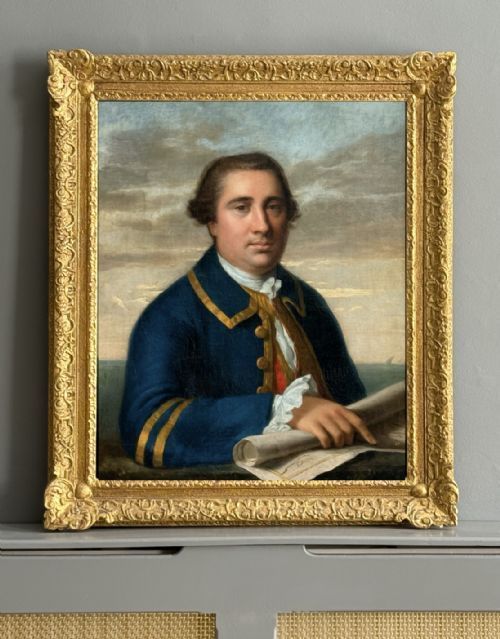


Georgian Naval Officer
These georgian naval officer pieces bring maritime history into the room through oil paintings, miniature portraits, and campaign trunks.
Georgian Naval Officer
A georgian naval officer search leads you directly into maritime portraiture and military equipment from the eighteenth and nineteenth centuries. You will encounter oil paintings on canvas alongside delicate portrait miniatures executed on enamel, paper, or agate panels.
The material record also encompasses practical items associated with sea service, such as camphorwood and mahogany campaign chests, alongside officers mess bowls. These artefacts document the visual culture and personal belongings of naval commanders from the Georgian and Regency periods.
Portraits dominate the selection, depicting captains, admirals, and gentlemen in naval jackets or full uniform. Works range from expansive oil paintings by listed artists to intimate portrait miniatures framed in gold.
Materials and construction
Painters utilised oil on canvas for larger portraits, building rich layers of pigment to capture the texture of naval uniforms and lace. Miniature painters worked on specialised surfaces including paper, enamel, and agate panels, framed in gold.
Makers constructed utilitarian storage vessels using dense timbers like mahogany and camphorwood. These chests incorporated brass fittings designed for durability during transport on military campaigns.
Listings combine oil paintings and watercolours on canvas and paper with wooden campaign trunks in mahogany and camphorwood.
Assessing quality and execution
Quality in these works rests upon the skill of the artist in portraiture, particularly in the handling of facial expression and uniform detail. Works by documented painters command attention through their accomplished brushwork and psychological depth.
Material preservation dictates the standard for both paintings and furniture. Intact original frames, well-maintained canvas surfaces, and robust brass hardware on campaign chests distinguish superior examples.
LEMUEL FRANCIS ABBOTT·Henry Bone ARA·John Simmons·Sir Thomas Lawrence·George Frederick Clarke·Samuel Lane·Robert Ker Porter·Ambrosini Jerome
The Georgian Naval Officer Glossary
- Campaign chest
- A sturdy wooden trunk, often made of mahogany or camphorwood, designed to be easily dismantled or transported during military operations. These pieces frequently feature brass corners and recessed handles.
- Enamel miniature
- A small-scale portrait painted using vitreous enamel on a metal base and fired in a kiln. This technique provides exceptional permanence and luminosity of colour.
- Mess bowl
- A vessel used for dining or food service within a ship or military mess. These items reflect the domestic arrangements of naval officers at sea.
- Agate panel
- A polished slice of mineral used as a stable, smooth substrate for miniature painting. The natural banding of the stone sometimes forms part of the composition.
Georgian Naval Officer: Frequently Asked Questions
How do I identify a naval officer portrait?
Look for specific uniform details in the clothing, such as naval jackets, epaulettes, and gold braid. Many subjects are also depicted holding maritime instruments, swords, or standing before coastal backdrops.
Inscriptions on the reverse or contemporary documentation often record the name of the sitter and sometimes the artist responsible for the work.
What is a military campaign trunk?
A military campaign trunk is a portable storage box built for officers on active service. They utilise sturdy woods like camphorwood or mahogany to withstand rough transport.
These chests incorporate protective brass corners, flush-fitting handles, and sectional interiors designed to hold uniforms and personal gear securely.
How are portrait miniatures framed?
Portrait miniatures from this period frequently feature precious metal surrounds, including gold frames. Some examples incorporate specialised backings such as agate panels.
These compact works were designed to be carried on the person or displayed intimately within domestic interiors rather than hung on large walls.
What periods do these pieces span?
The pieces span the eighteenth and nineteenth centuries, encompassing the Georgian, Regency, and early Victorian eras. This timeline covers the height of sail power and naval expansion.
Stylistic shifts across these decades are visible in the transition from eighteenth-century formal portraiture to more naturalistic nineteenth-century depictions.