
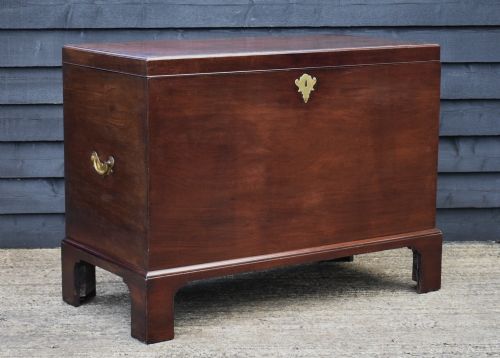
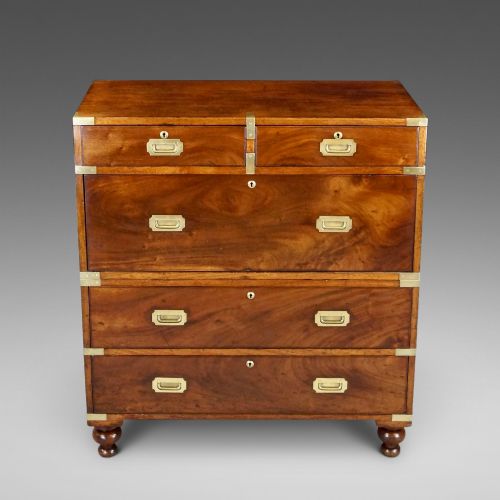
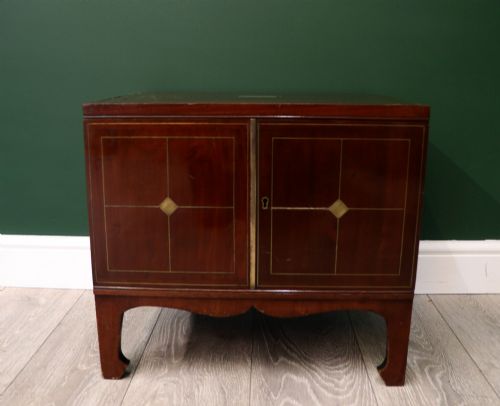
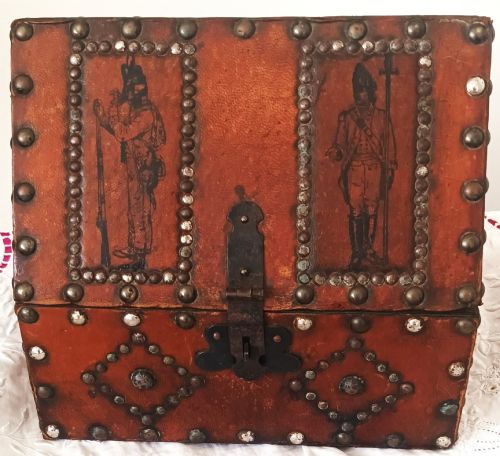
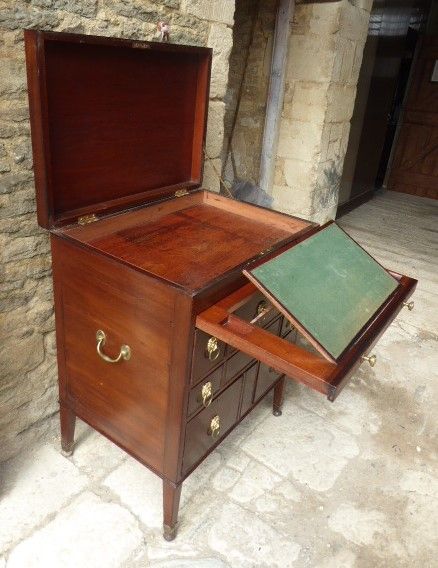


Georgian Military Chest
Georgian military chest pieces are travel-ready brass-bound cases designed for officers on the move, offering robust storage with clever folding handles.
Georgian Military Chest
When you search for a georgian military chest, you encounter practical travel storage designed for officers on the move. The pieces on this page span chests of drawers, writing slopes, trunks, and dressing chests.
Mahogany and teak dominate the selection, often reinforced with brass corners and flush handles to withstand rough journeys. These items range from compact boxes to large two-part chests built to separate easily for transport.
The aesthetic bridges functional utility and refined cabinet-making, with many examples originating from the Georgian period through to the nineteenth century.
How they were made
Constructed primarily from dense hardwoods like mahogany and teak, these pieces rely on solid timber frames built to endure rigorous transit. Iron and brass feature heavily in the hardware, providing structural reinforcement to corners, edges, and seams.
Craftsmen inset brass handles and corner brackets flush into the wood to prevent snagging during transit. Many chests utilise a two-part modular construction held together by metal brackets, allowing officers to transport heavy drawers individually.
Object forms span chests of drawers, writing slopes, washstands, blanket chests, and apothecary boxes.
What varies in quality
The distinction between standard examples and superior pieces rests on the precision of the brass work and the grade of timber selected. Finely executed recessed handles and neatly dovetailed joints signal higher workshop standards.
Original fitted interiors, such as secret compartments in writing slopes or intact ceramic and glass components in apothecary boxes, elevate a piece above standard utilitarian storage.
The Georgian Military Chest Glossary
- Flush handle
- A handle set into a recessed cavity so it does not project beyond the surface of the wood. This prevents damage and catching during transit.
- Dovetail
- A joint formed by interlocking wedge-shaped fingers of wood. It provides exceptional tensile strength for drawer construction.
- Writing slope
- A portable box with an angled, hinged writing surface that lifts to reveal storage for stationery. Many include inkwells and secret compartments.
- Teak
- A dense, durable tropical hardwood resistant to moisture and warping. It appears frequently in pieces built for colonial service.
Georgian Military Chest: Frequently Asked Questions
How were military chests transported?
These chests were built in two separate sections with removable feet and side carrying handles for easier loading onto pack animals or wagons.
Officers on campaign relied on this modular design to move their heavy belongings across rough terrain without damaging the woodwork.
Are these chests always made of mahogany?
While mahogany is the most common timber seen across these listings, makers also utilised teak, oak, walnut, and camphorwood.
Choice of wood often depended on the region of manufacture and the specific climate the officer expected to encounter.
What is the difference between a chest and a slope?
A chest provides large-scale storage through drawers or deep trunk compartments meant for clothing and equipment. A writing slope is a smaller tabletop box specifically designed for correspondence and paperwork.
How do I identify a true campaign piece?
Look for recessed brass hardware, sectional construction designed to separate, and durable secondary timbers intended for travel. These structural adaptations distinguish campaign items from standard domestic furniture of the same period.