


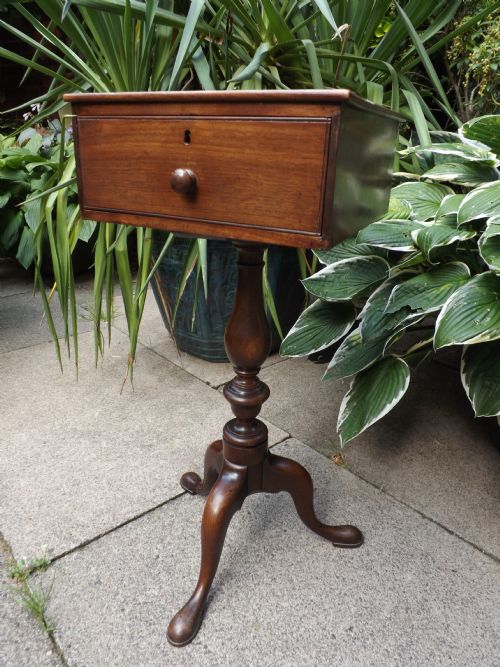

Georgian Mahogany Workbox
A georgian mahogany workbox brings refined utility to any room, offering neat compartments for needlework alongside handsome timber grain.
Georgian Mahogany Workbox
When you search for a georgian mahogany workbox, you encounter compact lidded chests designed for ladies' sewing and needlework, alongside elegant sewing tables raised on stands.
The pieces listed on this page span the Georgian, Regency, and Edwardian eras, encompassing portable boxes with drawers and freestanding occasional tables.
How they were made
Cabinetmakers utilised solid mahogany and flame mahogany veneers over secondary timbers, often selecting boards with rich, active grain patterns for the exterior surfaces.
Fine boxwood banding and shell inlay frequently accent the primary wood, while brass handles, cartouches, and escutcheon plates provide functional hardware.
Internal trays and fitted compartments utilise secondary woods, sometimes incorporating bone or ivory details for needle winders and small spool holders.
Listings on this site span the eighteenth to the twentieth centuries, showing mahogany alongside decorative brass, boxwood, and bone details.
What varies in quality
Quality rests heavily on the selection of timber, moving from plain sawn boards to highly figured flame mahogany with deep chatoyancy.
The crispness of inlay work and the retention of original brass fittings and internal partitions separate standard examples from superior specimens.
The Georgian Mahogany Workbox Glossary
- Workbox
- A portable box or freestanding table designed to hold sewing equipment, threads, and needlework supplies. These pieces often feature fitted interior trays and locking lids.
- Escutcheon
- A protective plate surrounding a keyhole, frequently cast in brass to prevent the wood from splitting around the lock. On better pieces, these are finely engraved.
- Flame mahogany
- A veneer cut from the branch junction of the mahogany tree, producing a distinctive, flickering flame-like pattern. Cabinetmakers reserved this timber for principal display surfaces.
- Boxwood banding
- A narrow strip of pale yellowish wood inlaid around the edges of a lid or drawer front to create a contrasting border. It defines the geometric panels of the piece.
Georgian Mahogany Workbox: Frequently Asked Questions
What is a georgian mahogany workbox used for today?
These compact boxes and tables serve as elegant storage for desktop stationery, jewellery, or modern craft supplies.
Their fitted compartments make them particularly useful for keeping small everyday items organised on a dressing table or desk.
How do I distinguish a box from a work table?
A box is designed to be lifted and placed upon a table or chest, often featuring carrying handles or a portable shape.
A work table stands on its own legs, sometimes incorporating a fabric bag or a wooden drawer beneath the main surface for sewing materials.
How do I care for mahogany furniture?
Keep the wood away from direct sunlight and strong heat sources to prevent the timber and veneers from drying out.
Apply a traditional wax polish sparingly and buff with a soft cloth to maintain the natural lustre of the grain.
How can I tell the period of a workbox?
Examine the construction methods, timber selection, and hardware style to gauge the age of the piece.
Georgian and Regency examples typically display hand-cut dovetails and older brass fixings, whereas Edwardian pieces often incorporate lighter inlay work.