







Georgian Mahogany Wall Shelf
A georgian mahogany wall shelf brings warm timber tones and practical display space to any room, offering classic lines that anchor a traditional interior.
Georgian Mahogany Wall Shelf
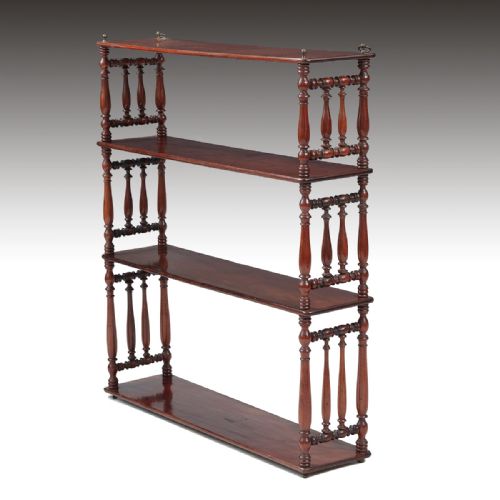
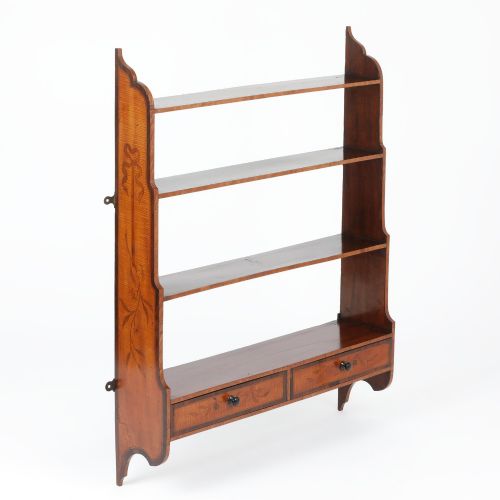
When you search for a georgian mahogany wall shelf, you encounter wall-mounted storage pieces designed to save floor space while displaying books, plates, and decorative objects.
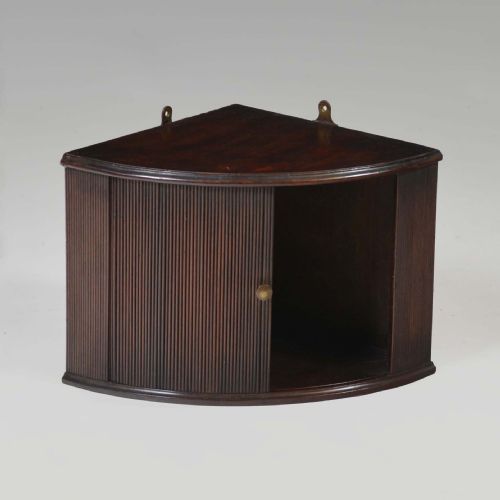
The selections available here range from open hanging shelves and corner units to pieces featuring drawers, pigeon holes, and cupboard doors.
Most examples date across the Georgian, Regency, and nineteenth-century periods, often incorporating secondary timbers such as satinwood and oak alongside the primary mahogany.
Materials and construction
Cabinet makers utilised dense mahogany for the primary structure and shelves, sometimes adding satinwood banding or brass fittings for visual contrast.
Joints were traditionally cut by hand, and carcase backs frequently employ secondary softwoods or oak panels appropriate to the period.
Georgian Mahogany Wall Shelf Retail Price Guide 2026
Typical asking prices for georgian mahogany wall shelf among the pieces listed under this phrase on Sellingantiques today, from the lower quarter to the upper quarter. They describe what is for sale here now, not the wider market.
Several pieces include hidden tambour fronts and tiny pigeon holes, perfect for concealing secret correspondence from inquisitive houseguests.
Assessing quality
The distinction between standard utility pieces and finer examples rests on the depth of the timber's grain and the crispness of any applied mouldings.
Proportion and the preservation of original hanging fixtures dictate the desirability of a piece, alongside how cleanly secondary woods are integrated into the overall design.
The Georgian Mahogany Wall Shelf Glossary
- Mahogany
- A durable tropical hardwood prized for its rich reddish-brown colour and stable grain. It forms the primary material for the majority of these wall units.
- Bow front
- A convex curved front profile common on corner shelves and cupboards. This curved shaping requires skilled woodworking to ensure smooth integration.
- Pigeon holes
- Small open compartments used for sorting documents and letters on desktop organisers. They appear in several desk-top variations within this category.
- Satinwood
- A light-coloured exotic timber utilised for contrasting stringing and decorative inlay work. It frequently highlights the edges of shelves and panels.
Georgian Mahogany Wall Shelf: Frequently Asked Questions
How were these shelves originally mounted?
These units generally feature integrated wooden brackets or hanging loops screwed directly into the backboards. Historic fixings required sturdy wall anchors to support the weight of heavy books and ceramics.
Modern placement requires checking that the wall fixings align securely with the internal vertical supports of the shelving unit to ensure stability.
What is the difference between hanging shelves and corner shelves?
Hanging shelves are flat-backed units designed to sit flush against a straight wall section, often incorporating multiple tiers for books or plates. Corner shelves are engineered with angled sides to fit snugly into room junctions.
Both forms served to maximise vertical storage in period homes where floor space was limited.
Are these pieces strictly from the eighteenth century?
While the design vocabulary originates in the Georgian period, the category includes later interpretations from the nineteenth century and revival eras. Construction techniques and secondary woods help clarify the actual date of manufacture.
Items span various decades from the late eighteenth century through to later Victorian reproductions.
Can these shelves support heavy books?
Most hanging shelves were built to hold lighter volumes, pamphlets, or decorative ceramics rather than massive encyclopaedias. The structural integrity depends on the condition of the shelf joints and the backboard fixings.
Distributed weight is safer for older timber construction than loading heavy items onto a single tier.