


Georgian Fruit Serving Spoons
Georgian fruit serving spoons are silver pieces from the eighteenth and early nineteenth centuries designed for citrus and soft desserts.
Georgian Fruit Serving Spoons
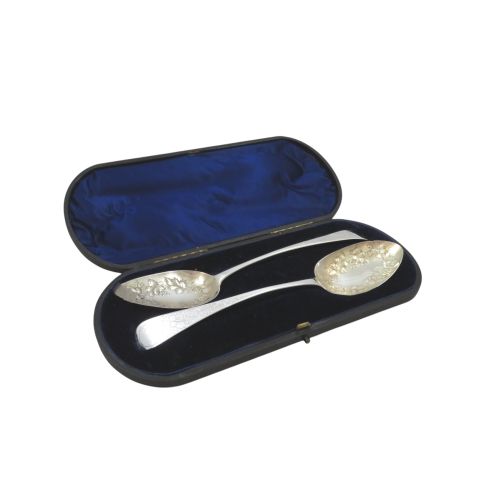
When you search for georgian fruit serving spoons, you encounter eighteenth century and early nineteenth century silverware fashioned for the dining table. These serving utensils appear in sterling silver, often with gilt or gold wash bowls, and occasionally accompanied by fitted cases lined with velvet, silk, or leatherette.
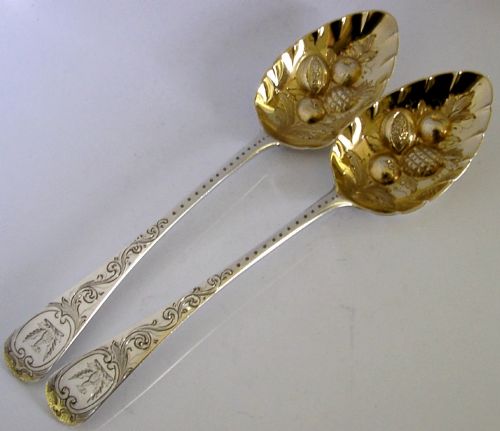
The pieces on this page include berry spoons, sifter spoons, dessert spoons, and shell shaped English or Irish serving spoons. Makers such as Peter & Anne Bateman and William Chawner II produced these items during the Georgian and George III periods, frequently incorporating family crests or later embossed fruit decoration.
How they were made
Silversmiths shaped these utensils from sterling silver, hammering and casting the metal into serving spoons, dessert spoons, and sifters. London and Irish assay offices hallmarked the pieces, recording the standard of the silver.
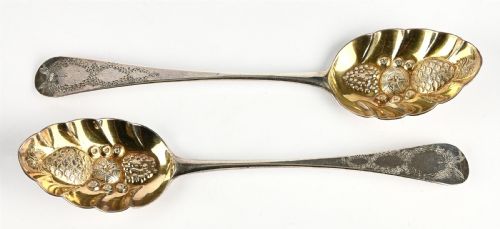
Many spoons received a gold gilt or gold wash surface to the bowl, contrasting with the sterling silver handles. Fitted cases lined with silk, velvet, or leatherette protected the sets.
Listings span the eighteenth century and the Georgian period, utilising sterling silver, gold gilt, and fitted cases lined with velvet.
What varies in quality
Quality rests in the crispness of the hallmarks, the integrity of the silver bowls, and the presence of original fitted cases lined with velvet or silk. Spoons bearing clear London or Irish assay marks and maker details like those of Peter & Anne Bateman hold distinct weight.
The definition of the embossing on berry spoons and the preservation of the gold wash or gilt finish separate standard utensils from finer examples.
Peter & Anne Bateman·William Chawner II
The Georgian Fruit Serving Spoons Glossary
- Berry spoon
- A large serving spoon, often Georgian, embossed and engraved with fruit designs at a later date. These pieces were adapted for serving berries and soft fruits.
- Gilt
- Silver coated with a thin layer of gold, frequently applied to the interior bowls of serving spoons. This technique protected the silver from the acidity of fruits.
- Hallmark
- An official stamp applied by an assay office to indicate the silver standard, the city of origin, and the year of production. London and Irish marks appear frequently on these spoons.
- Sifter
- A serving spoon with a pierced or perforated bowl used for dusting sugar over fruit or desserts. These often appear alongside berry spoons in fitted cases.
- Sterling silver
- The primary metal alloy used for Georgian cutlery, consisting of substantial silver content regulated by law. It provides the durability required for dining utensils.
Georgian Fruit Serving Spoons: Frequently Asked Questions
What are georgian fruit serving spoons?
These are sterling silver utensils produced during the eighteenth and early nineteenth centuries, designed specifically for serving fruit, berries, and desserts at the dining table.
They appear as single pieces, pairs, or sets, frequently featuring hallmarked silver and occasionally retaining their original fitted cases.
How were berry spoons used?
Berry spoons served fruits and berries from communal bowls during formal Georgian and Victorian dinners. The deep bowls accommodated soft produce easily.
Many of these spoons feature embossed fruit decoration added to earlier eighteenth century silver blanks, reflecting changing dining fashions.
How do I identify a Georgian silver spoon?
Examination of the hallmarks stamped on the reverse of the stem reveals the assay office, the maker's mark, and the date letter corresponding to the Georgian period.
London and Irish hallmarks provide specific clues to the origin and year of manufacture for these sterling silver pieces.