





George III Sterling Flatware
George iii sterling flatware brings the crisp weight of Georgian silver to the table, offering utility shaped by eighteenth-century silversmiths.
George III Sterling Flatware
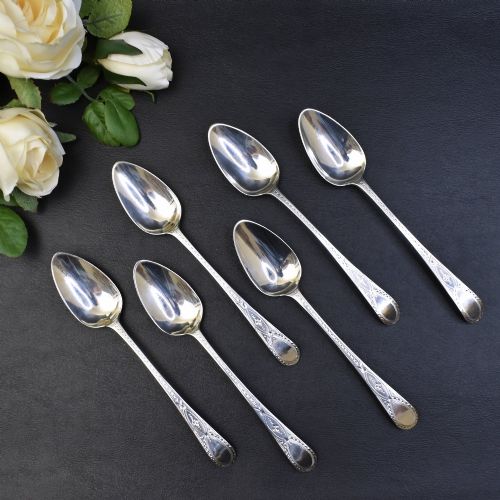
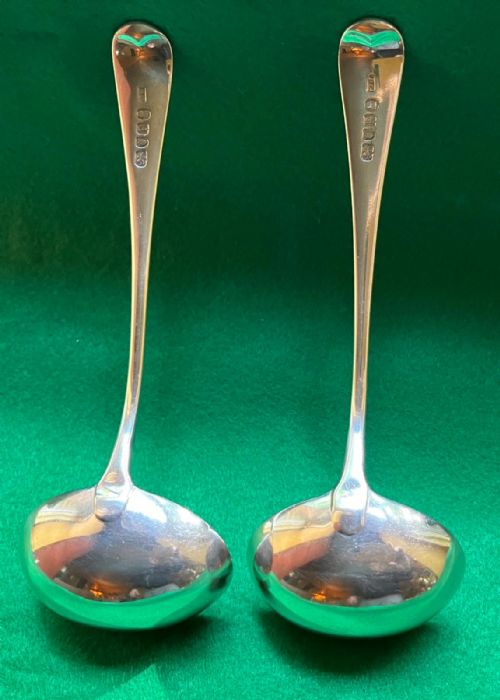
The assortment on this page relies heavily on Georgian forms, including old english and hanoverian patterns alongside specialised serving utensils. Buyers encounter individual caddy spoons, matched sets of teaspoons, and larger ladles originating from London, Birmingham, Exeter, York, and Dublin.
How george iii sterling flatware was made
Silversmiths formed these utensils from sterling silver, frequently applying gold gilt highlights to bowls and interior details. Manufacturing involved hammering, casting, and piercing metal to create fish slices, strainers, and decorative caddy spoons.
Makers finished handles with bright-cut engraving, crests, and traditional patterns before submitting pieces to assay offices for hallmarks. Fitted presentation boxes utilised wood covered in velvet, silk, or leatherette to house specific serving sets.
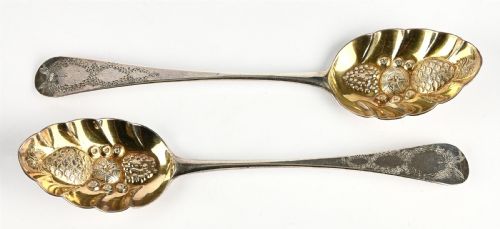
Some spoons arrived with fruit embossed onto their bowls decades late, proving Victorians loved an upgrade just as much as we do.
What varies in quality
Quality rests upon the crispness of the original engraving and the preservation of maker marks and town hallmarks. Pieces featuring specialised decoration like vine leaf motifs or pierced work demonstrate greater skill than plain utility items.
The survival of original gilding and the weight of the silver influence desirability among collectors. Complete sets or matched pairs command attention over isolated single spoons.
Joseph Willmore·Peter And Anne Bateman·Wilkes Booth·Thomas Daniell·Alexander Henderson
The George III Sterling Flatware Glossary
- Sterling silver
- An alloy containing a high proportion of pure silver paired with other metals to ensure durability for daily dining.
- Hallmark
- A series of stamped marks indicating the assay office, maker, and year of production.
- Bright-cut
- An engraving technique using faceted cuts to reflect light from shallow angled grooves.
- Caddy spoon
- A short-handled spoon specifically designed for measuring loose tea leaves from a caddy.
- Hanoverian pattern
- An eighteenth-century flatware design featuring a raised ridge down the centre of the stem.
George III Sterling Flatware: Frequently Asked Questions
How do I date george iii sterling flatware?
Dating relies on the stamped hallmarks showing the assay office city letter and the monarch profile duty mark.
Additional date letters specific to each assay office pinpoint the exact year of manufacture.
Are these utensils safe for daily use?
Sterling silver handles daily dining if washed by hand using mild soap and stored properly.
Avoid dishwashers and harsh abrasives to preserve the engraved details and original hallmarks.
What is a berry spoon?
A berry spoon is a serving spoon featuring fruit repousse work added to the bowl during a later Victorian period.
Original eighteenth-century spoons were frequently embellished this way decades after their initial manufacture.
Why do some spoons feature gold wash?
Gold gilt applied to the bowl interior protected the silver from corrosion when touching acidic foods.
This technique appears frequently on caddy spoons and sugar tongs.