
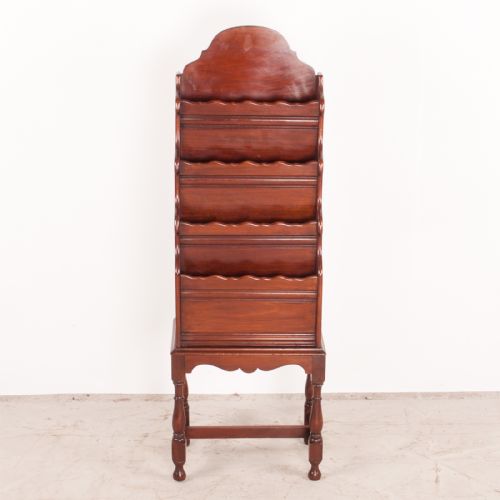


Georgian Folio Stand
A georgian folio stand is a sturdy paper holder designed for prints and drawings, prized by collectors who need to store large sheets flat.
Georgian Folio Stand
When you search for a georgian folio stand, you encounter heavy wooden pieces designed to hold large sheets of paper, prints, and drawings securely. These items appear across several periods including the Regency and George III eras, alongside later revivals from the twentieth century.
The primary forms on this page include floor-standing folio cabinets, open racks, and low tables with compartment divisions. Many examples display substantial country house proportions, intended for libraries, studies, and artists' studios.
Makers often constructed these objects from dense timbers like mahogany and rosewood, ensuring the frame supports heavy portfolios without tipping. The selection encompasses both dedicated folio stands and related items such as canterburys and magazine racks.
Materials and construction
Cabinetmakers relied heavily on solid mahogany and rosewood for the structural framework, occasionally incorporating birds eye maple and oak for interior sections. These dense hardwoods provided the necessary strength to sustain heavy paper collections without warping over time.
Decoration often involved fine boxwood inlay and ebonised wood details to accentuate the edges and panels of the cabinets. Brass fittings, including castors and hinges, appear frequently to facilitate the movement of these heavy library pieces.
The listings span multiple periods, featuring pieces from the eighteenth century, Regency era, and nineteenth century, alongside twentieth-century examples.
Assessing quality in folio storage
The distinction between standard examples and superior pieces rests on the choice of timber and the precision of the joinery. Dense, highly figured mahogany and well-matched rosewood veneers indicate a higher tier of production.
Attention to detail in the secondary elements, such as crisp boxwood inlay and heavy original brass castors, separates utilitarian items from grand country house furnishings. The rigidity of the frame and the smoothness of any adjustable mechanisms further define the standard of craftsmanship.
The Georgian Folio Stand Glossary
- Folio stand
- A piece of furniture designed to hold large sheets of paper, maps, or prints in an upright or sloped position. These stands often feature adjustable sides to keep papers secure.
- Canterbury
- A low stand with vertical divisions, originally used for holding sheet music or portfolios. They frequently share design characteristics with folio stands.
- Boxwood inlay
- A decorative technique where small pieces of pale boxwood are inserted into a contrasting darker wood surface. This creates geometric or botanical patterns along the edges of the cabinet.
- Birds eye maple
- A figured timber showing small, swirling dots that resemble bird eyes within the grain. Cabinetmakers utilised this decorative wood for interior panels and feature surfaces.
- Ebonised wood
- Timber treated with a dark stain or finish to imitate ebony. This process provides a sharp, black contrast against lighter woods like mahogany.
Georgian Folio Stand: Frequently Asked Questions
What is a folio stand used for?
These stands were originally built for country house libraries and artist studios to store large maps, architectural drawings, and loose prints.
Today, they serve the same practical purpose for collectors who need to keep large paper items organised and accessible without folding them.
How do I tell a Regency stand from a later piece?
Regency examples typically feature specific timber selections like rosewood and incorporate brass mounts or boxwood inlay characteristic of the early nineteenth century.
Later revival pieces from the twentieth century often use different secondary woods and lack the specific patination found on older items.
Are these stands suitable for modern homes?
Their sturdy construction and compact footprint make them practical for displaying artwork or holding modern magazines and oversized books.
Many examples function well as occasional tables or display racks in living spaces and studies.
What woods were commonly used?
Mahogany is the predominant timber found in these listings, offering the structural strength required for heavy paper storage.
Other materials include rosewood, oak, birds eye maple, and ebonised wood, often enhanced with brass hardware.