





Georgian Curved Sideboard
A georgian curved sideboard brings sweeping architectural lines to a dining room, offering deep storage without heavy corners.
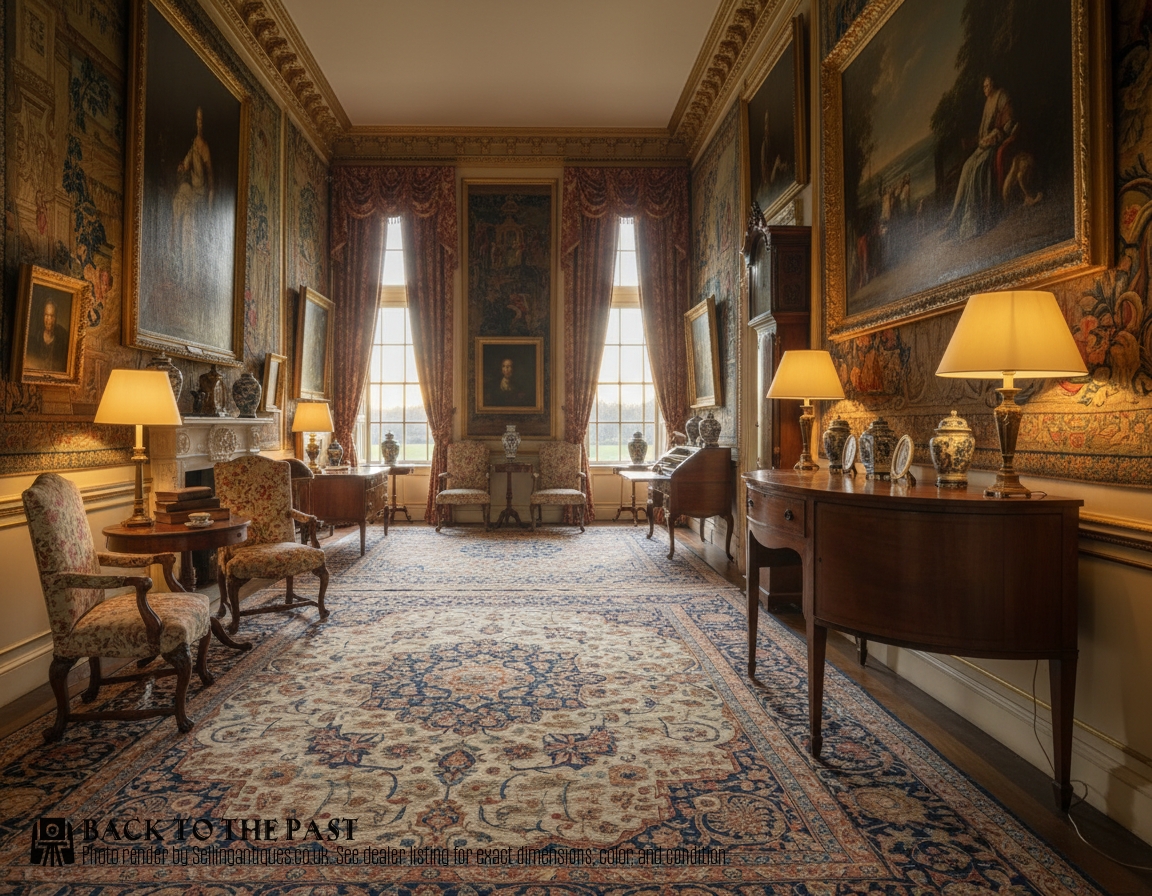
Georgian Curved Sideboard
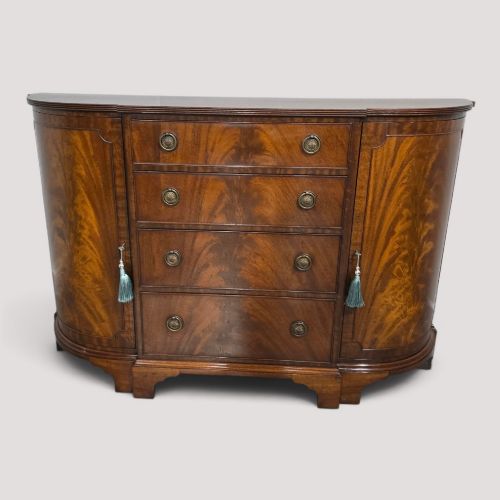
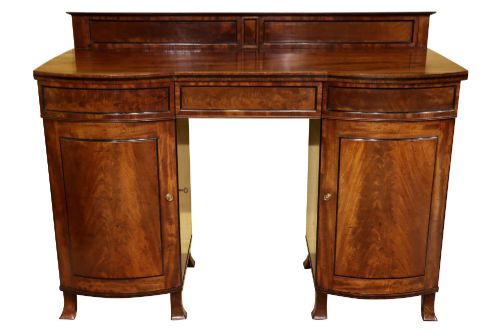
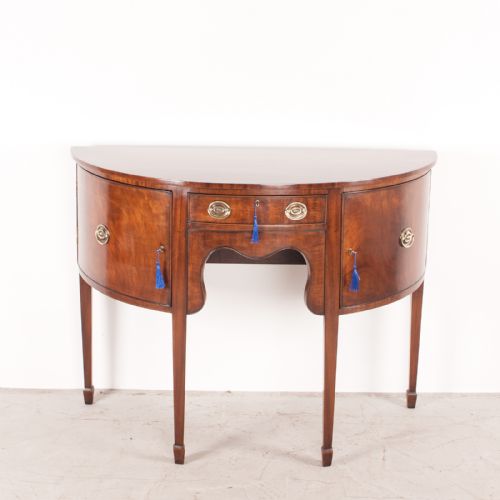
A georgian curved sideboard presents a sweeping frontal line, spanning bowfronts, serpentine shapes, and demi-lune forms. These serving pieces organise dining rooms through deep central drawers flanked by cellarets and cupboards.
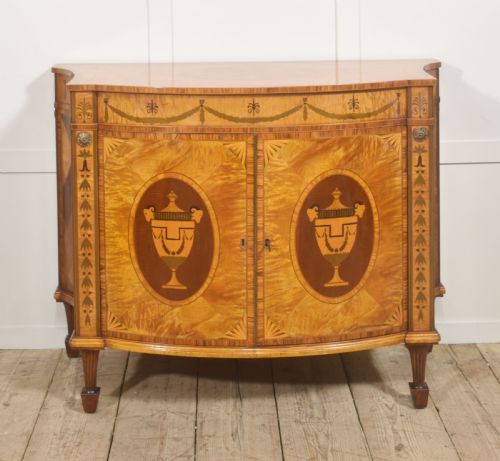
The most common examples on this page are mahogany bowfront sideboards from the Georgian and Regency periods. Cabinetmakers also produced larger serpentine shapes and neoclassical satinwood demi-lune commodes for grander reception rooms.
Origins stretch from the late eighteenth century into the nineteenth century, alongside later revivals from the early twentieth century. Makers varied the profiles from gentle curves to sharp half-circles designed to fit flush against dining walls.
Materials and construction
Cabinetmakers built these pieces using solid mahogany and flame mahogany veneer laid over secondary timbers. Surfaces often feature boxwood and satinwood inlay to define drawer fronts and borders.
Makers shaped the curved carcasses by steaming and bending timber or constructing layered segments. Brass handles, backplates, and occasional marble tops complete the assembly of these serving tables and side cabinets.
Listings span the eighteenth, nineteenth, and early twentieth centuries, featuring mahogany, satinwood, and marble top surfaces.
Distinctions in craftsmanship
Quality rests in the rhythm of the curve and the selection of timber figures. Flame mahogany veneers matched across multiple drawers elevate a piece far above plain boards.
Fine examples display crisp boxwood inlay and well-fitted drawer linings rather than heavy mechanical repairs. The integration of original brass hardware and the crispness of edge mouldings signal superior workshop output.
The Georgian Curved Sideboard Glossary
- Bowfront
- A convex curved front that projects outward in a smooth arc. This shape softens the corners of a dining room.
- Serpentine
- A front profile curving inward at the centre and outward at the ends, or vice versa. It requires advanced carpentry to execute smoothly.
- Demi-lune
- A half-moon shape used for smaller side cabinets and commodes. These fit closely against flat walls while saving floor space.
- Cellaret
- A deep drawer or compartment built into a sideboard to hold wine bottles. Interiors often retain lead linings or wooden dividers.
- Marquetry
- Decorative patterns formed by inserting pieces of contrasting wood into a veneer layer. This technique appears on neoclassical satinwood pieces.
Georgian Curved Sideboard: Frequently Asked Questions
How do I style a curved sideboard in a modern dining room?
Position the piece against a principal wall where its curved profile can catch natural light. Use the surface to display heavy tableware or serving trays without crowding the edges.
Keep surrounding furniture simple to let the mahogany grain and inlay work stand out. The internal cupboards remain practical for storing linens and silver.
How do I tell an 18th-century piece from a 20th-century revival?
Examine the secondary timbers inside the drawers and the wear patterns around the handles. Eighteenth-century pieces show hand-cut dovetails and natural ageing in the mahogany.
Twentieth-century reproductions often use uniform secondary woods and machine-cut joints. The finish and general weight of the carcass also point toward the later production dates.
What were cheese coasters used for?
Cheese coasters were small serving accessories placed directly on dining tables during the Georgian period. They allowed diners to slide heavy cheeses along the mahogany surface without scratching the wood.
Many featured boat-shaped wooden frames with rollers underneath. They match the timber and inlay work found on larger sideboards of the same era.