





Georgian Cistern Barometer
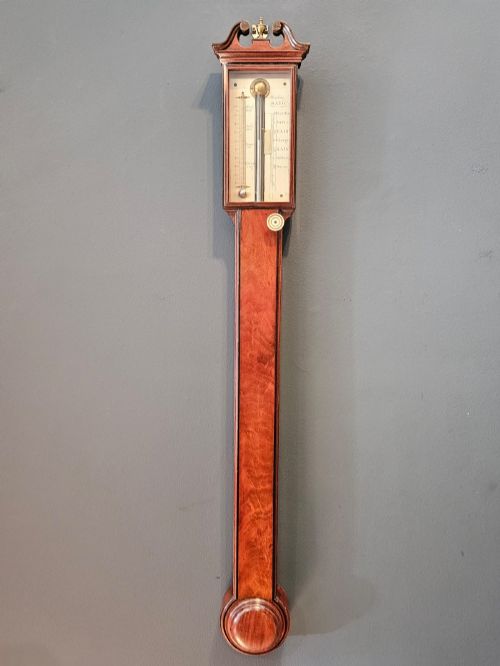
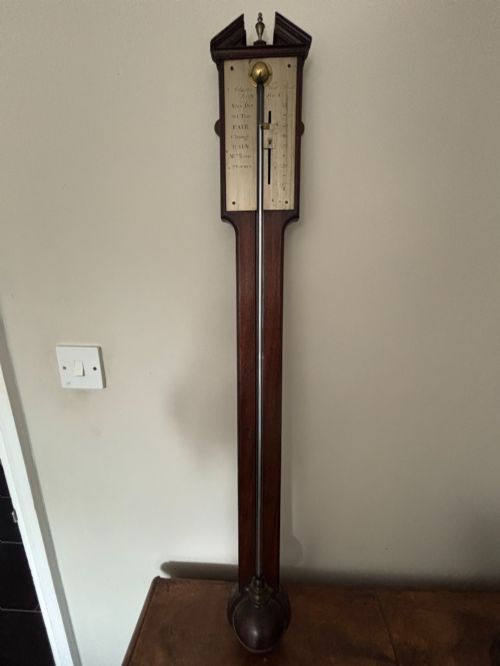
A georgian cistern barometer measures atmospheric pressure through a column of mercury visible inside a tall wooden trunk.
Georgian Cistern Barometer
A georgian cistern barometer is a precision scientific instrument housed in a domestic cabinet designed to hang upon a wall or stand upright in a hallway. These instruments record changes in barometric pressure using a column of liquid metal contained within a glass tube.
The pieces appearing on this page span the georgian, regency and nineteenth-century periods, taking the form of traditional stick barometers. Mahogany forms the primary casing material, alongside walnut and boxwood stringing.
Makers inscribed their names upon the silvered brass or metal plates set into the wood. Cabinets range from flat backboards to curved bow-fronted designs.
How they were made
Cabinetmakers constructed the tall cases using solid timbers like mahogany and walnut, frequently selecting figured grain for the main trunk. Woodworkers shaped boxwood stringing and veneers to decorate the edges of the trunk and the cistern cover at the base.
Instrument makers fitted glass tubes into the wooden channels and mounted silvered brass or metal scales behind the upper portion to display weather descriptions and numerical measurements. Brass fittings secured the glass cistern covers and suspension rings.
Makers occasionally spelt their own names with adventurous phonetic creative spelling on the brass dials.
What varies in quality
Quality rests in the legibility and execution of the engraved silvered brass scale and the selection of timber used for the case. Finer examples display crisp maker signatures and detailed boxwood inlay rather than plain surfaces.
The proportion of the bow-fronted or flat wooden trunk dictates visual balance. Original brass cistern covers and intact glass tubes elevate the integrity of the instrument.
George Adams London·Blunt·Dollond of London·JB Bergna Newcastle·Sandrino of Liverpool·Gilbert London·Bate·James Gatty London·Alexander Adie·Pinchetti & Co London·Tarone Gally & Co·Corti of Exeter·Malacrida of Dublin
The Georgian Cistern Barometer Glossary
- Cistern
- The small reservoir at the base of the barometer that holds the mercury pool. It connects directly to the main glass tube.
- Stick barometer
- A tall, narrow instrument where the vertical tube is exposed or framed down the centre of a wooden board. This format dominated production throughout the eighteenth and nineteenth centuries.
- Silvered brass
- A sheet of brass treated with a silver solution to create a white, reflective surface for engraving scale markings and weather text. Makers polished and lacquered these plates after cutting the numbers.
- Bow front
- A convex curve shaping the front of the wooden casing. This profile softens the strict vertical lines of the instrument.
- Stringing
- Thin lines of contrasting wood inlaid into the primary timber of the case. It provides decorative borders around the edges of the barometer trunk.
Georgian Cistern Barometer: Frequently Asked Questions
How do I read a georgian cistern barometer?
Read the height of the mercury column against the engraved scale on the silvered brass plate.
Numbers and weather words like rain or set fair indicate the current atmospheric pressure.
Where should I hang a stick barometer?
Hang the instrument on an interior wall away from direct sunlight and heat sources.
Stable indoor temperatures help protect the antique wood and glass components.
Can these barometers be calibrated?
Adjustment screws near the cistern allow for minor calibration against known local pressure readings.
Professional handling ensures the mercury column remains stable during any adjustment.
How do I identify the period of the wood?
Examine the grain patterns and construction methods used in the mahogany or walnut casing.
Drawer joints, backboards and inlay styles point toward specific decades of manufacture.