


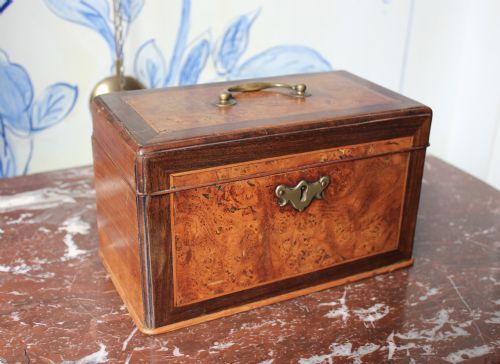


Georgian Brass Escutcheon Box
A georgian brass escutcheon box combines rich timber and neat metalwork, offering both useful storage and period character for any room.
Georgian Brass Escutcheon Box
When you search for a georgian brass escutcheon box, you are looking at practical timber containers designed for holding tea, work materials, documents, or valuables. These pieces range from compact tea caddies to large military travelling chests and campaign trunks.
You are most likely to meet mahogany, rosewood, and camphorwood forms spanning the eighteenth and nineteenth centuries. They often feature inlaid stringing, boxwood banding, and distinctive brass keyhole surrounds.
The objects serve as tangible examples of Georgian and Regency craftsmanship, originating from domestic parlours, maritime cabins, and military campaigns. Each survivor carries the marks of travel and daily use through changing decades.
How they were made
Cabinet makers constructed these boxes using dense hardwoods such as mahogany, padouk, and rosewood, frequently reinforced for travel with rope handles or recessed brass fittings. Timber veneers like burr elm and walnut added patterned visual depth to domestic tea caddies and workboxes.
Fine joinery details such as boxwood banding, inlaid stringing, and fitted interior compartments required careful hand-tooling. Brass escutcheons and cartouches were neatly flush-mounted into the wood surrounding keyholes and lids.
Georgian Brass Escutcheon Box Retail Price Guide 2026
Typical asking prices for georgian brass escutcheon box among the pieces listed under this phrase on Sellingantiques today, from the lower quarter to the upper quarter. They describe what is for sale here now, not the wider market.
Camphorwood was selected for sea chests because its strong natural scent kept dampness and insects away from sailors' uniforms.
What varies in quality
The selection of timber grain and the precision of decorative inlays separate simpler utility trunks from finer parlour pieces. Richly figured rosewood, burr elm, and padouk indicate higher initial cost and greater ambition in the workshop.
The refinement of the brass hardware, from simple stamped plates to heavy cast mounts and flush escutcheons, signals the grade of the piece. Clean lines in the dovetailing and intact internal compartments show superior original construction.
The Georgian Brass Escutcheon Box Glossary
- Escutcheon
- A flat plate of brass surrounding a keyhole, designed to protect the surrounding timber from wear. It often provides a decorative focal point on the front of a box.
- Campaign
- A style of portable furniture built for military officers on the move, featuring recessed handles, robust brass corners, and sectional designs. These chests were made to withstand rough transport.
- Tea caddy
- A small box made to store dry tea leaves securely under lock and key when tea was an expensive commodity. They frequently contain internal lidded compartments.
- Stringing
- A thin, contrasting strip of wood inlay, such as boxwood, set into the surface of a box to create neat geometric borders. It highlights the edges of lids and drawers.
- Cellarette
- A fitted container or chest designed to hold bottles securely during the Georgian period. They often incorporate lead linings or timber dividers.
Georgian Brass Escutcheon Box: Frequently Asked Questions
What were these boxes used for?
These boxes served various domestic and travel purposes, ranging from keeping valuable tea leaves secure in a parlour to transporting officer belongings on military campaigns. Smaller examples held sewing equipment and correspondence.
Larger trunk forms accommodated clothing and sea provisions during long maritime journeys, reflecting the mobile lifestyles of their original owners.
How do I care for antique wood?
Keep wooden boxes away from direct sunlight and sudden temperature shifts to prevent the timber and veneers from splitting or warping. Gentle dusting with a dry cloth maintains the surface.
Applying a traditional wax polish occasionally helps nourish hardwood finishes like mahogany and rosewood without building up heavy chemical residues.
How can I tell the period?
Dating relies on observing timber choices, construction techniques, and decorative styles characteristic of the Georgian and Regency eras. Mahogany and padouk dominate mid-eighteenth-century pieces, while rosewood gains popularity later.
Hardware styles, dovetail tightness, and secondary woods inside the boxes also provide clear physical clues to their decade of manufacture.
Are campaign boxes waterproof?
Military and sea chests utilised dense woods like camphorwood and robust brass fittings to withstand damp conditions during travel. However, they were built primarily for secure transport rather than submersion.
Camphorwood naturally repelled insects and moisture, helping protect contents inside cabins and campaign tents.