


Georgian Armorial Porcelain
Georgian armorial porcelain brings painted coats of arms and crests directly to the table through durable ceramic tableware.
Georgian Armorial Porcelain
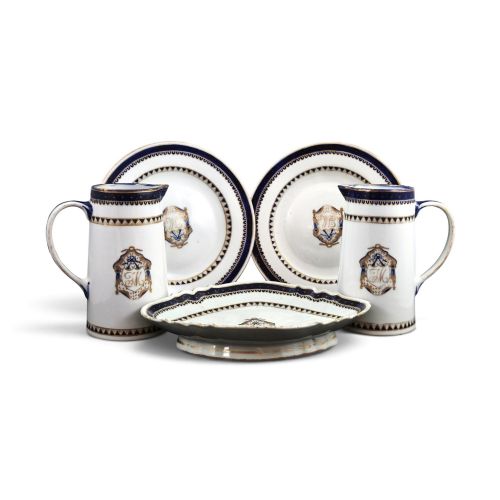
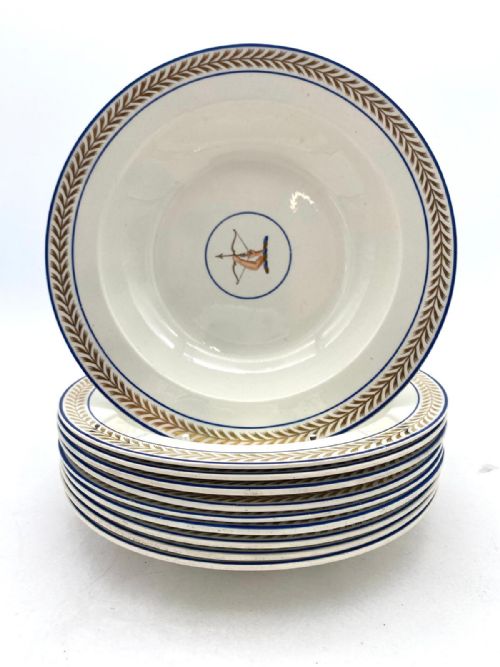
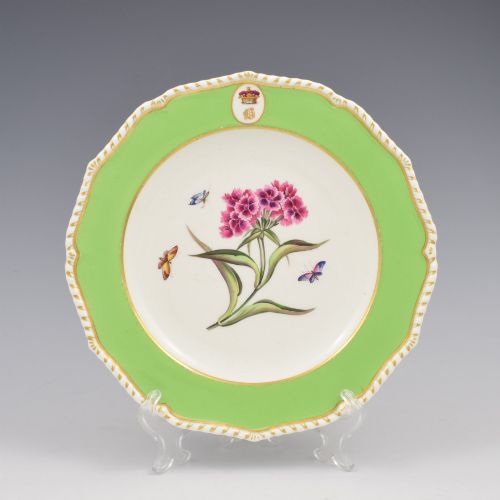
Georgian armorial porcelain consists of plates, dishes, cups, saucers, and jugs painted with family crests and coats of arms. These services were commissioned by prominent families and institutions during the eighteenth and early nineteenth centuries.
The selections here span Chinese export pieces alongside English factories such as Derby, Worcester, and Wedgwood. Forms range from dessert plates and soup plates to pudding bowls and chestnut baskets.
Most examples date across the eighteenth century, the Regency period, and around 1800. Buyers encounter both Chinese export porcelain and domestic soft-paste porcelain or creamware.
How they were made
Potters shaped porcelain, creamware, and earthenware bodies before applying painted enamel decoration by hand. Artisans incorporated gold leaf and gilding to highlight armorial bearings and borders.
Chinese export works were painted overseas before shipping to Britain, while English factories utilised soft-paste porcelain and refined earthenware bodies.
Object types include plates, teacups and saucers, soup plates, creamware pudding bowls, and chestnut baskets.
What varies in quality
The precision and detail of the painted coat of arms dictate the artistic merit of each piece. Heraldic accuracy and delicate brushwork distinguish superior commissions from standard productionware.
The condition of the enamel colours and the preservation of the gold leaf influence overall visual appeal. Finer services also exhibit sophisticated border patterns and unblemished ceramic bodies.
Wedgwood·Bloor Derby·Chamberlain Worcester·Flight Barr And Barr·Barr Flight And Barr
The Georgian Armorial Porcelain Glossary
- Armorial
- Bearing a coat of arms or heraldic device. These motifs identify the original family or institution that commissioned the service.
- Creamware
- A refined cream-coloured earthenware perfected in Staffordshire during the eighteenth century. It offered a lighter, more durable alternative to traditional pottery.
- Soft-paste porcelain
- An artificial porcelain composition fired at lower temperatures than hard-paste porcelain. English factories utilised this material extensively before true porcelain formulas became widespread.
- Enamel
- Opaque glass-coloured pigments fused to the ceramic surface during firing. This technique allowed vibrant multi-coloured heraldic designs.
- Gilding
- The application of gold or gold leaf to ceramic surfaces. It frames heraldic crests and accentuates plate rims.
Georgian Armorial Porcelain: Frequently Asked Questions
How do I identify the family crest?
Heraldic charges, mottos, and coronets painted on the porcelain correspond to specific historical families. Reference books on British and European heraldry help match coats of arms to their original owners.
Many armorial services were recorded in historical peerages or family archives upon commission. Local heraldic dictionaries provide keys to deciphering specific helmets, shields, and supporters.
Can I use these plates for dining?
Most collectors treat eighteenth and early nineteenth-century armorial porcelain as display items rather than daily tableware. Historic glazes and delicate enamels are vulnerable to modern detergents and cutlery.
Hand washing in lukewarm water with mild soap is essential if handling these pieces. Thermal shock from hot food or dishwashers can crack fragile soft-paste bodies.
How do I distinguish Chinese export from English porcelain?
Chinese export porcelain from the eighteenth century typically displays characteristic paste traits and palette colours associated with Qianlong production. Brushwork and iron-red touches often differ from domestic English factories.
English pieces from Worcester or Derby exhibit distinct body weights, foot rings, and factory paste formulas. Examining the unglazed foot rim usually reveals differences between oriental and domestic clays.
What does Regency style mean for these ceramics?
Regency style reflects the aesthetic prevalent during the early nineteenth century under the Prince Regent. Designs often feature bolder neoclassical motifs, rich gilding, and distinct border patterns.
Services from this era demonstrate changing ceramic body compositions and evolving taste in heraldic presentation. Forms became heavier and more architectural compared to earlier eighteenth-century wares.