
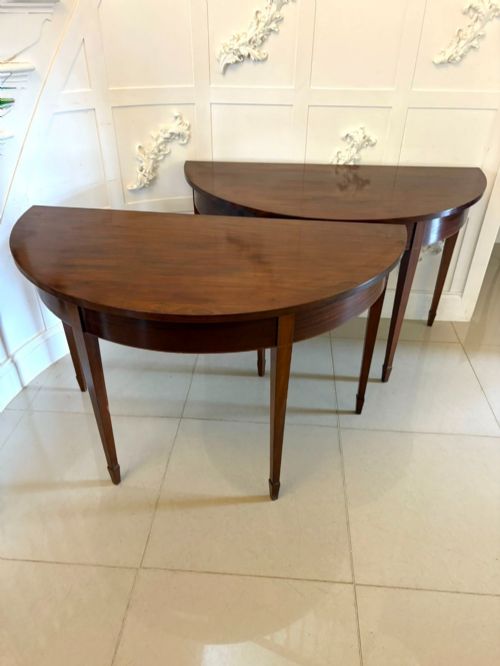
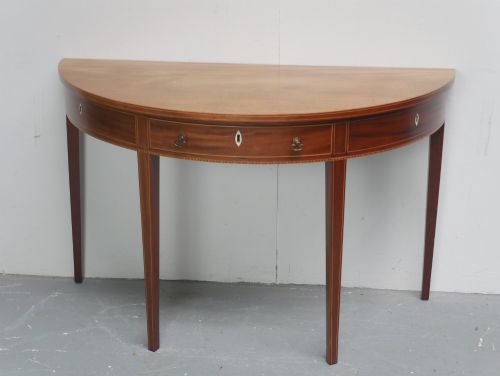
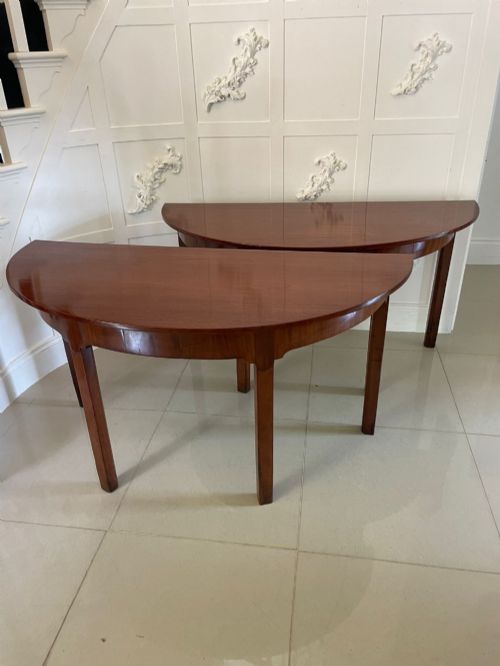
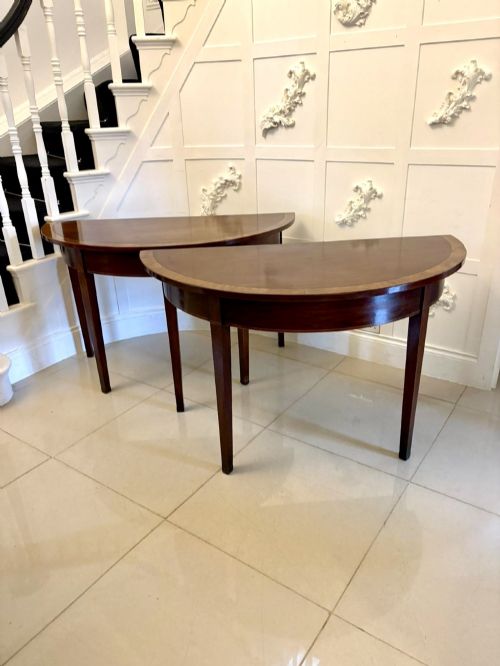



George III Demi Lune Table
When a search brings up a george iii demi lune table, you are looking at semicircular furniture designed to stand flat against a wall.

George III Demi Lune Table
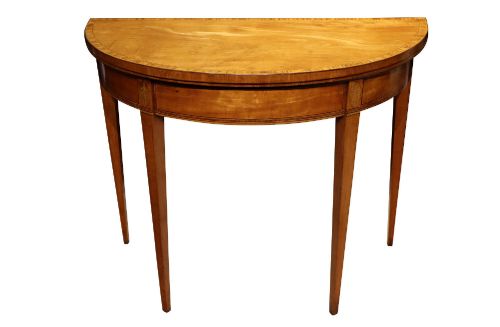
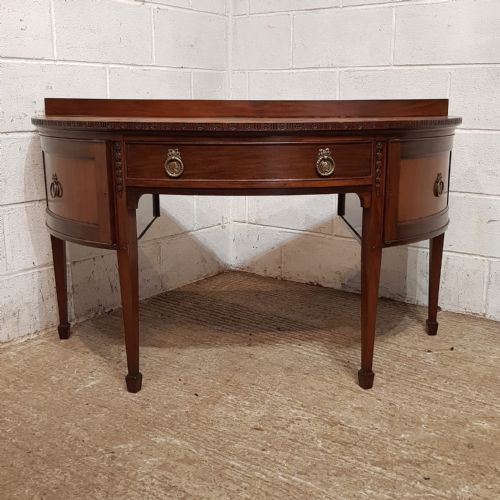
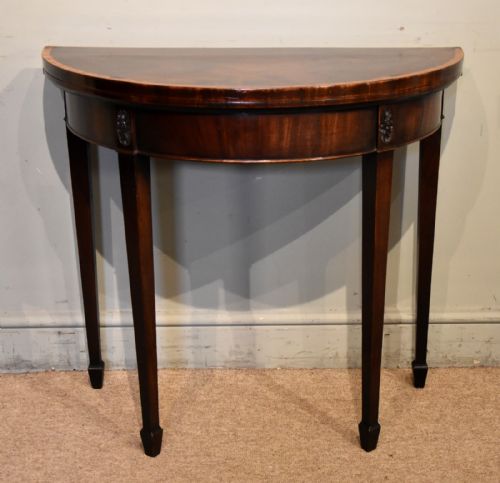
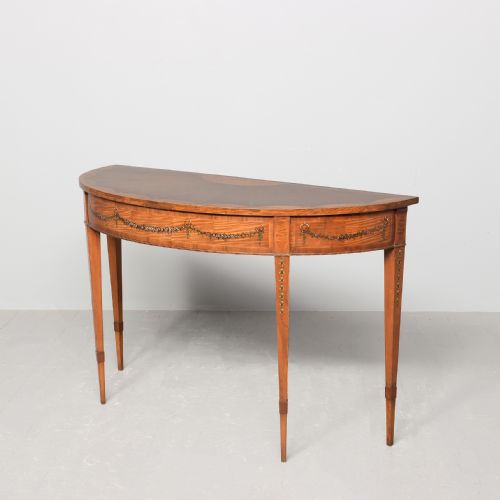
A george iii demi lune table typically takes the form of a console, card, tea, or side table designed with a semicircular top and matching frieze. These pieces sit flush against a wall to save space while providing a decorative surface in a principal room.
The versions most commonly found here date from the Georgian and Regency eras, spanning the eighteenth and early nineteenth centuries. They appear frequently in figured mahogany or contrasted with lighter timbers.
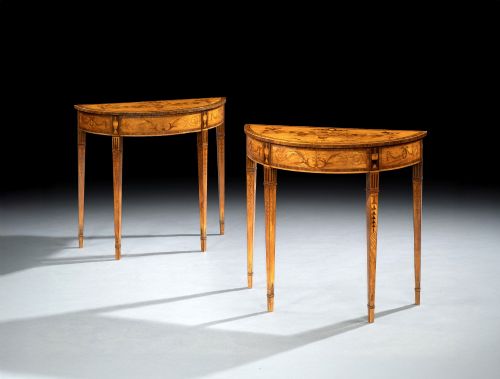
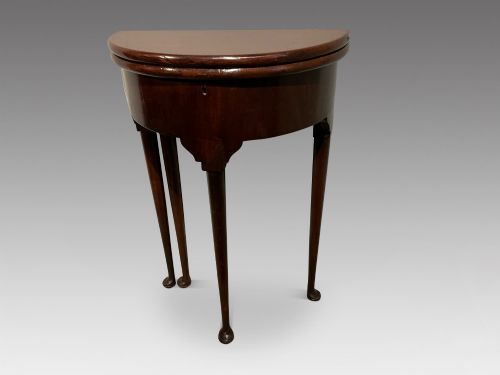
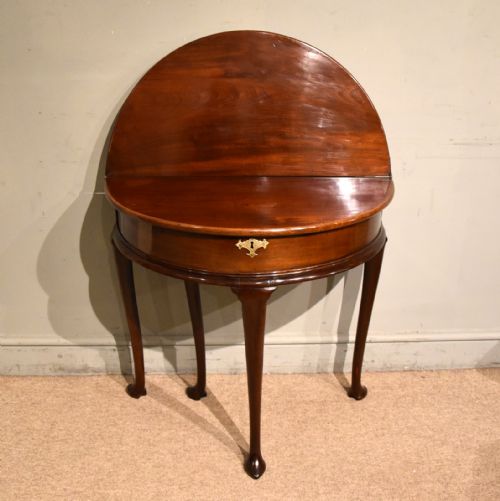
Makers adapted the half-moon shape into folding card and tea tables with hinged tops supported by swinging rear legs. Side and console variants remain fixed, occasionally constructed as matched pairs for symmetry in formal interiors.
How they were made
Cabinetmakers utilised solid and veneered timbers, selecting figured mahogany for primary surfaces and pairing it with satinwood, boxwood, and kingwood for contrasting details. Crossbanding frames the curved edges of the top, while delicate stringing outlines the legs and aprons.
Inlaid decoration incorporates marquetry and painted motifs executed within neoclassical and Sheraton revival styles. Craftsmen integrated brass hinges and swing-out gate legs on folding tables to support the heavy timber leaves securely.
Some card tables hide secret spaces inside their frames where eighteenth-century players once stored their coins and markers.
What varies in quality
The distinction between standard examples and the finest pieces rests on the choice of timber figure and the precision of the inlay. Highly figured mahogany displays deep, rippling grain patterns that catch the light across the curved top.
Workmanship shows in the crispness of the satinwood crossbanding and the complexity of the marquetry or painted ornamentation. Integration of matching pairs indicates a higher tier of original commissioning.
The George III Demi Lune Table Glossary
- Demi-lune
- A half-moon or semicircular shape utilised for tables designed to stand against a wall. This profile became particularly popular during the neoclassical period.
- Crossbanding
- A narrow strip of veneer laid across the grain of the primary surface along the border. It frames the curved top of a table.
- Marquetry
- Decorative patterns formed by fitting together contrasting veneers of wood or other materials. These intricate designs adorn the tops and aprons of formal furniture.
- Console table
- A table supported by wall brackets or legs, designed for placement against a vertical surface. Many demi-lune tables serve this architectural function.
- Stringing
- Thin lines of contrasting timber inlaid into shallow channels on the surface of the furniture. This linear detail defines the edges of legs and framing elements.
George III Demi Lune Table: Frequently Asked Questions
What is a demi lune table used for?
These semicircular tables served multiple functions in period interiors, acting as pier tables for decorative ornaments or functioning as card and tea tables when fitted with folding tops.
Placed flat against a wall, they provided surface space in hallways and reception rooms without obstructing walkways.
How do I identify a George III table?
Identification relies on observing specific construction traits, timber choices such as figured mahogany, and decorative idioms like neoclassical stringing or satinwood inlay.
Dates typically centre on the late eighteenth century, aligning with the reigns and design preferences of the Georgian era.
Are these tables usually found in pairs?
Surviving examples frequently appear as matched pairs, originally commissioned to stand symmetrically on either side of a fireplace or doorway.
Single tables are equally common, functioning independently as side or console furniture in smaller spaces.
How do card tables work?
Card and tea tables feature a hinged top that folds open to reveal a baize-lined or polished timber playing surface.
A rear leg swings outward on a gate-leg action to support the doubled weight of the opened top.