


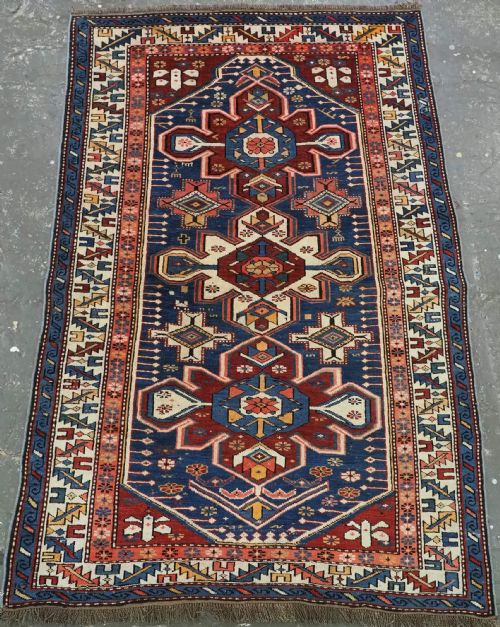

Geometrical Wool Rug
A geometrical wool rug anchors a room with structured pattern, drawing the eye to centuries-old tribal and village weaving traditions.
Geometrical Wool Rug
When you search for a geometrical wool rug, you encounter hand-knotted and flatwoven floor coverings originating from Anatolia, the Caucasus, Persia, and Central Asia. These textiles span periods from the mid-eighteenth century through the nineteenth century and into the early twentieth century.
You are most likely to meet prayer rugs, village runners, and tribal carpets featuring medallion designs, rams horn motifs, and lattice patterns. These pieces represent distinct regional weaving cultures including Caucasian, Turkmen, and Ottoman styles.
The forms range from compact area rugs and prayer formats to long runners and larger carpets. Each piece displays the characteristic rectilinear motifs and repeated geometric forms typical of traditional regional workshops and nomadic tribes.
How they were made
The construction relies on hand-knotted wool and hand-spun wool piled onto foundations of cotton or wool, alongside flatwoven kilim techniques. Artisans utilised natural dyes to achieve deep colour palettes that endure across centuries.
Weavers worked from memory or traditional tribal patterns, creating precise rectilinear layouts such as triple lobbed medallions and floral lattices. The density of the knotting and the quality of the spin determine the handle and weight of each textile.
Geometrical Wool Rug Retail Price Guide 2026
Typical asking prices for geometrical wool rug among the pieces listed under this phrase on Sellingantiques today, from the lower quarter to the upper quarter. They describe what is for sale here now, not the wider market.
Regional styles represented include Caucasian, Ottoman Anatolian, Persian Bidjar, and Turkmen tribal traditions.
What varies in quality
The finesse of a geometrical wool rug depends on the tightness of the weave and the precision of the geometric layout. Superior examples display crisp lines in motifs such as the rams horn mihrab or the triple lobbed medallion.
Material choice and dye depth dictate the visual resonance of the piece. Finer rugs employ tightly spun hand-spun wool and rich natural dyes that yield complex tonal variations across the field.
The Geometrical Wool Rug Glossary
- Mihrab
- The arched niche found on prayer rugs, often indicating the direction of prayer. In regional weaving, this shape frequently incorporates geometric rams horn motifs.
- Medallion
- A central ornamental design motif placed in the field of a rug. Classic Caucasian and Anatolian examples often feature multi-lobed or geometric variations.
- Kilim
- A flatwoven textile produced without a pile. These pieces rely on interlocking weft techniques to create sharp geometric patterns.
- Prayer Rug
- A smaller format rug designed for individual devotion, typically featuring a single mihrab arch at one end. These were produced across Ottoman and Caucasian regions.
Geometrical Wool Rug: Frequently Asked Questions
How do I care for a vintage wool rug?
Vacuum gently without using a rotating brush roll to protect the wool pile and hand-knotted foundations.
Keep the rug out of direct sunlight to preserve the natural dyes and prevent fading over time.
Where were these geometric rugs made?
The pieces originate from traditional weaving centres including Anatolia, the Caucasus, Persia, and Northern Afghanistan.
Nomadic tribes and village communities in these regions produced distinct styles such as Ushak, Bidjar, Kazak, and Ersari.
What is the difference between a rug and a carpet?
Carpets generally refer to larger floor coverings designed to span substantial areas of a room.
Rugs and prayer formats tend to be smaller, intended for specific focal points or devotional use.