
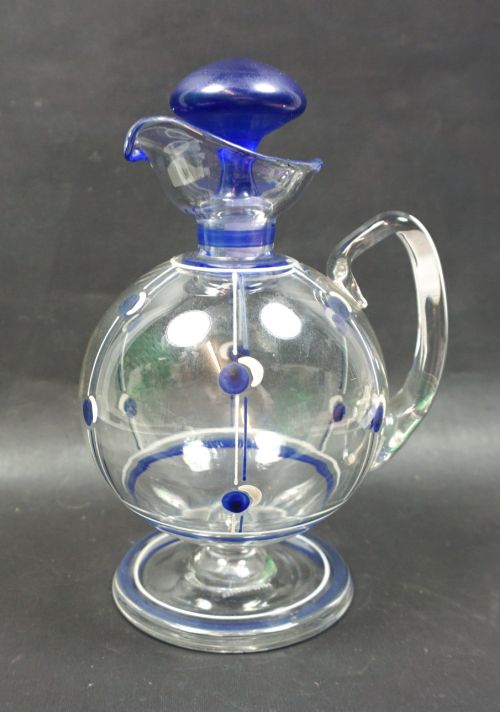


Geometric Decanter and Glasses
These geometric decanter and glasses sets bring sharp angles and striking colour from the Art Deco period straight to your drinks tray.
Geometric Decanter and Glasses
A geometric decanter and glasses set brings together matched drinking vessels and serving pieces defined by strong lines and modernist motifs. You are most likely to encounter Czech decanter sets from the nineteen thirties, often complete with matching glasses and occasionally mounted on a matching tray.
The selection ranges from wine jugs and perfume bottles to claret jugs spanning the Victorian era through to nineteen forty. Pieces emerge from Bohemia and Czechoslovakia, alongside English interpretations featuring cut crystal and sterling silver.
The primary forms include decanter sets with six matching glasses, standalone claret jugs, and vessels enhanced by blue enamel decoration or bold green glass. Each piece reflects the functional geometry favoured by makers of the period.
How they were made
Makers utilised lead crystal, cut crystal, and standard glass as the foundational medium for these vessels, shaping them through moulding and wheel-cutting. The resulting facets catch the light and emphasise the angular forms characteristic of the style.
Decoration relied heavily on hand enamelling applied directly to the glass surface, often in geometric patterns that complemented the faceted body. Metal components incorporated silver plate, chrome, and sterling silver for mounts, collars, and hinged lids.
Object types documented across the inventory include claret jugs, perfume bottles, and decanter sets complete with matching glasses and trays.
What varies in quality
The distinction between standard production and exceptional work rests on the precision of the glass cutting and the crispness of the enamel application. Superior examples display clean geometric lines where the facets align perfectly across both the decanter and the accompanying glasses.
Material composition also dictates the grade of the piece, with heavy lead crystal and solid sterling silver mounts representing the upper tier of manufacture. The presence of a fully matching tray and a complete set of undamaged glasses elevates the integrity of the ensemble.
Karl Palda·Hukin & Heath·Dr Christopher Dresser·Mosey
The Geometric Decanter and Glasses Glossary
- Art Deco
- A design style of the nineteen twenties and nineteen thirties characterised by streamlined forms, geometric shapes, and modern materials. It replaced the organic curves of earlier movements with sharp angles and stylised motifs.
- Lead crystal
- A type of glass containing metallic oxide that increases weight, brilliance, and clarity. This material allows for deeper, sharper cuts than ordinary glass.
- Claret jug
- A specialised pouring vessel designed for serving red wine, typically featuring a handle and a hinged metal lid. They frequently combine glass bodies with silver plate or sterling silver mounts.
- Enamel
- A decorative fused glass coating applied to the surface of glassware for colour and pattern. Hand enamelling provides a tactile finish that stands slightly proud of the glass.
- Aesthetic Movement
- A nineteenth century British design movement that emphasised visual and sensory beauty over narrative or practical function. It influenced later decorative arts through disciplined form and ornamentation.
Geometric Decanter and Glasses: Frequently Asked Questions
What is included in a typical set?
A standard set comprises a central decanter with a matching stopper accompanied by six drinking glasses. Some configurations also include a matching glass tray to hold the complete assembly.
Individual variations might substitute the decanter for a wine jug, claret jug, or perfume bottle while retaining the same geometric aesthetic.
How do I date these items?
Dating relies primarily on stylistic markers associated with the Art Deco period around nineteen thirty, alongside specific national origins such as Czechoslovakia and Bohemia. Victorian and later nineteen forty pieces are identified through distinct mounting styles and material combinations.
Maker attributions and model numbers stamped on silver plate or sterling silver mounts provide additional chronological reference points.
Are these sets safe to use for drinks?
Most pieces function adequately for serving beverages, provided the glass and enamel decorations are handled with appropriate care during washing. Hand washing in lukewarm water prevents thermal shock and protects delicate enamel work.
Decanters used historically for cosmetics, such as perfume bottles, are better retained for display rather than liquid consumption.
How should I display a decanter set?
Arranging the decanter and glasses together on a sideboard or drinks trolley allows the geometric facets to catch ambient light effectively. Keeping the set on its matching tray unifies the display and protects underlying furniture surfaces.
Positioning the pieces away from direct sunlight preserves the vibrancy of any applied blue enamel and coloured glass.