


Geometric Dangle Earrings
Geometric dangle earrings bring together sharp lines and suspended movement, offering the unmistakable geometry of the Art Deco era alongside Victorian and mid-century designs.
Geometric Dangle Earrings
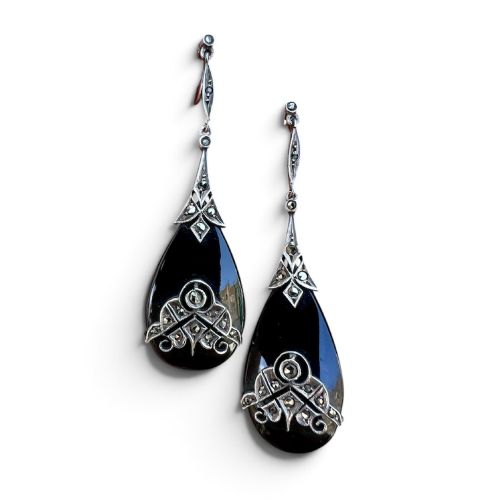
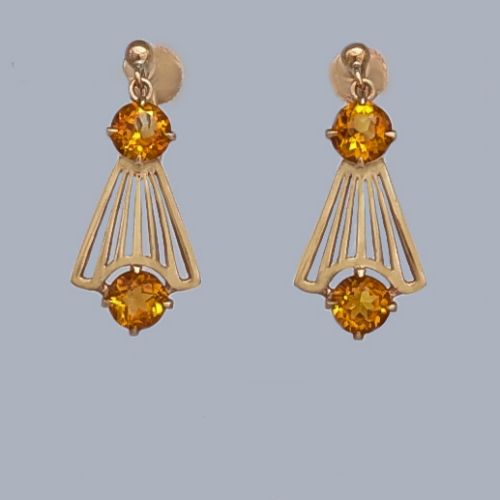
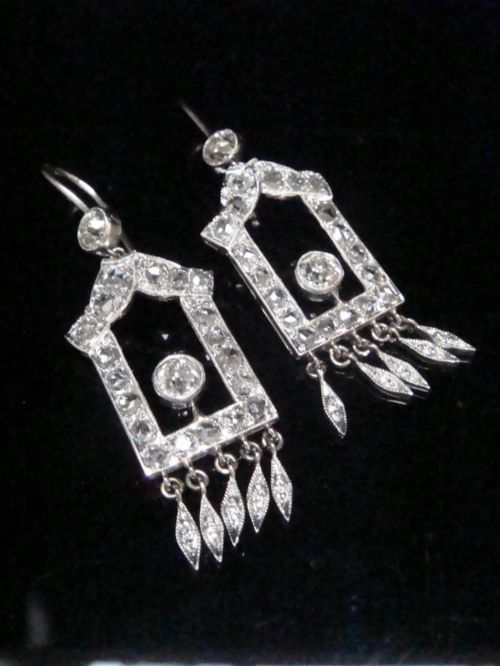
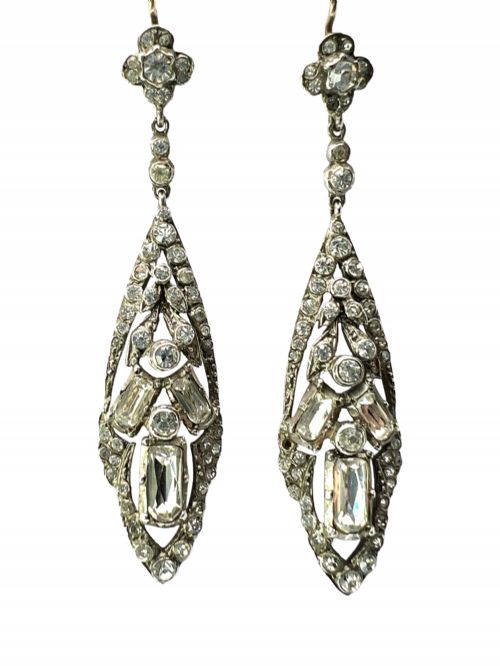
Geometric dangle earrings combine linear forms with hanging drops, appearing most frequently in the clean angles and symmetrical layouts of the Art Deco period. Pieces span from the 1870s through the mid-century, including Edwardian platinum work, Victorian gold and silver pairings, and modernist chrome and bakelite items. Buyers encounter drop earrings, dangle earrings, and night and day configurations designed to catch the light with every movement.
The selections on this page draw heavily on 1920s and 1930s aesthetics, where squares, rectangles, and teardrops dominate the silhouette. Alongside these, earlier Victorian square cross wheel and rock crystal pieces offer distinct historical weight, while 1950s designs introduce aquamarines and pearls in 9ct gold.
How they were made
Craftsmen built these geometric dangle earrings using precious metals like platinum, 18ct white gold, 9ct gold, and silver, often pairing gold and silver together in traditional settings. Stones such as diamonds, citrine, amethyst, emeralds, and aquamarines are cut into baguettes and squares to match the rigid architectural lines of the mountings.
Surface texture and contrast come from marcasite, enamel, paste, and black onyx, while modernist examples utilise chrome and moulded bakelite. Articulated joints allow the lower sections of the drops to move independently, requiring precise metalwork to secure the stones within rigid geometric frames.
Bakelite and chrome make a surprise appearance alongside fine platinum and diamonds, proving that 1930s modernists loved industrial plastics just as much as precious stones.
What varies in quality
The calibre of a pair of geometric dangle earrings rests on the precision of its metalwork and the integration of the stones within the design. Superior examples display crisp, sharp angles in platinum or white gold, where every square-cut diamond or gemstone sits flush and secure.
Material choice dictates the tier of the piece, shifting from base metals and chrome with glass or bakelite up to substantial diamond and platinum mountings. The sophistication of the articulation - how smoothly the drop sections pivot and hang - separates standard production from exceptional jeweller work.
The Geometric Dangle Earrings Glossary
- Art Deco
- A design style from the 1920s and 1930s characterised by symmetry, clean geometric lines, and stylised motifs. It defines the majority of the drops and dangles found in this selection.
- Night and day earrings
- Convertible drop earrings featuring removable lower sections that alter the length and formality of the piece. They allow the wearer to transition from a subtle daytime stud or short drop to an elaborate evening display.
- Marcasite
- Small, faceted pieces of pyrite set into silver to resemble sparkling diamonds. This technique provides a dark, metallic shimmer popular in antique and period jewellery.
- Baguette
- A rectangular cut used for gemstones and diamonds, favoured for its straight edges. It forms the backbone of linear geometric jewellery designs.
- Paste
- Hand-cut and polished lead glass used as a brilliant gemstone simulant in antique jewellery. It allows for vibrant colour and substantial settings without utilising precious stones.
Geometric Dangle Earrings: Frequently Asked Questions
What periods do these earrings come from?
The selections span from the Victorian era and the 1870s through the Edwardian period into the 1920s and 1930s Art Deco movement, extending onward to 1950s mid-century designs. This broad timeline covers everything from ornate nineteenth-century rock crystal to sleek modernist chrome.
Each period brings distinct material choices and structural conventions, allowing buyers to trace the evolution of drop and dangle forms across nearly a century of jewellery design.
How do night and day earrings work?
Night and day earrings feature a modular construction with detachable lower drops that hook onto the upper stud or component. This mechanical setup permits the wearer to shorten the piece for daytime wear and lengthen it for evening events.
Such configurations require sturdy platinum or gold hinges and secure clasps to support the shifting weight while maintaining clean geometric lines in both states.
What materials are typical in these designs?
Common metals include platinum, 18ct white gold, yellow gold, 9ct gold, and silver, occasionally paired in traditional multi-metal mounts. Gemstone settings feature diamonds, emeralds, aquamarines, citrine, amethysts, and pearls, accompanied by decorative accents like marcasite, black onyx, and enamel.
Later modernist examples incorporate alternative substances such as chrome and moulded bakelite alongside coloured glass, expanding the visual range of the geometric forms.
How can I tell Art Deco from Victorian pieces?
Art Deco pieces rely on stark symmetry, sharp angles, and crisp rectangular or square motifs executed in platinum or white gold. Victorian examples tend to feature softer rounded elements, crosses, and wheel patterns set in yellow gold alongside silver.
Examining the metal colour, stone cuts, and overall structural rigidity quickly separates the industrial geometry of the 1930s from the romantic ornamentation of the nineteenth century.