


French Victorian Gold Pendant
When you search for french victorian gold pendant, you encounter wearable ornaments crafted in eighteen-carat gold, often set with pearls, diamonds, and rubies, that carry personal sentiments.
French Victorian Gold Pendant
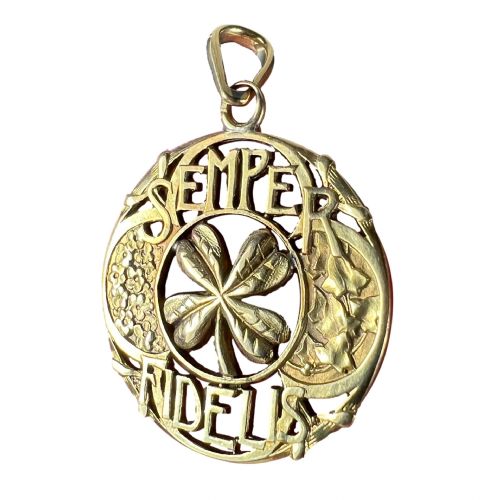
A french victorian gold pendant encompasses wearable jewels and lockets from the nineteenth century and the Edwardian era, featuring materials such as yellow gold, rose gold, seed pearls, and diamonds. Buyers find pieces shaped as hearts, clovers, flowers, and religious medals, alongside double photo lockets designed to hold miniature portraits or hair mementos.
The selection on this page blends French regional jewellery styles with British Victorian manufacturing dates, spanning the 1860s through to the early 1900s. These ornaments range from simple monogram medals to elaborate gem-set lockets incorporating natural sapphires, turquoise, and hand-painted miniatures.
How they were made
Goldsmiths utilised high-carat yellow and rose gold, frequently combining eighteen-carat gold with silver settings for gemstones to maximise the brilliance of rose-cut and table-cut diamonds. Metalwork techniques included chased floral motifs, repoussé puffy hearts, and delicate wirework forming acanthus and fleur-de-lis designs.
Gemstones such as rubies, sapphires, and seed pearls were hand-set into the gold surface, while glass and crystal protected painted miniatures and photographic compartments within hinged lockets.
Listings feature items incorporating 18ct gold, silver, diamonds, rubies, seed pearls, turquoise, and painted miniatures.
What varies in quality
The standard of a pendant rests upon the crispness of the chasing and the complexity of the goldwork, where hand-engraved detailing and well-defined floral reliefs distinguish finer examples from mass-produced items. The selection of gemstones also dictates worth, as matched natural pearls and clean rubies require greater skill in selection and mounting.
Internal construction determines longevity, particularly the integrity of hinges on photo compartments and the security of stone settings. Superior pieces maintain alignment in their bezels and retain original clasps or suspension loops without distortion.
The French Victorian Gold Pendant Glossary
- Repoussé
- A metalworking technique where the gold is hammered from the reverse side to form a raised design on the front. This method creates the characteristic rounded volume seen in puffy heart pendants.
- Rose-cut
- An antique gemstone cutting style featuring a flat base and a domed crown composed of triangular facets arranged in a symmetrical pattern. This cut gives stones a softer reflection compared to modern brilliant cuts.
- Locket
- A hinged pendant opening to reveal a compartment for miniatures, photographs, or hair. Victorian examples frequently utilise glass covers and gold frames.
- Acanthus
- A classical ornamental motif derived from Mediterranean foliage, utilised in Victorian jewellery to render scrolling leaf patterns. It appears frequently on chased gold borders and floral frames.
- Fleur-de-lis
- A stylized lily design associated with French royalty, incorporated into nineteenth-century religious and sentimental jewellery. The motif is typically rendered in gold with seed pearl or diamond accents.
French Victorian Gold Pendant: Frequently Asked Questions
How do I open a locket?
Many nineteenth-century lockets feature a small side notch or a hinged bezel designed to release the internal glass frame. Gentle pressure with a fingernail is usually sufficient to separate the front cover from the back plate.
Avoid using metal tools to pry open stubborn hinges, as this can scratch the gold or distort the fitted glass compartments.
What is a photo pendant?
A photo pendant is a hinged jewellery piece engineered to display paper photographs or painted miniatures behind glass panels. These compartments allowed wearers to keep images of family members close to the chest.
Most examples contain internal gold rims that hold the photographic paper securely in place against the glass.
How do I care for antique gold?
Clean high-carat gold components with warm soapy water and a soft brush to remove accumulated oils from daily wear. Avoid submerging lockets that contain paper photographs or hair mementos behind glass.
Store pieces individually in soft pouches to prevent abrasions between harder gemstones and the softer eighteen-carat gold surfaces.
Are these pieces marked?
French gold items from the nineteenth century frequently bear small stamped hallmarks known as punchmarks, indicating the purity of the metal and the origin of manufacture. These tiny stamps are often located on the jump ring, the exterior edge of the frame, or the bail.
Common French marks from this period include the eagle head denoting eighteen-carat gold purity.