

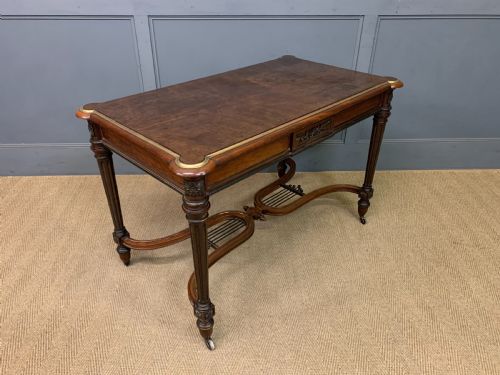
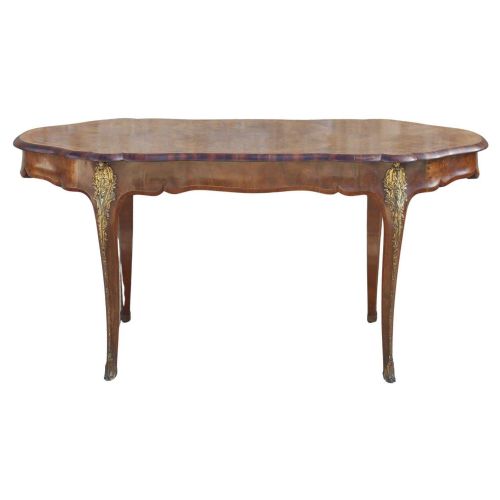

French Style Library Table
When you want a French style library table, you are looking at nineteenth-century writing desks and centre tables defined by elaborate mounts and classic continental forms.
French Style Library Table
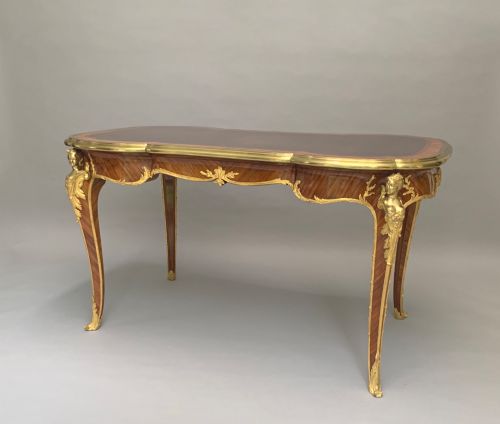
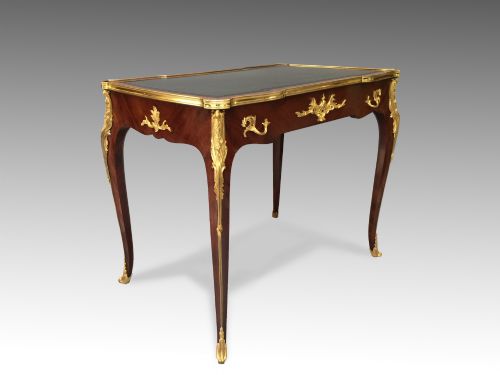
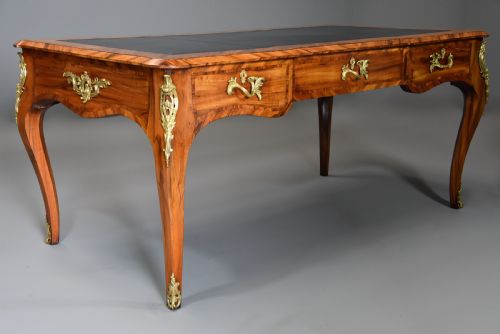
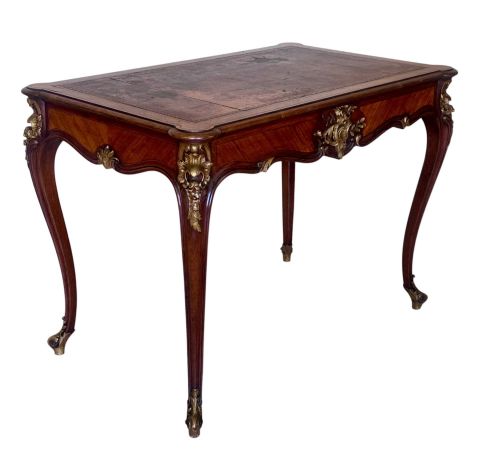
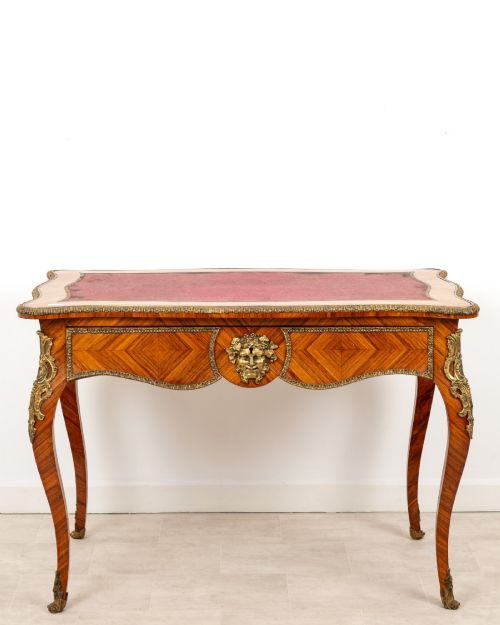
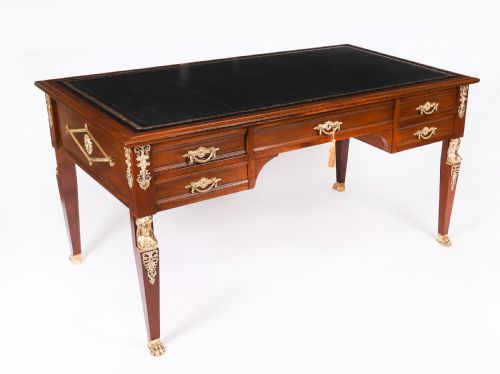
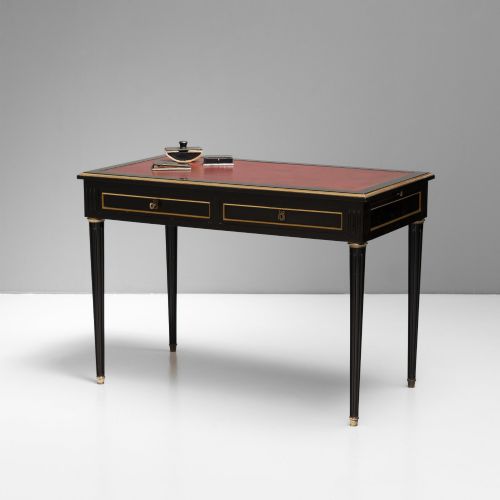
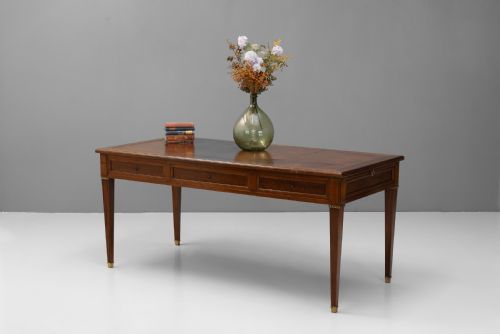
A French style library table encompasses nineteenth-century bureau plat desks, centre tables, and writing tables originating from France or produced in distinct revival aesthetics. These pieces serve as functional writing surfaces and decorative centrepieces, frequently positioned in the middle of a room rather than against a wall.
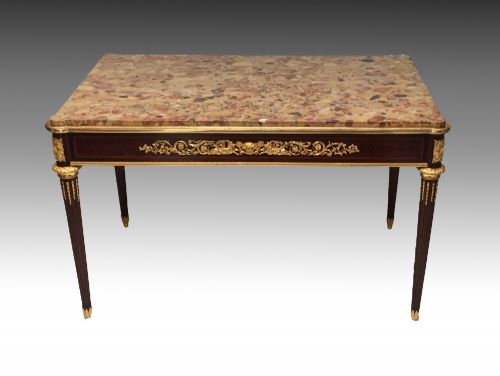
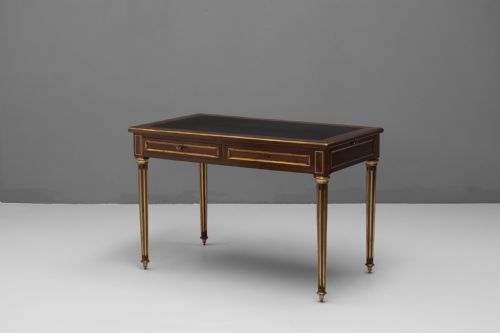
The most common examples on this page are nineteenth-century bureau plat desks and centre tables displaying Louis XV and Louis XVI revival characteristics. They combine practical drawers with ornamental veneers and metal mounts, echoing the luxury of royal courts.
Makers and workshops across the nineteenth century adapted historical French designs, producing both grand exhibition pieces and smaller domestic writing tables in walnut, kingwood, and mahogany.
Materials and construction
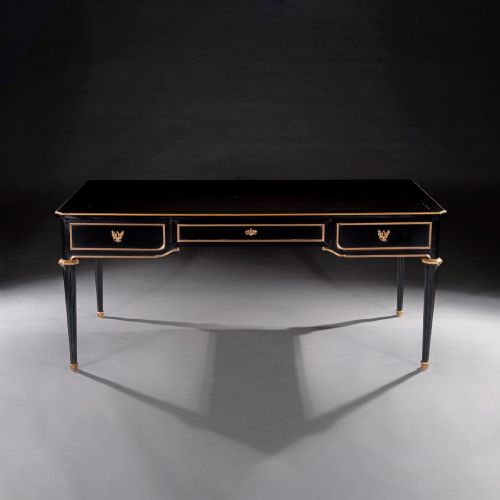
Cabinet makers utilised dense structural timbers such as mahogany and walnut, overlaid with decorative veneers including kingwood, satinwood, amboyna, and burr walnut in geometric parquetry or floral marquetry patterns. Ebonised wood also appears among nineteenth-century examples for a contrasting dark finish.
Ormolu and gilt bronze mounts decorate corners, legs, and apron edges, cast and chased to highlight scrollwork and classical motifs. Leather writing surfaces, often tooled with gold, inset the top panels of bureau plat desks.
Styles recorded across current and archived stock include Louis XV revival, Louis XVI, Empire, and Directoire aesthetics.
What separates the finest examples
Quality rests in the crispness of the bronze or ormolu casting and the precision of the marquetry work. Finely chiselled mounts fit snugly against the wooden contours without gaps, while lesser pieces rely on simpler cast metal and plain veneers.
The choice of secondary timbers and the complexity of the internal drawer construction distinguish master workshops from standard production. Tables bearing signatures or attribution to notable cabinet makers display superior joinery and hand-finished details throughout.
Francois Linke·Edwards and Roberts·CH Jeanselme and Co·Donald Ross·Maison Millet·Zweiner
The French Style Library Table Glossary
- Bureau plat
- A freestanding writing desk with drawers in the frieze, typically finished on all sides for placement in the centre of a room. This form dates back to seventeenth-century France and remained popular through the nineteenth-century revivals.
- Ormolu
- Gilt bronze ornamentation applied to furniture mounts, clock cases, and decorative objects. The technique involves treating brass or bronze with an amalgam of mercury and gold, then firing to leave a rich golden layer.
- Marquetry
- Decorative veneer work arranged in pictorial or geometric patterns using various coloured woods, shells, or metals. Craftsmen cut these thin elements precisely to fit together within the wooden ground.
- Parquetry
- Geometric wood inlay forming repeating patterns such as cubes, lozenges, or chequers across a furniture surface. It differs from marquetry by strictly using geometric tile arrangements rather than floral scenes.
- Cabriole leg
- A furniture leg that curves outward at the knee and tapers inward toward the foot, mimicking animal limbs. Originating in antiquity, it became a defining feature of eighteenth-century and revival styles.
French Style Library Table: Frequently Asked Questions
What is a bureau plat?
A bureau plat is a freestanding writing desk fitted with drawers along the frieze. It was designed to sit in the middle of a room rather than against a wall.
These desks feature finished backs and detailed mounts so they look correct from every angle during use.
How do I identify Louis XV style?
Louis XV style is characterised by asymmetrical curves, naturalistic floral motifs, and cabriole legs. Ormolu mounts on these pieces emphasise flowing, organic shapes.
Straight lines are largely avoided in favour of serpentine fronts and rounded corners.
Where were these tables used?
These tables served in grand libraries, salons, and private studies as writing surfaces or ornamental centrepieces. Wealthy households used them for correspondence and reading.
Their finished backs allowed them to occupy prominent positions in the middle of reception rooms.
How do I care for leather desk tops?
Leather desk inserts require gentle cleaning with a slightly damp cloth and occasional application of appropriate leather cream. Avoid harsh chemical cleaners and excessive moisture.
Keeping them out of direct sunlight prevents the leather and the surrounding gold tooling from fading.
What distinguishes Louis XVI style?
Louis XVI style marks a return to neoclassical symmetry and straight lines, contrasting with the curves of the preceding Louis XV period. Pieces feature fluted tapered legs and geometric or classical architectural ornamentation.
Ormolu mounts on these tables often incorporate urns, ribbons, and acanthus leaves.