


French Style Chaise
These pieces of french style chaise seating bring elegance to a room through curved woodwork and upholstered lounging lengths.

French Style Chaise
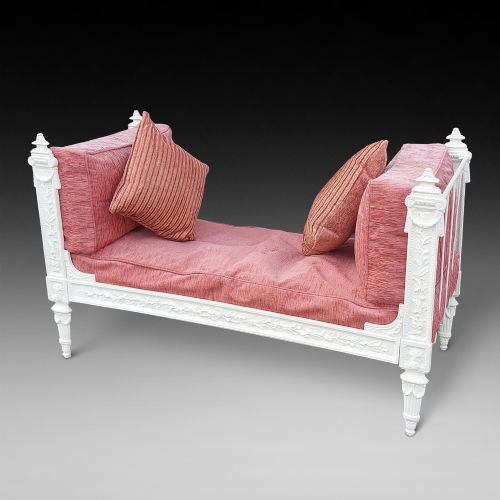
A french style chaise provides an elongated seat for reclining, drawing upon historical designs such as the Louis XV style, Louis XVI style, and Napoleon III periods. These items encompass daybeds, duchesse brisée forms, and conversation seats designed for relaxed posture.
The versions most commonly met on this page include nineteenth-century walnut frames, Victorian pieces, and twentieth-century interpretations from around nineteen ten and nineteen thirty. Makers and creators applied painted finishes, giltwood, and carved details to mimic classical French aesthetics.
Object types stretch from miniature chaise models to three-piece duchesse brisée suites and double end settees. Buyers select these for boudoirs and drawing rooms where traditional lounging furniture sets a formal tone.
Materials and construction methods
Wood frameworks utilise solid timbers like walnut, mahogany, beech, and giltwood to support intricate carved ornamentation. Cast iron also appears in specific nineteenth-century daybed examples, providing sturdy structural integrity.
Upholstery relies on textiles such as velvet, linen, and standard fabric, frequently finished with buttoning and cane inserts. Original paint layers and gilt decoration finish the visible wooden elements.
Listings feature nineteenth-century and early twentieth-century dates, spanning Victorian, Louis XV, and Louis XVI styles.
Quality differences across pieces
Superior examples display crisp hand-carved woodwork on walnut or giltwood frames, whilst lesser items feature simpler turned elements or later decorative painting. The depth and precision of the carving dictate the visual impact of the piece.
Upholstery integrity separates fine items from standard ones, particularly where original paint finishes or period textiles remain intact versus modern recovered surfaces. Complete multi-piece duchesse brisée sets command greater interest than single modified components.
The French Style Chaise Glossary
- Duchesse brisée
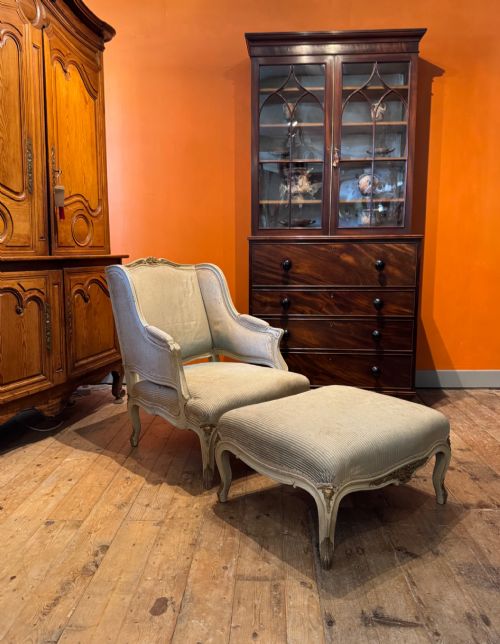
- A multi-part chaise longue comprising a chair and one or two footstools that combine to form a single continuous lounging surface. This form originated in France during the eighteenth century.
- Giltwood
- Timber treated with a thin layer of gold leaf applied to its surface for decorative effect. It appears frequently on formal nineteenth-century frames.
- Canapé corbeille
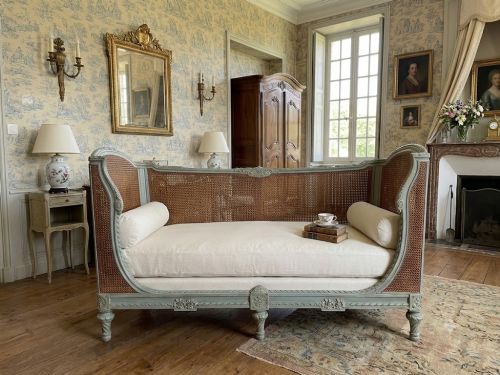
- A French term for a basket-shaped sofa or daybed featuring a rounded enclosing backrest. These often incorporate cane panels or upholstered padding.
- Napoleon III
- A nineteenth-century French design period associated with eclectic revivals of earlier royal styles and opulent ornamentation. Pieces from this era often feature dark woods and rich upholstery.
- Piecrust
- A decorative edge carving resembling the fluted pastry rim of a pie. This detail is found on the woodwork of specific nineteenth-century chaises.
French Style Chaise: Frequently Asked Questions
What is a duchesse brisee?
A duchesse brisée is a multi-piece lounger made up of an armchair and matching footstools that fit together. It allows the user to recline fully with leg support.
Historically, these were used in French salons for daytime resting and reading in comfort.
How do I style a daybed?
Daybeds and chaises work well placed against a drawing room wall or angled in a large bedroom. They serve as secondary seating during the day and quiet spots for reading.
Pair them with complementary armchairs or footstools to balance the elongated shape within the room.
Are these pieces comfortable?
Comfort depends on the depth of the upholstery, the angle of the backrest, and whether the springs or webbing remain supportive. Many period chaises feature buttoned upholstery designed for firm support.
Original padding may feel firmer than modern seating, reflecting the standards of nineteenth-century manufacture.
How do I identify a Victorian chaise?
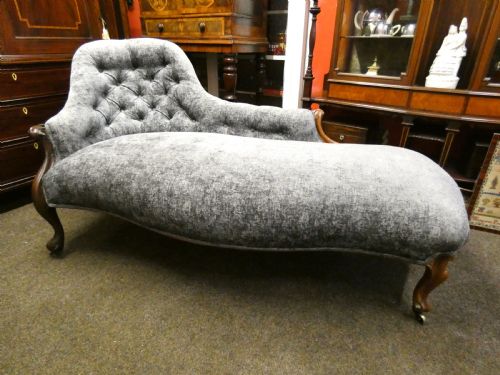
Victorian chaises typically feature dark walnut frames, buttoned velvet or fabric upholstery, and curved wooden crests. They often exhibit single scrolled ends designed for reclining.
Makers of this era drew inspiration from French rococo revivals, producing ornate carved details on the show wood.