



French Salon Centre Table
A french salon centre table brings ornamental presence and rich timber to a room, offering a freestanding surface designed to command attention from every angle.
French Salon Centre Table
A french salon centre table represents a diverse group of freestanding furnishings originating from nineteenth-century and Edwardian periods, designed to sit in the middle of a room rather than against a wall. These pieces frequently appear in revival modes such as Louis XV and Louis XVI, adopting decorative idioms that channel earlier royal aesthetics.
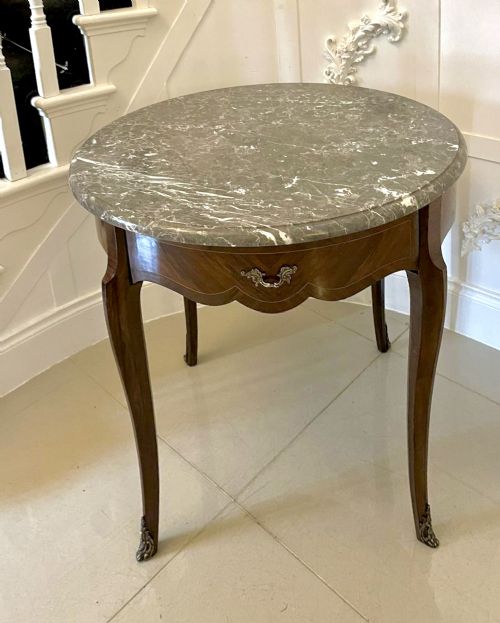
The selection on this page centres primarily on centre tables, coffee tables, and occasional tables fashioned in walnut, mahogany, and kingwood. Many incorporate inset marble tops or porcelain plaques, reflecting the opulent interior tastes of their original domestic contexts.
How they were made
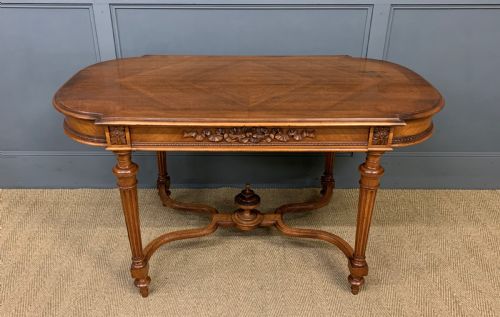
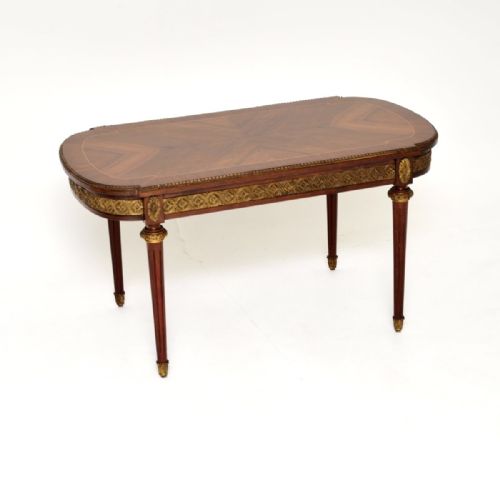
Cabinet makers utilised dense hardwoods like walnut, mahogany, and kingwood as the structural foundation for these pieces, often applying intricate marquetry patterns across the surfaces. The timber was frequently shaped through curved lines and mounted with gilt bronze or brass ormolu to accentuate the structural contours.
Many examples incorporate heavy stone or ceramic elements, featuring grey marble surfaces or Sevres style porcelain panels set securely into the wooden frames. These mixed media constructions demanded precise carpentry to join stone, metal, and wood harmoniously.
French Salon Centre Table Retail Price Guide 2026
Typical asking prices for french salon centre table among the pieces listed under this phrase on Sellingantiques today, from the lower quarter to the upper quarter. They describe what is for sale here now, not the wider market.
Materials appearing across the current selection include walnut, mahogany, kingwood, ormolu, brass, marble, and porcelain.
What varies in quality
The standard of execution in the marquetry inlay and the crispness of the ormolu mounts largely separate standard examples from finer works. Finer pieces demonstrate meticulous attention to timber selection and delicate hand-chasing on the metal mounts.
The integration of materials also dictates overall calibre, particularly where marble or porcelain is fitted flush to the surrounding timber frame. Superior execution ensures that stone and ceramic inserts align seamlessly with the wooden structure.
Joseph Emmanuel Zwiener
The French Salon Centre Table Glossary
- Ormolu
- Gilt bronze mounts applied to furniture to decorate and protect corners and legs. This technique creates a bright golden contrast against dark timbers like walnut and mahogany.
- Kingwood
- A dense, exotic timber with characteristic dark figuring prized by cabinet makers. It frequently appears in decorative veneers on nineteenth-century salon tables.
- Marquetry
- The art of applying small pieces of veneer to a structure to form decorative patterns. Craftsmen utilised different wood tones to create intricate floral or geometric designs.
- Sevâeâs style porcelain
- Ceramic plaques painted with decorative scenes or motifs and glazed. These elements were often inset into table tops during the nineteenth century.
French Salon Centre Table: Frequently Asked Questions
Where should a centre table be placed?
These pieces are designed to be freestanding and look complete from all four sides. They sit best in the middle of a principal room or a spacious hallway where circulation allows uninterrupted viewing.
Because they lack a designated front or back, they function effectively as focal points away from perimeter walls.
How do I care for a marble top?
Marble surfaces require gentle cleaning with a damp cloth and mild soap to preserve the polish. Acidic liquids should be wiped away immediately to prevent dulling the stone.
Using coasters and mats helps protect both the stone and the underlying timber frame from moisture rings.
Are these tables sturdy enough for daily use?
Most examples are built from substantial hardwoods like mahogany and walnut, providing a solid structure for everyday placement of lamps and decorative objects. Their primary purpose, however, remains decorative rather than heavy utility.
Care should be taken when moving them, especially those featuring heavy marble inserts or delicate ormolu mounts.
How can I identify a revival style?
Revival pieces borrow decorative vocabulary from earlier periods such as the reigns of Louis XV and Louis XVI, featuring curved cabriole legs or straight tapered supports. Nineteenth-century makers reinterpreted these historical motifs with contemporary woodworking techniques.
Examining the construction methods beneath the surface often reveals the actual age of the piece.