
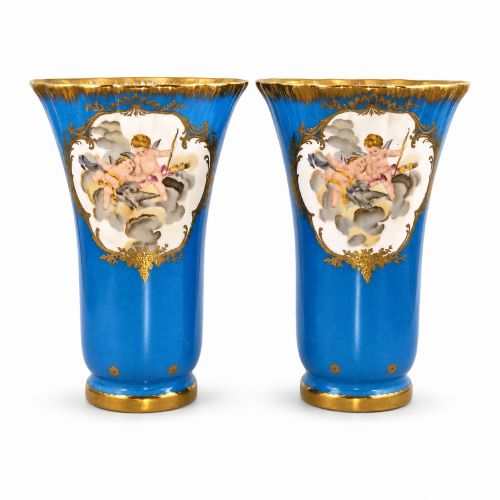


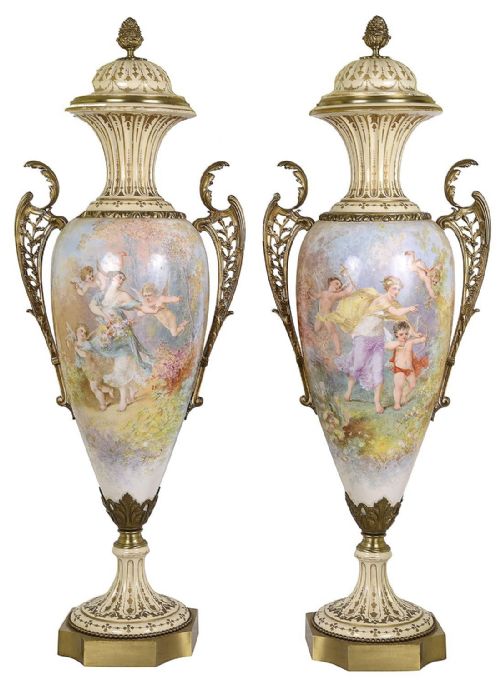

French Rococo Style Vases
French rococo style vases bring exuberant asymmetry and gilt mounts into a room, shaped by nineteenth-century revivals of eighteenth-century court taste.
French Rococo Style Vases
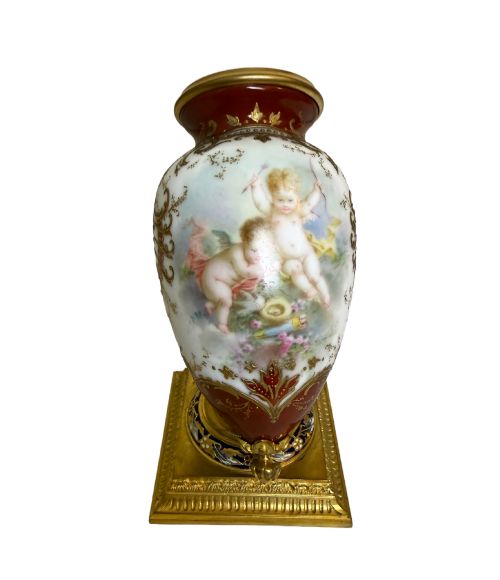
French rococo style vases encompass nineteenth-century decorative vessels, garniture sets, and ewers that adopt the curving lines and ornate flourishes of the old French monarchy. Buyers seeking french rococo style vases will encounter works drawing directly upon Sevres factory models, alongside pieces produced by Parisian potteries and regional makers.
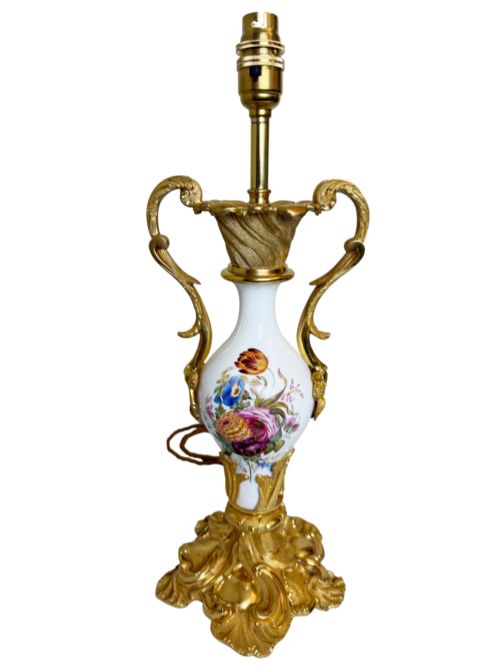
The objects take many forms, including lidded vases, potpourri containers, and mounted porcelain bodies flanked by handles of cast metal. These items range from petite cabinet pieces to tall decorative pairs designed for mantelpieces and salon tables.
The selection here includes pieces spanning the nineteenth century, from the eighteen-fifties through to nineteen-twenty, alongside later interpretations. They demonstrate how makers across Europe adapted French taste well beyond its original period.
How they were made
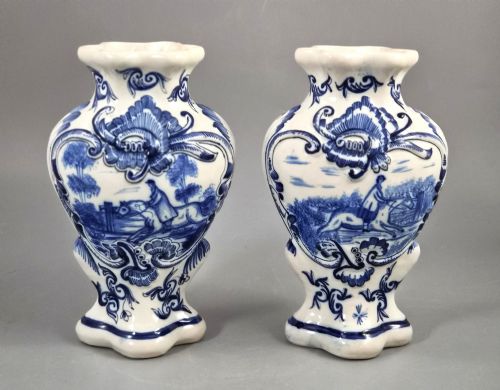
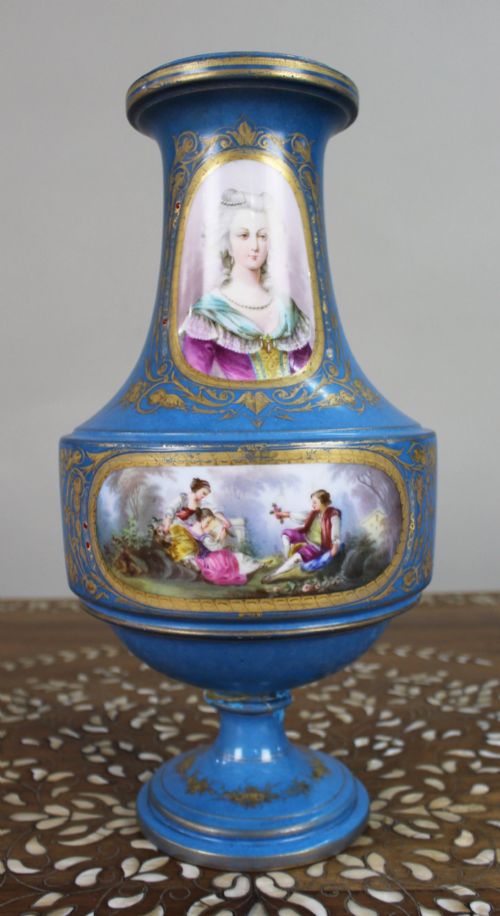
Makers shaped these objects using hard-paste or soft-paste porcelain bodies, frequently painted with floral motifs or rich monochrome grounds such as bleu celeste. Earthenware and tin-glazed faience also appear, demonstrating varied ceramic traditions across France and other European workshops.
Metal mountings in gilt bronze or ormolu frame the ceramic bodies, fastened securely with pins or screws. These cast mounts provide the characteristic C-scrolls, foliate handles, and rocaille bases that define the revival style.
Some vases arrived with handles shaped like leaping dolphins, proving that eighteenth-century French designers took marine life very seriously indeed.
What varies in quality
The refinement of the cast bronze mounts separates standard production from finer examples, visible in the crispness of the chasing and the warmth of the gilding. Heavier, deeply carved mounts indicate greater workshop investment than thin, flat stampings.
Hand-painted ceramic details reveal distinct tiers of craftsmanship, from loose factory decoration to meticulous brushwork on cobalt grounds. The weight of the porcelain and the precision of the fit between ceramic and metal parts signal the original maker's intent.
Fourmaintraux Courquin·Samson Paris·Jacob Petit·Vion et Baury·Henry Dasson
The French Rococo Style Vases Glossary
- Ormolu
- Gilded bronze applied as decorative mounts on furniture and ceramics. This technique involves coating bronze with a mercury-gold amalgam and heating it to leave a durable metallic layer.
- Garniture
- A set of three or more matching vases or urns designed to be displayed together on a mantelpiece. These matched groups often include a central lidded vessel flanked by smaller matching companions.
- Potpourri
- A vase or jar with a pierced cover intended to hold dried scented plant material. Such vessels typically feature elaborate openwork lids to allow fragrance to circulate.
- Ewer
- A large jug with a flared spout and a shaped handle, originally used for pouring water. In decorative contexts, ceramic ewers served purely ornamental functions alongside matched basins.
- Bleu Celeste
- A bright turquoise blue ground colour used extensively on porcelain. This distinctive shade became famous through its association with the Sevres factory.
French Rococo Style Vases: Frequently Asked Questions
What is a french rococo style vase?
These pieces are nineteenth-century decorative vessels that imitate the curved, asymmetrical forms of eighteenth-century French design. They combine glazed porcelain bodies with cast gilt metal mounts.
Buyers select them to introduce classical nineteenth-century interior ornamentation into a room, often displaying them on mantelpieces or cabinets.
How do you spot a Sevres style piece?
Sevres style pieces typically feature rich coloured grounds, hand-painted floral panels, and elaborate gilt bronze mounts. They follow the aesthetic established by the royal French porcelain manufactory.
Many nineteenth-century European workshops produced items in this taste, emulating the prestige and visual appeal of original French royal wares.
What are clock garniture sets?
Clock garniture sets consist of a central mantel clock accompanied by a matching pair of vases or candelabra. They were designed to create a balanced display across a fireplace mantel.
These coordinated sets share identical decorative motifs, mounting styles, and ceramic bodies to unify the appearance of a formal interior.
How should I clean my porcelain vase?
Dust these delicate decorative objects gently using a soft, dry brush to protect fragile gilt bronze mounts and painted surfaces. Avoid using water or liquid cleaners on areas with gold leaf or enamel.
Keeping them away from direct sunlight preserves the vibrant colours of the ceramic body and prevents the gilding from fading over time.