



French Rococo Revival Sofa
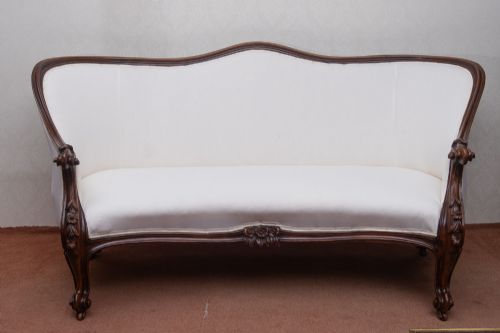
These French rococo revival sofas are lavishly carved wooden seats designed to bring curving Louis XV elegance into nineteenth-century drawing rooms.
French Rococo Revival Sofa
A french rococo revival sofa is an ornate seating piece drawing directly upon mid-eighteenth-century French design. These settees, couches, and salon suites emerge primarily across the nineteenth century, reflecting sustained enthusiasm for exuberant asymmetric curves.
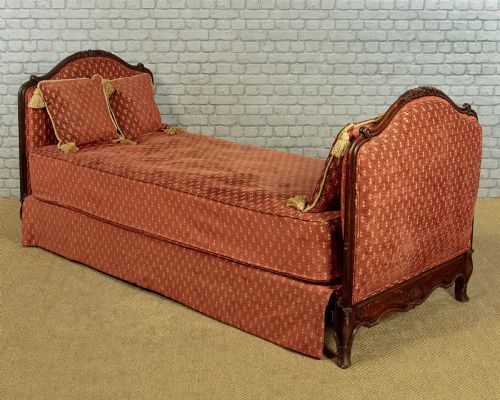
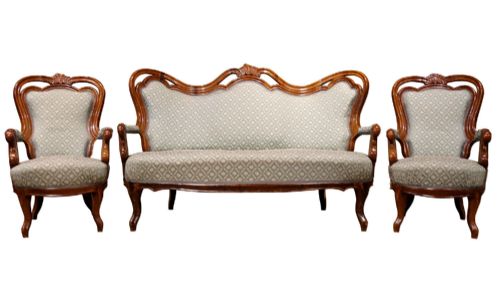
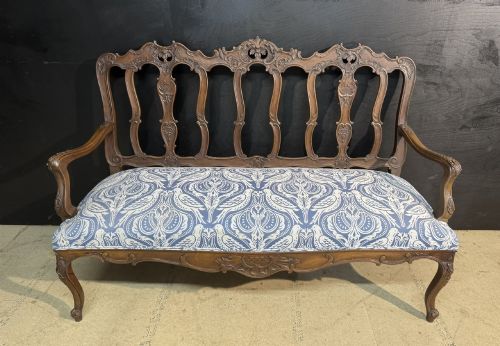
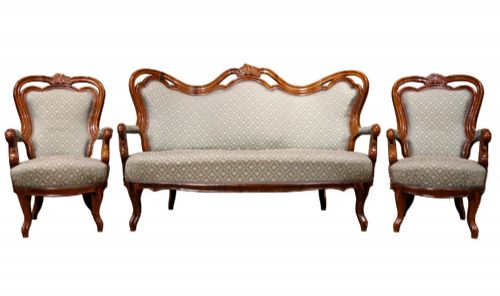
The versions most commonly met on this page span the Victorian era up to the early twentieth century. They range from intimate two-seater settees and chaise longues to substantial walnut frames and large salon suites.
Makers and manufacturers of the period interpreted Louis XV styles through varied regional lenses, producing continental seating alongside British interpretations. Each piece relies on deeply curved woodwork and generous proportions to establish its distinct persona.
How they were made
The structural framework relies predominantly on solid walnut, mahogany, rosewood, and amboyna, selected for dense grain capable of supporting deep hand-carving. Craftsmen shaped these timbers into sweeping cabriole legs and scrolled crest rails.
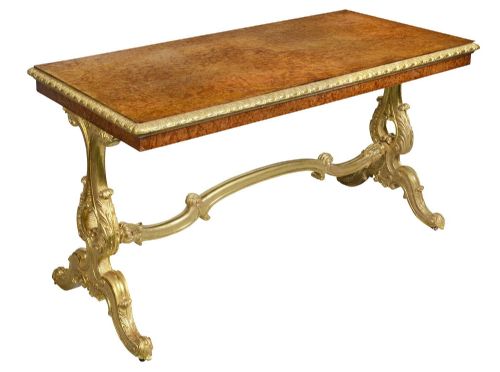
Surfaces frequently receive giltwood or gold paint finishes to emulate royal court furniture, while others display intricate marquetry and inlay work. Upholstery fabrics, plush velvets, and textured textiles are secured over traditional sprung foundations to complete the build.
Listings span the nineteenth and early twentieth centuries, featuring walnut, mahogany, rosewood, and giltwood constructions.
What varies in quality
Depth and sharpness of the wood carving distinguish higher tiers of production from simpler workshop output. Skilled hands produce crisper acanthus leaves and more fluid asymmetrical cartouches along the wooden frame.
The choice of primary timber and finishing technique dictates longevity and visual presence. Dense walnut and richly layered giltwood create a heavier, more stable construction than lighter secondary woods.
Holland and Son
The French Rococo Revival Sofa Glossary
- Cabriole leg
- A furniture leg that bends outward in a convex curve and tapers inward in a concave curve, ending in a pad or scroll foot. This shape mimics the leaping legs of an animal and typifies mid-eighteenth-century design.
- Chaise longue
- An upholstered couch shaped like a chair with a long seat large enough to support a person's legs. It functions as a hybrid daybed and lounging seat.
- Giltwood
- Wood that has been treated with gold leaf or gold paint to give a metallic gilded surface. It provides the reflective opulence seen on formal reception furniture.
- Salon suite
- A matching set of upholstered seating and tables designed for a formal drawing room. These ensembles ensure visual harmony across a large interior space.
- Marquetry
- Decorative patterns formed by inserting thin veneers of different woods, metals, or shells into a structural wood surface. It creates detailed pictorial or geometric designs across tabletops and rails.
French Rococo Revival Sofa: Frequently Asked Questions
What is a french rococo revival sofa?
A French rococo revival sofa is a nineteenth-century seating piece styled after the curving, ornate fashions of the French court under Louis XV. These pieces use expressive woodwork and padded upholstery to recreate eighteenth-century luxury.
They appear across Victorian and continental workshops, ranging from compact two-seater settees to large salon suites designed for formal entertaining.
Where were these sofas used?
These sofas served as central statement pieces within nineteenth-century drawing rooms, parlours, and formal reception spaces. They provided comfortable seating for social calls and afternoon gatherings.
Their decorative backs and carved frames meant they often stood away from walls to be viewed from all angles within a salon suite.
How do I live with one?
Integrating these pieces into a modern interior involves placing them where their curved wooden frames and upholstered textiles can be appreciated without obstruction. They pair well with neutral surroundings that highlight their intricate carvings.
Regular gentle dusting of the wood and careful vacuuming of the fabric help maintain the nineteenth-century materials in daily use.
How do I tell periods apart?
Distinguishing between periods relies on observing shifts in wood choice, carving depth, and structural silhouette. Mid-nineteenth-century examples often display deeper walnut carving and giltwood finishes, while later pieces lean towards simpler frames.
Makers adopted varying regional interpretations over the decades, moving from robust Victorian scaling toward lighter Edwardian proportions by the early twentieth century.