



French Repeater Travel Clock
A french repeater travel clock is a mechanical timepiece designed for portability, sounding the hours and quarters on demand.
French Repeater Travel Clock
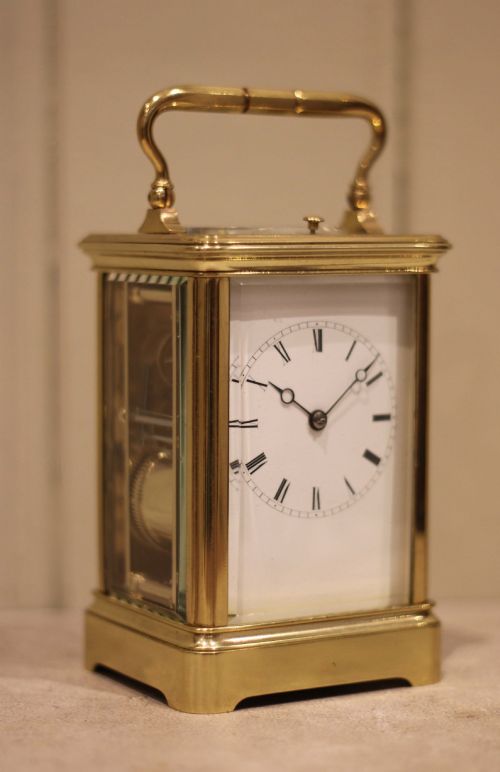
A french repeater travel clock brings precision timekeeping and mechanical complexity into a portable brass housing. When you search this phrase, you find portable timepieces spanning the nineteenth and early twentieth centuries, mostly originating from French workshops. The form centres on a glazed brass case that protects the movement while displaying the dial.
Most examples date from the Victorian period through the late nineteenth century, appearing in styles designated as French nineteenth century or traditional French. These clocks include carriage clock forms equipped with a repeating mechanism operated by a button or pendant. The typical version encountered combines a brass or gilt brass frame with bevelled glass panels surrounding a white enamel dial.
Materials and construction
Makers constructed these timepieces primarily using brass and gilt brass for the robust frames and cases, housing complex steel gear trains within. Bevelled glass panels fit tightly into the metal framework to enclose the movement while allowing visibility from all sides. White enamel dials display roman or arabic numerals, occasionally complemented by painted floral motifs or engraved brass masks.
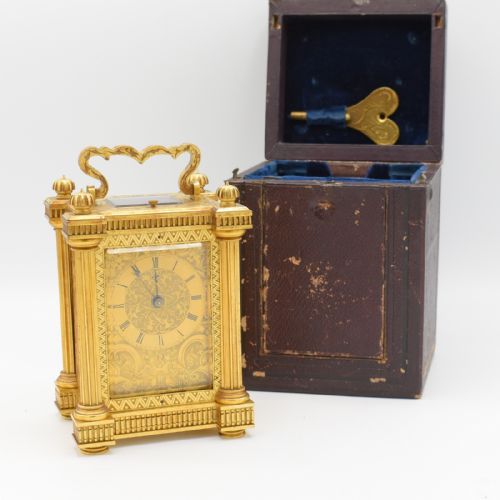
The mechanical movements rely on brass plates and steel arbors, often incorporating platforms for the escapement. Gilt finishes and polished steel components protect against tarnishing while providing a bright appearance. Leather travel cases frequently accompanied these clocks to protect the exterior during journeys.
French Repeater Travel Clock Retail Price Guide 2026
Typical asking prices for french repeater travel clock among the pieces listed under this phrase on Sellingantiques today, from the lower quarter to the upper quarter. They describe what is for sale here now, not the wider market.
Some travel clocks feature race horse interest engraved on the case, linking timekeeping directly to nineteenth-century sporting fixtures.
Assessing quality and craftsmanship
Quality in a french repeater travel clock lies in the complexity of the movement and the crispness of the case execution. Advanced complications such as grande sonnerie striking, alarm functions, and five-minute repeating distinguish finer examples from standard striking models. The presence of signed movements from noted makers indicates superior workshop standards.
Case finishing separates standard production from exceptional work, particularly where heavy gilding, detailed engraving, or porcelain enamel panels appear. Gorge cases and oval forms require precise metal shaping and heavy gauge brass. Original boxes and winding keys add to the integrity of a surviving piece.
Brunelot·L Epee·J F Bautte Et Cie·Bourdin Paris·Henry Jacot·Richard And Co·Alfred Drocourt
The French Repeater Travel Clock Glossary
- Repeater
- A mechanism that sounds the last elapsed hour and quarters when a button or pendant is pressed. This complication allowed owners to tell the time in the dark.
- Gorge case
- A distinct rectangular brass case style with stepped mouldings to the top and bottom frame. This form is frequently associated with high-quality French makers.
- Grande sonnerie
- A striking train that sounds the hours and quarters automatically on the passage of time, alongside the repeater function. It represents a high order of clockmaking skill.
- Platform escapement
- The small horizontal sub-assembly holding the balance wheel and escapement mounted on the upper plate. This innovation enabled portable clocks to keep accurate time while moving.
- Ting tang
- A two-hammer striking system that sounds two different notes for the quarters. It creates a distinct chime separate from standard bell or gong strikes.
French Repeater Travel Clock: Frequently Asked Questions
How does the repeater function work?
Pressing the button on top of the case activates a gear train that releases hammers to strike gongs or bells. The mechanism counts out the hours and quarters based on the current position of the time train.
This system required precise assembly to ensure the striking sequence matched the exact time shown on the dial.
What is a gorge case?
A gorge case is a specific architectural housing style featuring concave mouldings beneath a stepped top handle. It provides a heavy, robust frame for the glass panels.
This design appears frequently on higher-grade nineteenth-century travel clocks.
Did these clocks travel in carriages?
Yes, owners placed them in padded leather outer cases to withstand the vibrations of nineteenth-century transport. The sturdy brass construction and platform escapement allowed them to maintain accuracy during movement.
They served travellers who required portable timekeeping away from stationary mantel clocks.
How do I wind the movement?
A dedicated key fits square arbors accessible through the back door of the case to tension the springs for time and striking. Care must be taken not to overwind the mainsprings.
Many surviving pieces retain their matching original keys inside their fitted boxes.