


French Religious Medallion
When you search for a french religious medallion, you are looking at miniature devotional art cast in precious metals to be worn close to the heart.
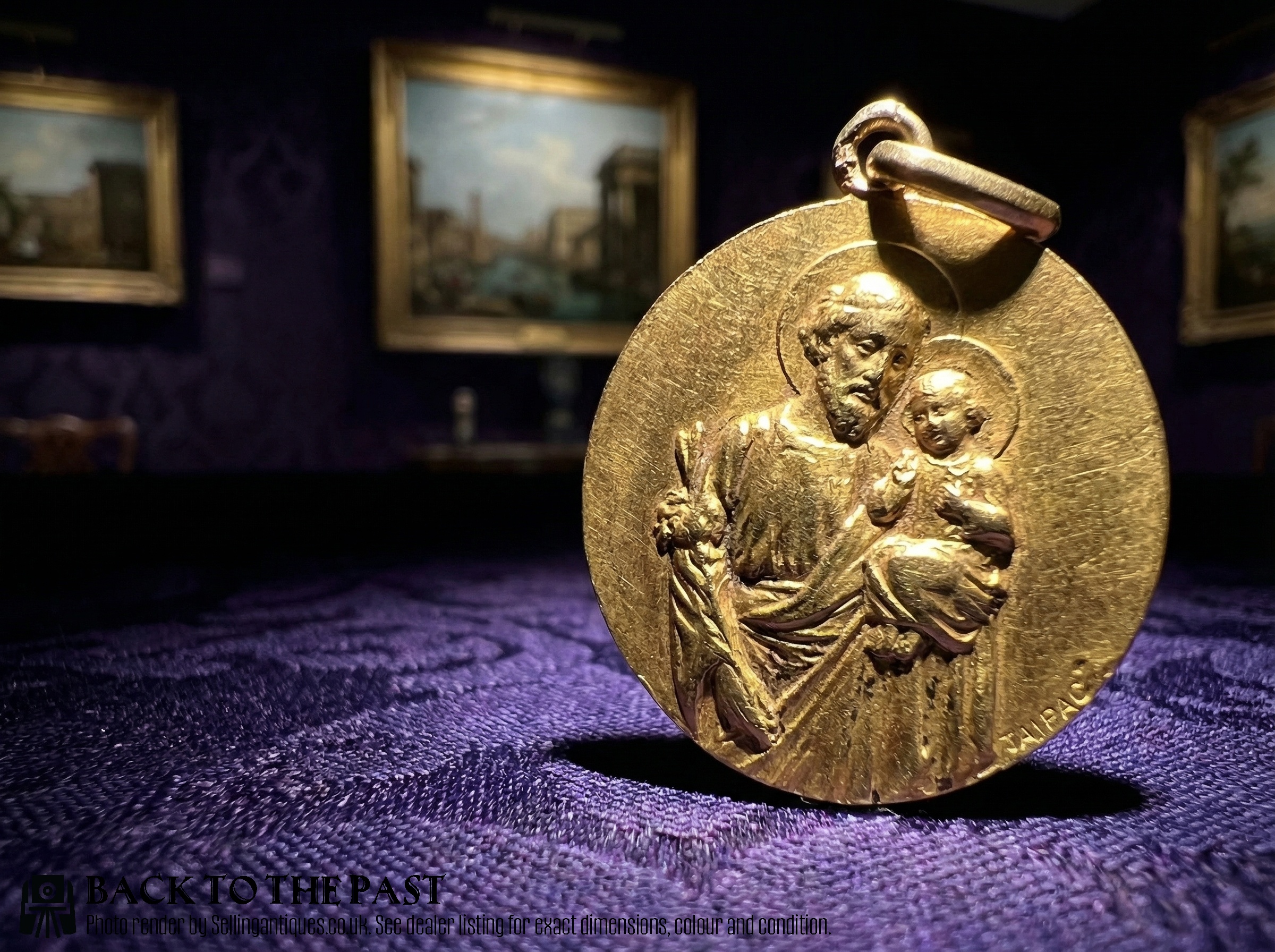
French Religious Medallion
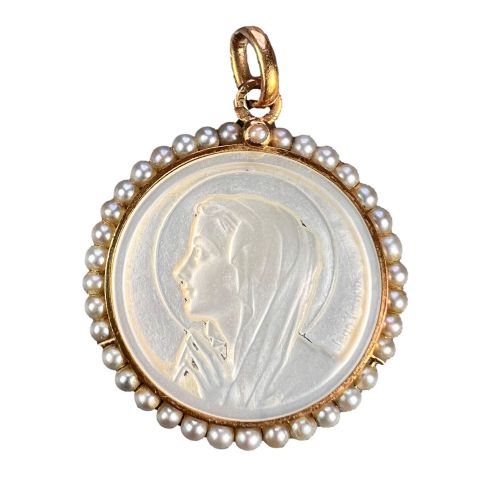
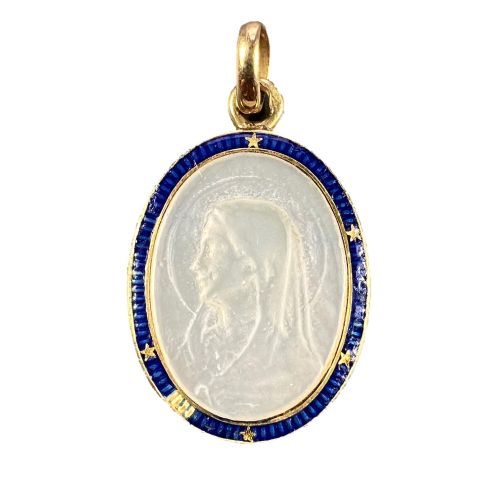
A french religious medallion is a small devotional pendant, most commonly taking the form of a circular or oval medal dedicated to the Virgin Mary, the Madonna and Child, or various saints. These pieces originate primarily from the late nineteenth century and the early decades of the twentieth century, reflecting deep currents of personal faith and fine metalworking traditions.
The version you are most likely to meet on this page is an eighteen-carat yellow gold pendant from around nineteen ten, often cast with raised figures and delicate inscriptions. They frequently appear alongside related charms and small devotional plaques intended for daily wear on a chain.
Beyond standard devotional subjects, the selection includes pieces celebrating specific figures such as Saint Christopher, Saint Joseph, or Saint John the Baptist. These items span stylistic shifts from ornate floral Art Nouveau designs to geometric Art Deco compositions.
Materials and Technique
The foundation of these pieces is eighteen-carat yellow, rose, or white gold, providing a durable yet warm metal base for detailed sculptural work. Goldsmiths struck or cast the medals to achieve sharp relief on the central figures, ensuring the tiny facial expressions and drapery folds remained distinct.
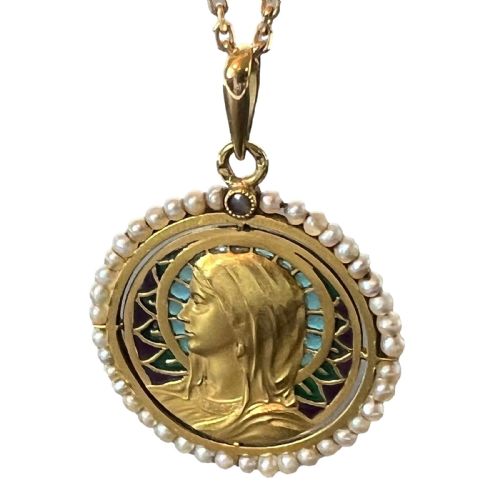
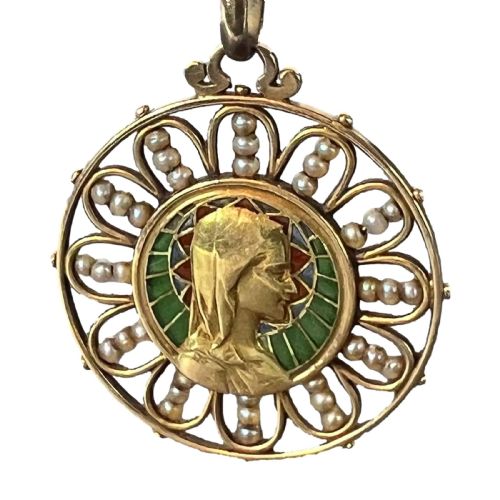
Colour and texture enter through the application of enamel, including translucent plique-à-jour work that catches the light like stained glass, alongside lustrous mother of pearl backgrounds. Artisans frequently enhanced the surfaces with seed pearls, small diamonds, and precise hand engraving to frame the sacred imagery.
Listings feature eighteen-carat yellow, rose, and white gold pieces accented with enamel and mother of pearl.
Standards of Execution
The integration of decorative techniques like enamel and plique-à-jour further separates standard production from exceptional examples. A cleanly fired enamel field and secure stone settings demonstrate a higher level of workshop discipline.
Emile Monier·Paul Brandt·Mazzoni·Pageli Perriat·Guilbert·Vernon·Emile Dropsy·Sellier·Rasumny·Ovide Yencesse·Tairac·Pageri Perroud·Monier Perriat
The French Religious Medallion Glossary
- Medallion
- A large metal pendant, typically flat or slightly convex, bearing a stamped or engraved design on one or both sides. These objects were often issued to commemorate sacraments, feast days, or personal devotions.
- Plique-à-jour
- An enamelling technique where the enamel is applied within a wire framework without a backing, allowing light to shine through the transparent or translucent colour. It resembles miniature stained glass.
- Pendant
- An ornament that hangs from a necklace, chain, or cord. In devotional jewellery, it serves to keep sacred imagery close to the wearer.
- Seed pearl
- A very small, naturally occurring pearl, often fractionally drilled and used to accent borders or floral motifs on jewellery from the nineteenth and early twentieth centuries.
- Relief
- Sculptural technique where the sculpted elements remain attached to a solid background of the same material. High relief projects boldly from the plane, creating strong shadows and depth.
French Religious Medallion: Frequently Asked Questions
What are french religious medallions made of?
These pieces are predominantly forged from eighteen-carat yellow gold, occasionally utilising rose or white gold variations.
They are frequently enhanced with decorative elements such as enamel, mother of pearl, seed pearls, and small diamonds.
Who made these religious medals?
Many medals were produced by skilled French ateliers and prominent individual medallists who signed their miniature works on the field.
Names such as Emile Dropsy and Paul Brandt frequently appear on the metal surface alongside traditional religious iconography.
How do I wear an antique medallion?
These pieces are traditionally suspended from a fine gold chain to be worn as a pendant close to the chest.
Their compact size also allows them to be added to charm bracelets or worn alongside other devotional pendants.
How can I tell the period of a medal?
Stylistic shifts offer clear clues, moving from flowing floral Art Nouveau motifs of the late nineteenth century to geometric lines of the Art Deco era.
Official hallmarks stamped directly onto the gold surface also help identify the French origin and approximate manufacturing period.