


French Religious Jewellery Charm
These pieces of french religious jewellery charm combine devotional portraiture with precious metalwork, offering wearable expressions of faith.
French Religious Jewellery Charm
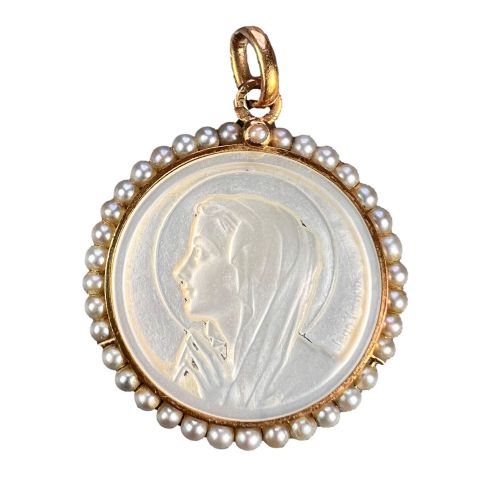
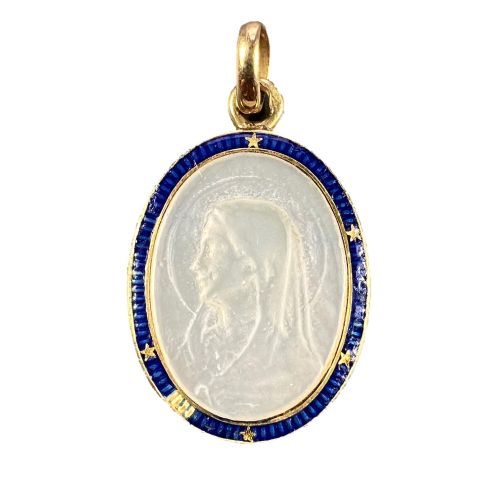
A french religious jewellery charm typically takes the form of a small pendant or medal designed to be worn on a chain or attached to a bracelet. These items depict sacred figures such as the Virgin Mary, Jesus Christ, and various saints, reflecting Catholic devotion in France during the late nineteenth and early twentieth centuries.
Most examples found in this collection date from the 1890s through the 1930s, encompassing Art Nouveau, Art Deco, and traditional devotional styles. Buyers encounter pieces configured as round medals, crosses, and octagonal charms stamped or cast in gold.
The typology bridges personal jewellery and religious artefact, serving simultaneously as protective amulets, commemorative tokens for milestones like first communions, and expressions of artistic metalwork.
Materials and Techniques
Gold forms the primary substrate for these pieces, predominantly utilising 18-karat yellow, rose, and white gold to provide a durable and lustrous foundation. Metalsmiths combined stamping and casting techniques to render detailed relief portraits of religious figures against textured or polished grounds.
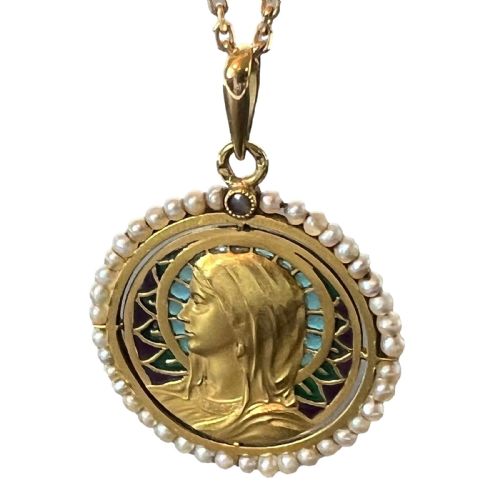
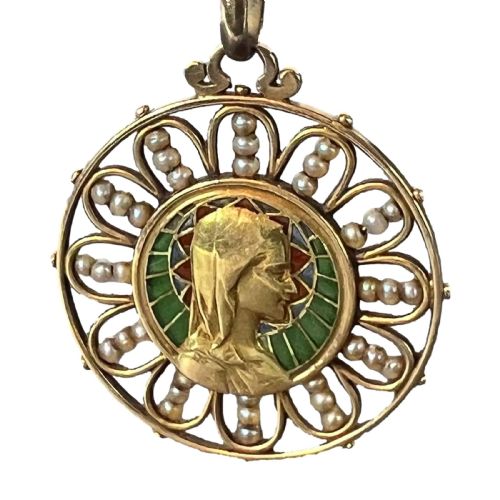
Enamel work frequently enhances the metallic designs, incorporating techniques like plique-a-jour to create translucent, stained-glass effects that catch the light. Mother-of-pearl and seed pearls also appear as backing plaques or decorative borders, adding organic iridescence to the golden frames.
Listings feature items primarily from the 1890s through the 1950s, executed in yellow, rose, and white gold.
Quality Variations
The distinction between standard pieces and finer examples rests on the crispness of the medallist's strike and the artistry of the surrounding ornamentation. Medals bearing the signatures of renowned French designers exhibit superior depth and anatomical precision in the depiction of figures such as the Madonna and Child.
Material complexity further differentiates the range, separating simple stamped gold discs from those incorporating translucent plique-a-jour enamel, hand-set seed pearls, or carved mother-of-pearl. The integration of delicate religious iconography executed with fine spatial balance distinguishes superior specimens.
Emile Monier·Paul Brandt·Mazzoni·Pageli Perriat·Emile Dropsy·Guilbert·Vernon·Sellier·Rasumny·Ovide Yencesse·Tairac
The French Religious Jewellery Charm Glossary
- Plique-a-jour
- An enamelling technique where enamel is applied in cells without a backing, allowing light to shine through the transparent material much like miniature stained glass. This method requires considerable skill to prevent the enamel from cracking during firing.
- Medal
- A flat, metal disc bearing a stamped or engraved design commemorating a person, event, or religious figure. In devotional contexts, these are often blessed and worn for spiritual protection.
- Seed Pearl
- Very small, natural or cultured pearls used decoratively in jewellery borders and accents. They add a soft, luminous texture that contrasts with polished gold.
- Art Nouveau
- An international style of art and architecture prevalent from the late nineteenth century to the First World War, characterised by organic lines and flowing, plant-inspired motifs. In religious items, it manifests as sinuous frames surrounding sacred portraits.
French Religious Jewellery Charm: Frequently Asked Questions
What do these medals depict?
These pieces primarily show Christian iconography, featuring the Virgin Mary in various traditional titles such as the Madonna and Child or Notre Dame of Lourdes. Other common subjects include Jesus Christ, the Sacred Heart, and figures like Saint John the Baptist and Saint Christopher.
Artists rendered these subjects in high relief, often surrounded by decorative borders of gold work, enamel, or pearls. Each depiction served a specific devotional purpose for the original wearer.
How are these charms worn?
Historically, owners wore these items suspended from necklaces, chatelaines, or attached to charm bracelets alongside other personal trinkets. The inclusion of a sturdy suspension loop ensures they hang securely from various types of chains.
Modern collectors continue to wear them as pendants on fine gold chains or incorporate them into contemporary charm bracelet arrangements. Their modest scale makes them suitable for daily wear.
How do I identify the period?
Dating relies heavily on stylistic markers, such as the flowing, organic lines characteristic of Art Nouveau pieces from the turn of the twentieth century. Geometric patterns and stylised motifs generally point towards the Art Deco period of the 1920s and 1930s.
Additionally, hallmarks stamped onto the gold components provide official French assay marks that confirm the metallic purity and origin. Maker signatures stamped into the metal also help anchor pieces to specific active decades of the ateliers.
Were these items worn daily?
Devotional medals and charms served as constant personal companions for their owners, functioning as physical expressions of faith and protective talismans. People wore them through daily activities, which accounts for the gentle wear found on many surviving examples.
Despite this regular use, the durability of 18-karat gold allowed intricate details to survive across generations. Today, they transition easily from historical artefacts into cherished pieces of personal adornment.