


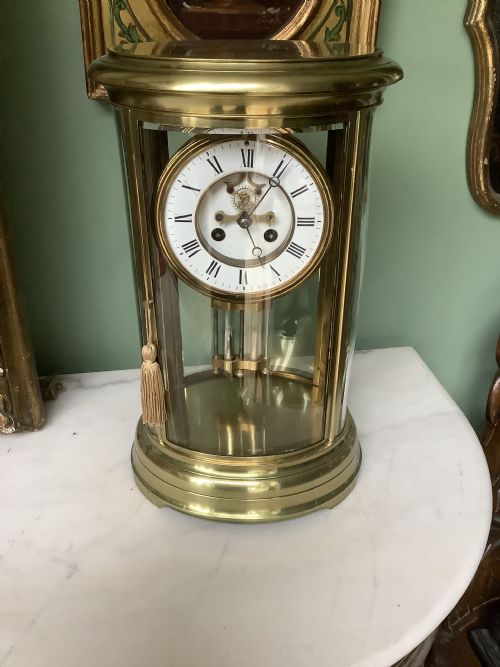


French Oval Brass Clock
These French oval brass clock pieces bring heavy glass and polished metal together on the mantel, offering the mechanical rhythm of nineteenth century timekeeping.
French Oval Brass Clock
When you search for a french oval brass clock, you find carriage clocks and four glass mantel clocks shaped with curved sides and housed in heavy brass frames. These pieces originate from the nineteenth century and early twentieth century, spanning Victorian, Edwardian, and Belle Epoque periods.
The versions you meet most often on this page take the form of carriage clocks with loop handles, or four glass mantel clocks that reveal the movement within. Smaller miniature examples and large striking pieces appear alongside crystal regulators and cloisonne enamel designs.
Materials and construction
Maker workshops built these bodies primarily from solid brass and gilt brass, often enclosing the mechanism behind bevelled glass panes. Enamel dials provide the face, sometimes decorated with additional details such as diamontes.
Makers integrated specialised techniques like cloisonne enamel into the brass framework, while leather cases protected the portable carriage clocks during travel. The mechanical movements inside rely on brass gears and escapements fitted into structured metal plates.
Miniature models prove that past owners wanted to check the hour while travelling light.
Quality differences
The distinction between standard production and top tier pieces lies in the crispness of the brass casting and the complexity of the movement. Heavier frames, sophisticated striking mechanisms, and repeater functions elevate a piece above simpler timepieces.
Artisanal additions such as hand-applied cloisonne enamel work or delicate dial painting separate ordinary examples from exceptional ones. The inclusion of the original fitted leather travel case also alters the standing of a carriage clock.
Drocourt·AD Mougin·Richard and Co Paris
The French Oval Brass Clock Glossary
- Carriage clock
- A small, portable spring-driven timepiece designed for travel during the nineteenth century. These clocks typically feature a rectangular or oval brass case with a handle on top.
- Four glass clock
- A mantel clock featuring glass panels on the front, back, and both sides to display the interior movement. They often house striking mechanisms and intricate escapements.
- Crystal regulator
- A mantel clock constructed with heavy bevelled glass panels held within a brass or gilt frame. The design allows light to pass through the entire body of the clock.
- Cloisonne
- An ancient decorative technique where metal wire is soldered to the brass surface to create compartments filled with coloured enamel paste. This method appears on select Victorian decorative panels.
- Repeater
- A mechanical complication in a clock that chimes the hours and quarters upon pressing a button on the case. This feature allowed owners to check the time in the dark.
French Oval Brass Clock: Frequently Asked Questions
How do I wind a carriage clock?
Wind the movement using a matching key inserted into the arbours on the backplate. Turn gently until resistance indicates the mainspring is fully tensioned.
Take care not to over-wind the mechanism, as this can strain the internal springs and disrupt the timekeeping accuracy.
What is a repeater mechanism?
A repeater mechanism is a complex addition that sounds the most recent hour and quarter-hour when you press a plunger on the case. It allowed travellers to hear the time in the dark without striking a light.
Clocks with this function require precise adjustment by a specialist horologist to maintain the correct chime sequence.
How are four glass clocks cleaned?
Dust the exterior brass and glass panels regularly with a soft, dry cloth to prevent film buildup. Avoid applying chemical polishes directly onto the metal near the enamel dial or glass edges.
Internal cleaning and oiling of the brass gear train should be left to a professional clockmaker every few years.
Why do some clocks have leather cases?
Portable carriage clocks originally came with fitted leather travelling cases to protect the brass and glass housing during journeys. These outer cases shielded the delicate escapement from dust and physical impact.
Surviving leather cases add context to the daily use and portability of nineteenth century timepieces.