



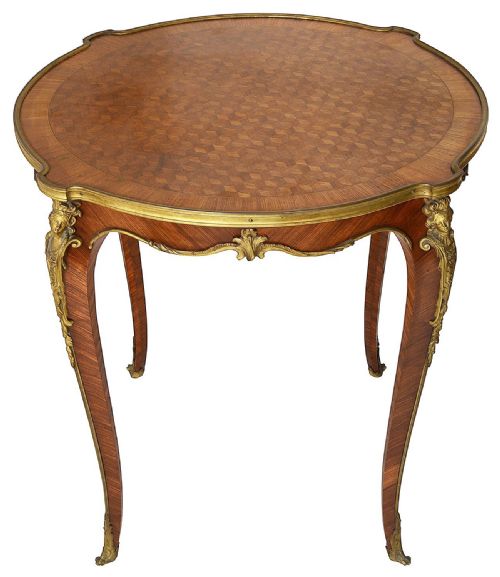

French Marquetry Wine Table
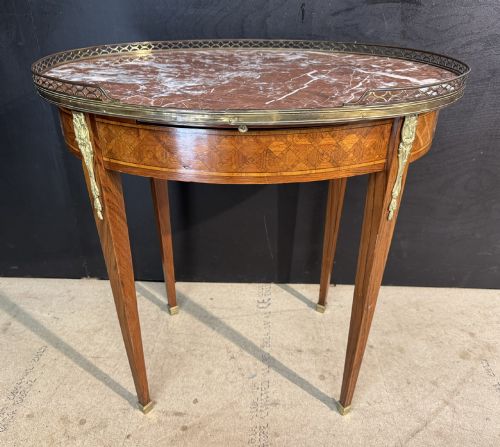
These french marquetry wine table pieces combine decorative timber veneers with practical surfaces, offering a refined way to serve drinks or display objects.
French Marquetry Wine Table
A french marquetry wine table brings together continental cabinet-making traditions and compact domestic furniture, often appearing as occasional tables, side tables, or guéridons. These pieces frequently double as jardinieres or wine coolers, incorporating metal liners or trays suited for holding bottles and plants.
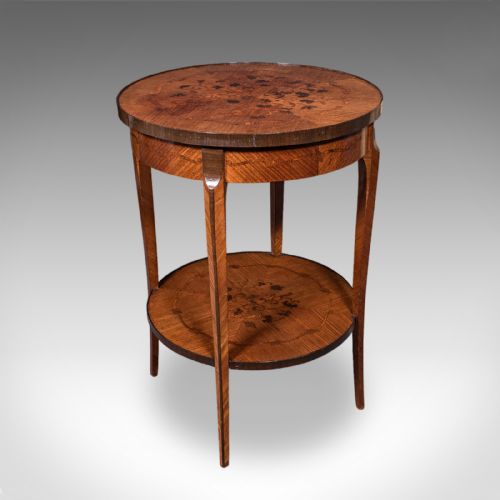
The selections available span the nineteenth century into the early twentieth century, taking shape through Victorian, Edwardian, and specific revival periods. Makers drew heavily upon Louis XV and Louis XVI repertoires, creating varied forms from small two-tier occasional tables to substantial centre tables.
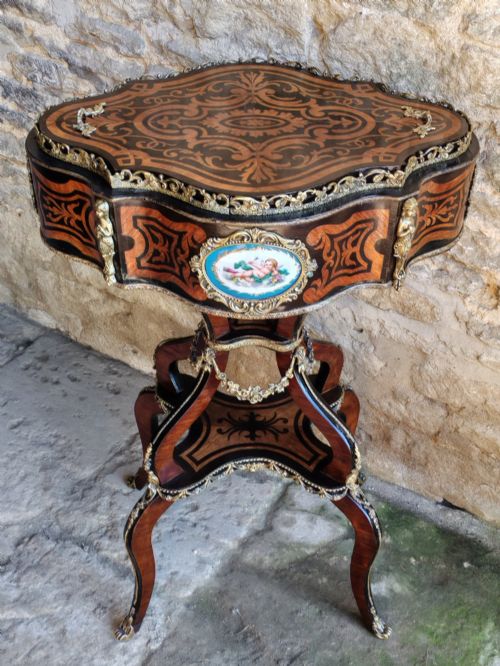
Buyers will encounter multiple stylistic interpretations, ranging from restrained neoclassical lines to more exuberant rococo revival curves. Walnut, mahogany, kingwood, and rosewood form the structural foundations, decorated with intricate wood patterns and contrasting lighter veneers.
How They Were Made
Craftsmen built these tables using robust carcases of walnut, mahogany, or satinwood, onto which they applied finely sliced veneers of kingwood and rosewood. Detailed marquetry and parquetry designs were assembled by hand, cutting contrasting wood species to form floral, geometric, or pictorial motifs.
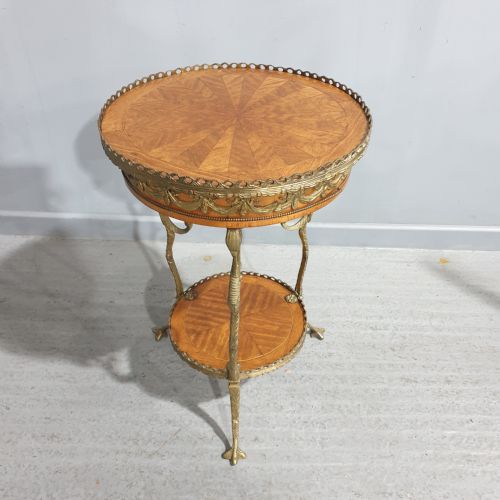
Metal enrichment played a vital structural and decorative role, with workshops mounting cast ormolu and brass borders, feet, and gallery rails around the tabletops. These metallic elements protected vulnerable edges and accented the curved contours typical of French revival designs.
What Varies in Quality
Quality rests significantly on the precision of the veneer work and the depth of the timber selection, where tightly figured burr walnut or rich kingwood elevates a piece. Superior examples display seamless joins within the marquetry panels, showing no lifting or shrinkage in the intricate wood inlays.
The standard of the metal mounts distinguishes finer tables from simpler workshop output, as crisp, chased ormolu details indicate superior handling compared to plain or heavily polished brass. Structural integrity in the legs and aprons, alongside well-integrated liner trays for cooler variants, marks the distinction between standard production and exceptional execution.
A Hugnet Paris·Linke
The French Marquetry Wine Table Glossary
- Marquetry
- Decorative veneer work arranged in pictorial or geometric patterns across a surface. Artisans cut various coloured woods together to create complex imagery.
- Guéridon
- A small circular French table supported by a central column or slender legs. This form gained immense popularity during the neoclassical and revival periods.
- Ormolu
- Gilded bronze used for decorative mounts and furniture trim. The technique involves applying a gold-mercury amalgam to cast bronze.
- Parquetry
- Geometric wood inlay forming repeating patterns such as cubes, bricks, or chevrons. It differs from marquetry by sticking strictly to geometric symmetry.
French Marquetry Wine Table: Frequently Asked Questions
What is a french marquetry wine table?
These pieces are decorative French occasional tables designed with inlaid wood veneers, frequently adapted to function as wine coolers or plant stands.
They combine the utility of a small serving surface with elaborate artistic cabinet-making traditions.
How were these tables originally used?
Wealthy households utilised them in reception rooms for serving drinks, holding bottles, or displaying floral arrangements.
The metal liners found in many examples allowed them to contain ice or water without damaging the surrounding timber.
How do I care for marquetry furniture?
Keep these tables away from direct sunlight and strong heat sources to prevent the delicate wood veneers from drying out and lifting.
Apply a traditional beeswax polish occasionally to nourish the timber and maintain a soft sheen.
How can I tell different periods apart?
Earlier nineteenth-century pieces often display heavier neoclassical proportions and rich mahogany or walnut foundations, while Edwardian and later revival examples lean towards lighter satinwood and kingwood.
Examining the style of the cast ormolu mounts and the complexity of the marquetry helps narrow down the decade of manufacture.