


French Marquetry Card Table
A French marquetry card table brings together intricate wood inlays and gilded mounts for a dual-purpose piece designed for evening gatherings.
French Marquetry Card Table
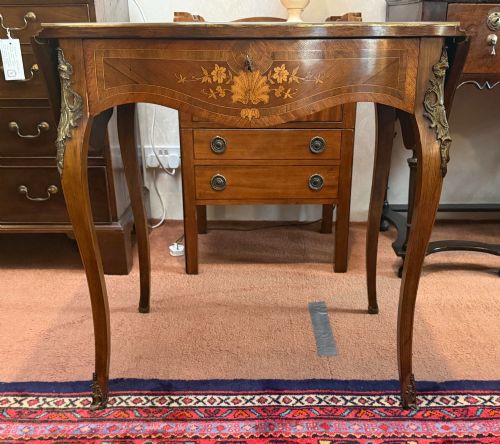
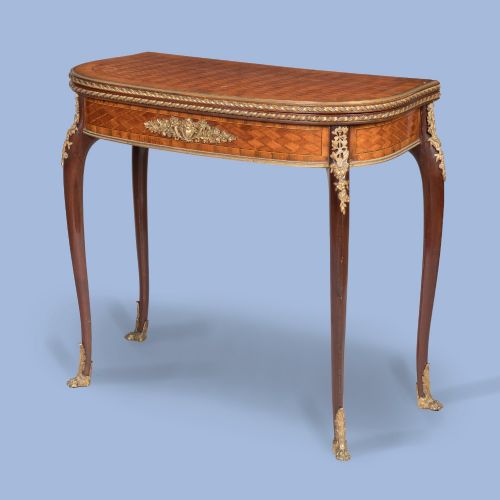
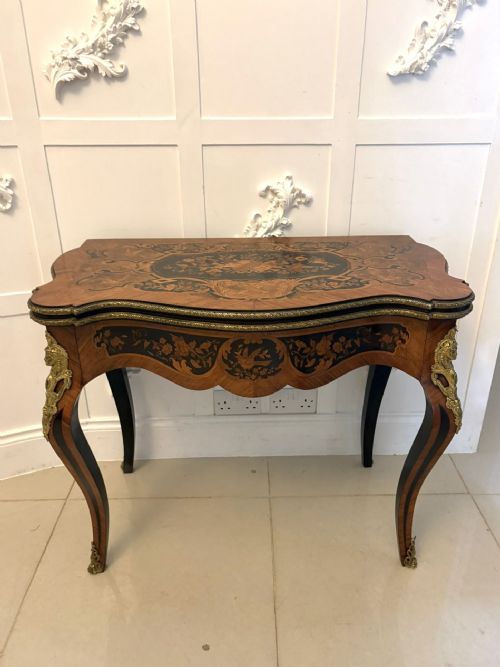
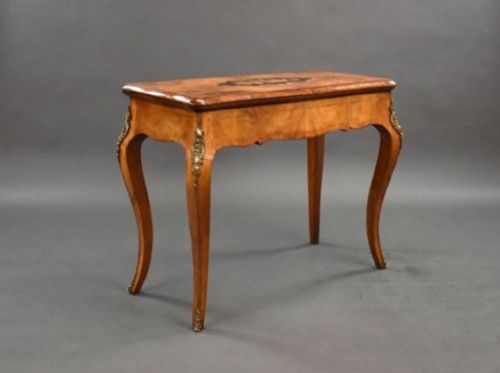
A french marquetry card table functions as a console or side table by day and opens to reveal a baize-lined surface for games. The form spans several decades of the nineteenth century, including the Victorian era, drawing heavily on Continental aesthetics.
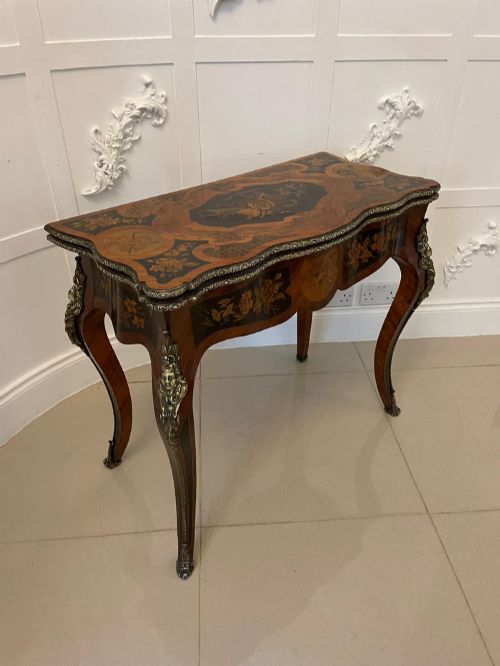
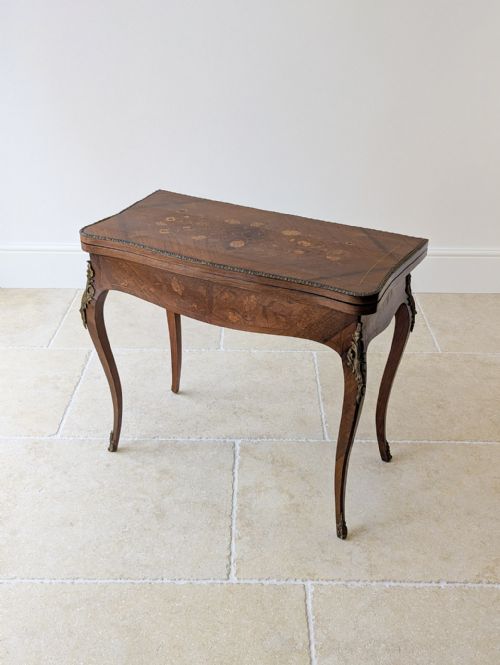
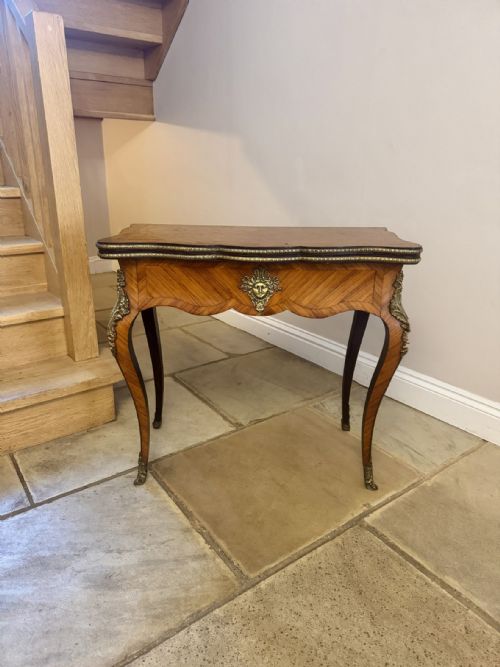
Most examples meet on this page follow Louis XV or Louis XVI revival styles, characterised by serpentine lines or straighter neoclassical proportions. Makers employed kingwood, walnut, and rosewood as grounds for elaborate floral or geometric wood inlays.
Makers frequently incorporated folding mechanisms that swivel or fold over to double the surface area. These tables often feature ormolu or gilt bronze mounts framing the marquetry panels.
How they were made
Cabinetmakers constructed these tables using a carcase of secondary wood veneered in kingwood, walnut, or mahogany. Marquetry designs were hand-cut from contrasting timbers, sometimes including exotic woods and mother-of-pearl detail, then pressed into the surface.
Ormolu mounts, cast in brass or bronze and subsequently gilded, were applied to edges, corners, and cabriole legs to highlight the structural lines. Brass inlay and parquetry geometric patterns appear alongside floral motifs to demonstrate technical precision.
Several tables manage to hide entire backgammon boards and card surfaces beneath unassuming floral veneer tops.
What varies in quality
The refinement of the marquetry cutting and the choice of timbers set apart different tiers of execution. Dense figure in the burr walnut or kingwood and crispness in the floral veneer composition indicate greater workshop skill.
Castings of the ormolu mounts show varying levels of chased detail and weight, with superior pieces displaying sharp relief and secure attachment. The smoothness of the pivoting or folding mechanism reflects the original maker's joinery standards.
François Linke·Joseph-Emmanuel Zwiener·Maison Millet·Edwards & Roberts·Henry Dasson
The French Marquetry Card Table Glossary
- Marquetry
- Decorative veneer work arranged in pictorial or floral patterns using various coloured woods. This technique requires cutting multiple veneer sheets simultaneously to fit pieces together precisely.
- Ormolu
- Gilded bronze or brass mounts applied to furniture edges and legs. The finish involves mercury gilding on older pieces or electroplating on later Victorian examples.
- Parquetry
- Geometric wood inlay forming repeating patterns such as cubes or chequers. This technique differs from floral marquetry by relying on straight lines and angles.
- Kingwood
- A dense, richly figured Brazilian timber utilised heavily in nineteenth-century French cabinetmaking. Its contrasting dark and golden brown stripes suit detailed veneering.
- Boulle
- Marquetry combining tortoiseshell and brass, named after the French cabinetmaker André-Charles Boulle. Pieces incorporating this method appear within revival styles.
French Marquetry Card Table: Frequently Asked Questions
How do I open the table?
Most French marquetry card tables feature a top that either folds over on hinges or swivels around to reveal a hidden compartment beneath. The pivoting mechanism usually requires a gentle lift and turn before the leaves rest flat.
Care should be taken not to force older wooden hinges or warped tops. Checking the alignment of the dowels and pivots ensures the surface stays level during card games.
What were these tables used for?
These pieces served as ornamental console or side tables against a drawing-room wall when not in use. During evening receptions, hosts opened them for card games, chess, or backgammon.
The baize or felt lining protected the cards and reduced noise during play. Some multi-functional variants also incorporated writing surfaces or hidden wells for counters.
How do I tell Louis XV from Louis XVI?
Louis XV style pieces rely on asymmetry, curves, and cabriole legs ending in sabots. The overall silhouette appears flowing and organic, dominated by floral marquetry and sweeping ormolu mounts.
LouisXVI style returns to straight lines, symmetry, and neoclassical proportions. Tapered fluted legs and geometric parquetry patterns distinguish this later revival aesthetic.
Where should I place it at home?
A French marquetry card table suits a living room, hallway, or study as a statement console piece. Keeping the folded top against a wall protects the hinges while displaying the detailed veneer work.
Direct sunlight should be avoided to prevent fading in sensitive timbers like kingwood and rosewood. Maintaining stable room humidity preserves both the veneer and the underlying carcase.