






French Mantle Clock Urns
French mantle clock urns bring nineteenth-century domestic grandeur into a room through monumental bronze, marble and hand-painted porcelain forms.
French Mantle Clock Urns
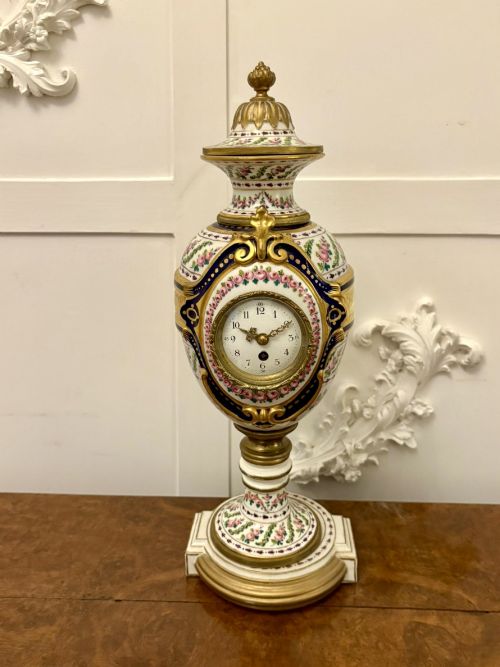
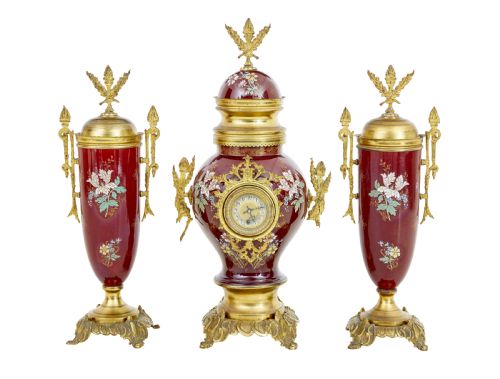
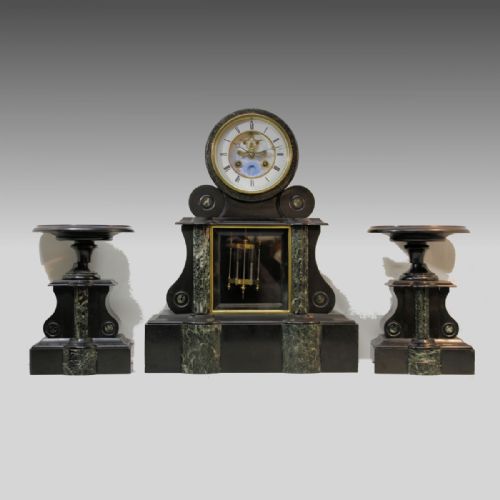
These french mantle clock urns combine central timepieces with matching side garnitures, forming symmetrical decorative sets designed for nineteenth-century mantelpieces. The evidence centres on Victorian and nineteenth-century examples spanning from eighteen hundred through to nineteen hundred.
Buyers encounter distinct configurations, from single urn-shaped porcelain and marble timepieces to complete three-piece garnet sets including flanking ornaments. Styles draw heavily on Louis XVI Revival, Rococo Revival, Neoclassical and French Empire aesthetics.
Materials and construction
Foundry work relied on cast brass, ormolu and gilt bronze, often paired with contrasting bodies of Sienna marble, block marble, slate and alabaster. These metallic and mineral elements provided the substantial weight required for large mantel pieces.
Surface decoration frequently incorporated hand-painted porcelain, enamel dials and toleware, sometimes displaying elaborate eight-day striking movements and specialised complications such as penny moon phases.
The documented object types range from single mantel clocks to three-piece garniture sets featuring matching urns.
Assessing quality and execution
Superior examples distinguish themselves through the crispness of ormolu chasing and the depth of gilding applied to cast bronze mounts. Finer pieces integrate high-grade marble or finely potted Paris porcelain with carefully hand-painted details.
The sophistication of the internal movement dictates worth, particularly when paired with matching garniture urns that retain their original proportions and undamaged enamel dials.
Achille Brocot
The French Mantle Clock Urns Glossary
- Garniture
- A set of matching ornamental vases or urns designed to sit alongside a mantel clock for symmetrical display. They share materials and decorative motifs with the central timepiece.
- Ormolu
- Finely ground high-carat gold mercury-gilded onto a bronze base metal. It provides a rich, lasting metallic lustre characteristic of luxury nineteenth-century French work.
- Toleware
- Painted or lacquered sheet metal utensils and decorative objects. It offers vibrant colour and decorative surface detail.
- Alabaster
- A fine-grained, translucent stone utilised for carved sculptural clock cases and garniture sets. It yields a soft, milky appearance under light.
- Enamel dial
- A metal clock face coated in fused powdered glass and fired to create a glossy, white surface. Numerals are painted onto the hardened glaze.
French Mantle Clock Urns: Frequently Asked Questions
What is a french mantle clock urn set?
A french mantle clock urn set consists of a main clock flanked by matching decorative urns or vases. These three-piece ensembles were created to decorate nineteenth-century drawing rooms.
The matching side pieces balance the mantelpiece visually, echoing the materials and decorative motifs of the central clock case.
How do I date a french mantle clock?
Dating relies on stylistic clues such as Neoclassical or Rococo Revival motifs, alongside the materials employed, including ormolu, porcelain and marble. Nineteenth-century pieces often feature Victorian production traits.
Movement types and dial construction also help narrow the decade of manufacture, matching the recorded periods between eighteen hundred and nineteen hundred.
What materials are used in these clocks?
These pieces utilise cast bronze, ormolu, gilt brass, and gilt metal alongside natural stones like Sienna marble, slate, and alabaster. Hand-painted porcelain and enamel feature prominently on dials and urn bodies.
Combined use of metal mounts and stone bodies gives these garnitures their characteristic nineteenth-century weight and presence.
How do I maintain an eight day movement?
Eight-day striking movements require periodic winding using a correctly fitted key to tension the springs safely. Professional servicing ensures the brass gears and escapements remain free of dust and old oil.
Placing the clock on a stable, level mantelpiece prevents the pendulum from going out of beat during daily operation.