



French Mahogany Semainier
A French mahogany semainier is a slender weekly chest designed for the bedchamber, offering seven drawers for daily linens.
French Mahogany Semainier
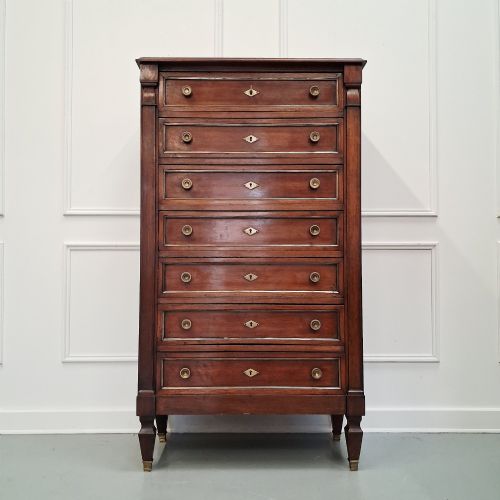
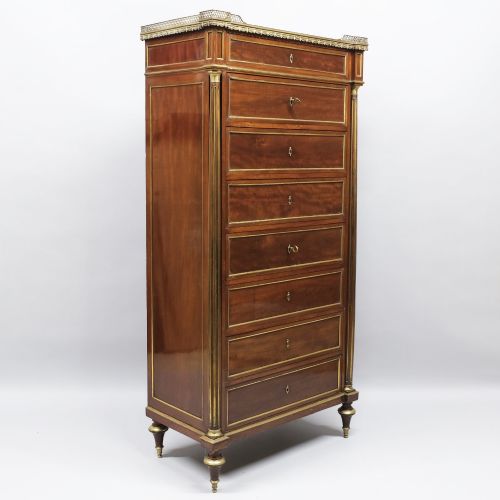
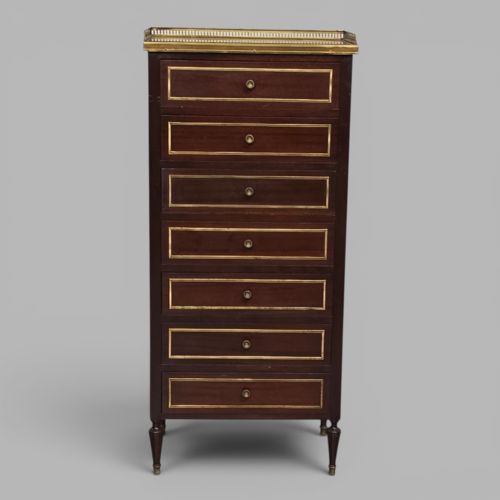
A French mahogany semainier provides a soaring vertical profile that maximises storage while occupying minimal floor space in a chamber. These tall chests typically present seven graduated drawers, corresponding traditionally to the days of the week.
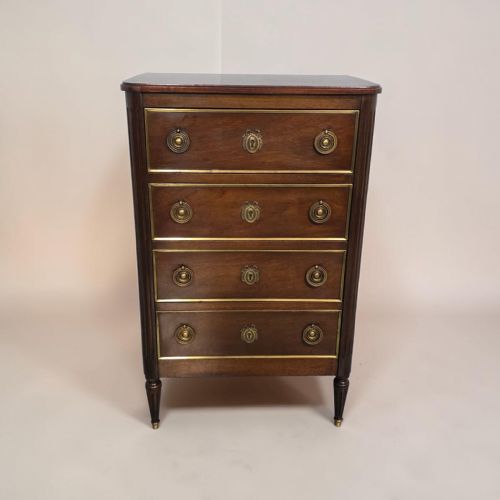
The pieces appearing on this page span from the early nineteenth century through to the interwar decades, taking forms such as the classical Empire model, the Wellington chest, and the pharmacy secretaire. Most examples showcase the rich figure of mahogany or flame mahogany, frequently crowned with a smooth slab of marble.
While many adopt strict architectural proportions with gilt bronze mounts, others lean towards softer revival styles with inlaid details. Buyers encounter everything from austere Regency designs to ornate Louis XV revival pieces.
Distinctions in quality
Quality rests significantly upon the choice of veneer and how symmetrically the flame mahogany grain is matched across the drawer fronts. Finer examples display continuous grain patterns that flow seamlessly from the top drawer down to the base.
The crispness of the cast brass or gilt bronze mounts dictates the grade of the piece, with sharper chiselling marking out superior workshops. Structural integrity also depends on the precision of the drawer dovetailing and the smoothness with which each tall drawer glides.
One remarkably industrious former owner clearly needed more than seven days, adapting a tall pharmacy cabinet into an extra-tall administrative filing hub.
The French Mahogany Semainier Glossary
- Semainier
- A tall, seven-drawer chest originating in France, traditionally utilised to hold a week's supply of undergarments and linens. The name derives from the French word for week.
- Ormolu
- Gilt bronze ornamentation applied to the corners, feet, and drawer mounts of case furniture. This technique involves gilding a mercury and bronze mixture.
- Flame mahogany
- A highly figured veneer harvested from the junction where major branches join the main trunk of the tree. It creates a distinctive, flickering flame pattern across the timber.
- Wellington chest
- A sturdy vertical chest featuring a hinged locking stile on one side that secures all drawers simultaneously. This form shares similarities with the tall proportions of the semainier.
- Cartonnier
- A specialised tall cabinet fitted with internal compartments or drawers designed to hold papers and documents. These pieces often match the height and elegance of the standard semainier.
French Mahogany Semainier: Frequently Asked Questions
How do I use a semainier today?
These tall chests serve wonderfully in modern bedrooms for organising socks, small garments, and accessories without claiming excessive floor space.
They also function well in hallways or studies to store paperwork, stationery, and daily household items.
Are all semainiers fitted with marble tops?
Many nineteenth-century examples feature heavy marble slabs designed to protect the timber surface from everyday use.
However, numerous wooden-topped variants exist, particularly those influenced by earlier classical or provincial designs.
What is the difference between a chest of drawers and a semainier?
A standard chest of drawers is broad and low, whereas a semainier is exceptionally tall and narrow by design.
The semainier specifically incorporates seven drawers to satisfy its traditional weekly purpose.
How do I date a French mahogany semainier?
Dating relies upon examining the secondary timbers, the style of the brass mounts, and the construction methods used within the drawer interiors.
Early nineteenth-century pieces often display heavier Empire proportions, while later nineteenth-century and 1920s examples incorporate revival details.