
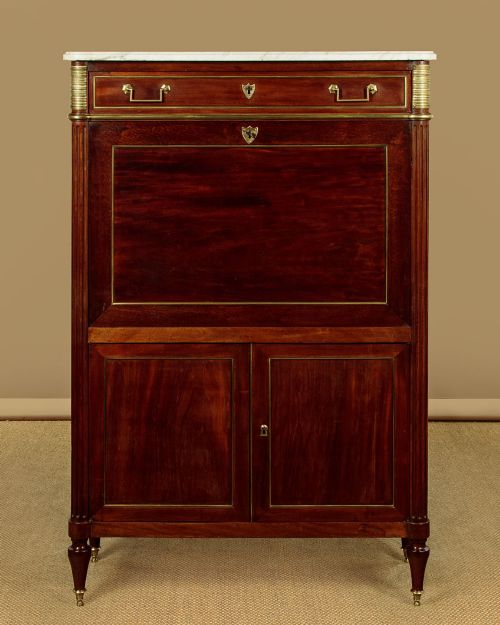
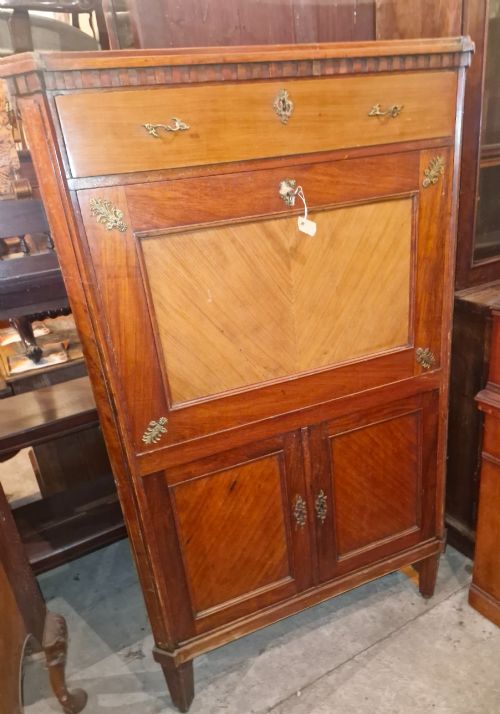
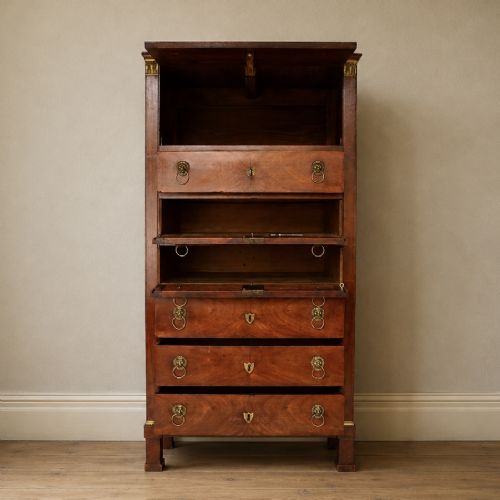
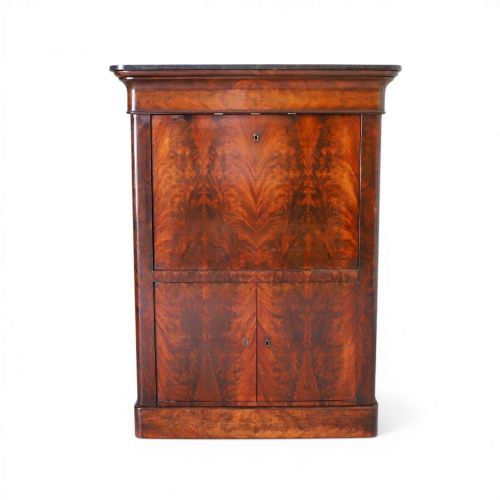



French Empire Secretaire Desk
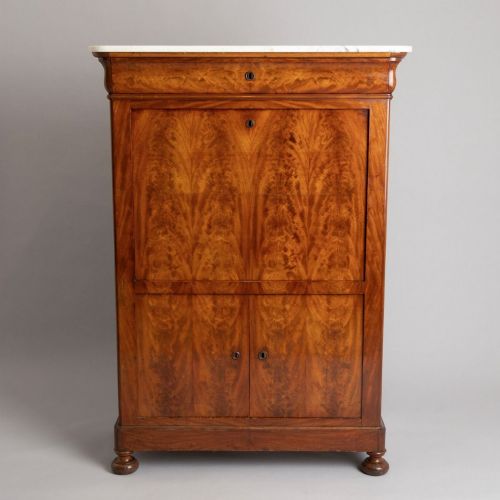
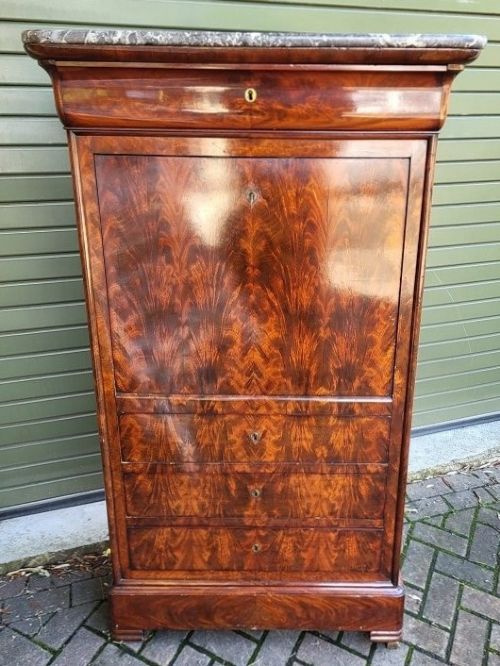
A french empire secretaire desk is a monumental writing cabinet with a fall front, offering hidden drawers and stately classical presence for a grand interior.
French Empire Secretaire Desk
When you search for a french empire secretaire desk, you encounter architectural writing furniture defined by upright proportions and concealed compartments. These pieces range from tall abattant cabinets with drop-down writing surfaces to cylinder desks and escritoires.
The pieces on this page span the nineteenth century, including specific dates around eighteen-thirty, eighteen-forty, eighteen-fifty, eighteen-sixty, and eighteen-eighty, alongside eighteenth-century examples and twentieth-century drink cabinet conversions. Styles stretch across French Empire, French Restoration, Louis Philippe, and French Neoclassical.
Forms include upright secretaire chests, pharmacy cabinets, and writing tables fitted with marble tops and mirror interiors. Mahogany and flame mahogany dominate, supported by walnut, rosewood, and oak structures.
Materials and construction
Cabinetmakers constructed these pieces using solid oak and pine carcases faced with rich veneers of mahogany, flame mahogany, walnut, and rosewood. The warm timber tones provide a smooth visual foundation for classical mounts.
Brass and ormolu mounts punctuate the timber surfaces, accentuating structural lines and key escutcheons. Heavy marble slabs form the writing or top surfaces on many examples, adding substantial weight and a cold contrasting texture.
Listings feature mahogany, flame mahogany, walnut, rosewood, oak, marble, brass, and ormolu across nineteenth-century periods.
Distinctions in quality
The distinction between standard examples and the finest pieces rests in the selection of timber veneers and the crispness of the brass or ormolu mounts. Flame mahogany grain patterning requires careful bookmatching across the drop front and drawer tiers.
Interior organisation dictates the upper tier of quality, where secret drawers, fitted pigeonholes, and original mirror panels demonstrate superior cabinetmaking skill. The integration of thick, unblemished marble tops also separates the better workshops from simpler regional production.
The French Empire Secretaire Desk Glossary
- Secretaire à abattant
- A tall upright cabinet featuring a hinged fall-front writing flap that conceals a fitted interior of small drawers and pigeonholes. This form keeps correspondence hidden when not in use.
- Ormolu
- Gilded bronze used for decorative mounts and accents on furniture. The technique creates a bright metallic contrast against dark mahogany surfaces.
- Escritoire
- A writing desk or cabinet designed for letters and paperwork. It typically incorporates a slanted or drop-down writing surface.
- Flame mahogany
- Timber cut from the fork of the mahogany tree, producing a distinctive flickering flame-like grain pattern. Cabinetmakers reserved this wood for the most prominent exterior surfaces.
- Cylinder desk
- A writing desk with a curved, rotating cylindrical shutter that closes over the desk top. This mechanism covers the writing slide and internal stationery compartments simultaneously.
French Empire Secretaire Desk: Frequently Asked Questions
How do I use the drop-down front?
The drop-down front, or abattant, releases via a key lock to form a horizontal writing surface supported by internal arms or the lower drawer frame.
Once lowered, it reveals a series of small drawers and pigeonholes designed for stationery and correspondence.
What is inside a secretaire cabinet?
The interior typically contains an arrangement of small wooden drawers, open pigeonholes, and sometimes hidden compartments known as secret drawers.
Certain variations include mirror-backed upper sections or fitted cocktail spaces from later twentieth-century adaptations.
How do I clean the marble top?
Clean the marble surface using a soft damp cloth with mild soapy water, avoiding acidic or abrasive household cleaners.
Dry the stone thoroughly to prevent water marks and protect the polished finish from etching.
How do I tell Empire from Louis Philippe style?
Empire pieces display strict classical symmetry, heavy ormolu mounts, and architectural proportions inspired by antiquity.
Louis Philippe furniture softens these rigid lines with simpler, more curved wooden profiles and minimal metal ornamentation.