



French Chiffonier Cupboard
These french chiffonier cupboard pieces combine timber and marble to store household items with elegance.
French Chiffonier Cupboard
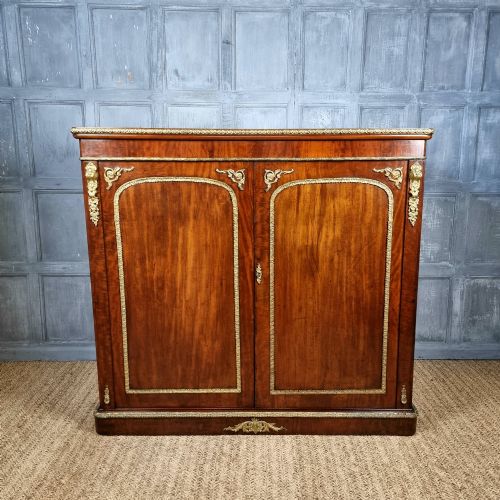
A french chiffonier cupboard serves as a functional storage cabinet often featuring a flat top surface and enclosed doors below. Buyers searching for a french chiffonier cupboard usually find sideboards, side cabinets, and sideboards and chiffoniers.
The selections span multiple eras, including the eighteenth century, nineteenth century, nineteen twenty, and nineteen thirty. Styles range across Victorian, French Empire, French Rococo, Louis XVI Revival, and French Chateau.
Most examples originate from nineteenth century production or later revivals, displaying forms such as side cabinets and sideboards and buffets. Walnut, mahogany, and rosewood dominate the surviving corpus of these pieces.
How they were made
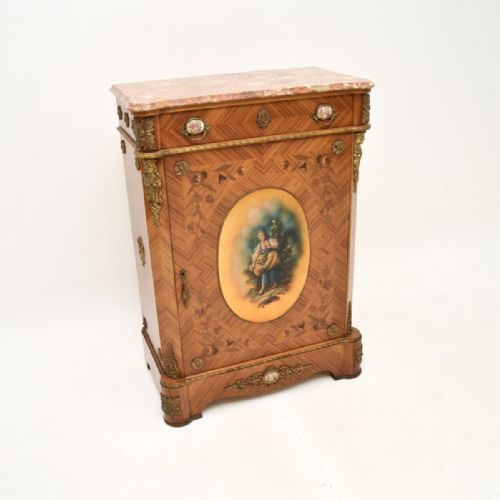
Cabinet makers utilised dense hardwoods such as mahogany, walnut, and rosewood for the primary carcase and structure. Marquetry and painted panels adorn specific surfaces alongside ebonised wood details.
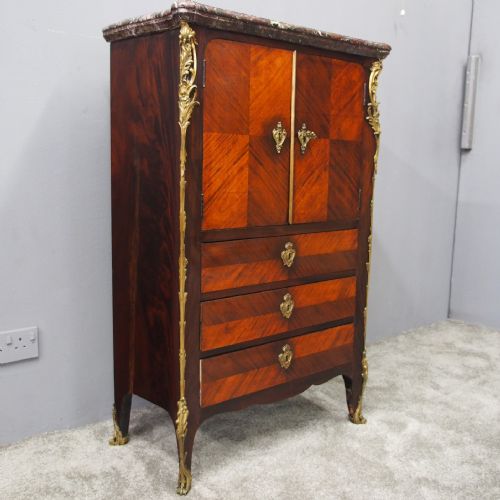
Marble tops feature on numerous examples, providing a durable and decorative upper surface. Brass and ormolu mounts punctuate the corners, keyholes, and feet of the more ornate cabinets.
Listings feature marble, brass, ormolu, kingwood, mahogany, walnut, ebonised wood, and rosewood across multiple centuries.
What varies in quality
The execution of floral marquetry and the selection of burr walnut veneers dictate the visual weight and refinement of a cabinet. Heavier metal mounts in brass and ormolu reflect greater expenditure during original production.
The integration of fitted marble slabs and the precision of the timber joinery separate standard utility pieces from exhibition grade works. Finer examples display meticulous grain matching across the doors and side panels.
Gillows·Leonard Boudin
The French Chiffonier Cupboard Glossary
- Chiffonier
- A low sideboard or cabinet featuring cupboards and sometimes a raised shelf back. It evolved during the nineteenth century to store tableware and linens.
- Marquetry
- Inwood patterned veneers applied to a carcase to create floral or geometric pictures. Craftsmen cut thin slices of contrasting timbers like kingwood and rosewood.
- Ormolu
- Gilt bronze mounts applied to furniture for decorative effect. The technique involves a mercury and gold amalgam fired onto brass or bronze.
- Ebonised
- Timber treated to resemble ebony through staining and polishing. Walnut and other woods undergo this process to achieve a dramatic black finish.
- Kingwood
- A dense Brazilian timber prized for its rich brown colour and dark figuring. It frequently appears in cabinet making from the eighteenth century onwards.
French Chiffonier Cupboard: Frequently Asked Questions
What is a french chiffonier cupboard?
A french chiffonier cupboard is a low storage cabinet combining timber construction with enclosed shelving. These units function as sideboards or side cabinets within domestic interiors.
Most surviving examples date from the nineteenth century or early twentieth century. They utilise woods such as mahogany, walnut, and rosewood.
Where do I put a french chiffonier cupboard?
These cabinets suit dining rooms, hallways, and living spaces where surface display and concealed storage are required. The flat top surface accommodates lamps, porcelain, or decorative objects.
Marble topped variants offer a durable surface that resists stains and wear. Their moderate height allows placement beneath windows or against hallway walls.
How do I clean marble top cabinets?
Marble surfaces require gentle wiping with a damp cloth and mild soap to preserve the polish. Acidic liquids can etch the stone and must be wiped away immediately.
Timber sections benefit from occasional dusting and wax application suited to hardwoods. Avoid placing these cabinets near direct heat sources to protect the veneer.