


French Chateau Chest Drawers
These French chateau chest drawers bring grand provincial utility to a bedroom, offering heavy timber construction and classical serpentine shapes.
French Chateau Chest Drawers
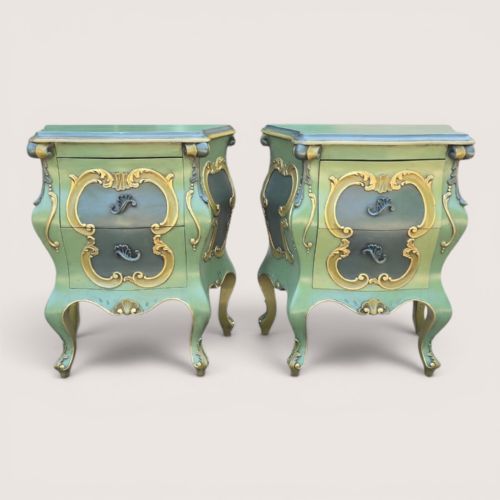
A French chateau chest drawers brings provincial grandeur into the bedroom, taking the form of commodes, bedside chests, and larger storage units. These pieces emerge across the eighteenth, nineteenth, and early twentieth centuries, reflecting enduring classical tastes from the regions of France and broader Continental Europe. Buyers encounter painted finishes, serpentine fronts, and substantial proportions designed for practical domestic use.
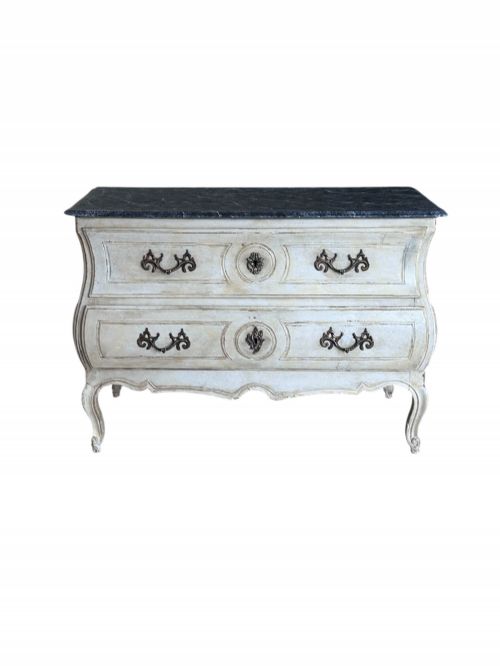
The selection ranges from eighteenth-century commodes in kingwood or painted oak to early twentieth-century bedside pairs and larger Louis XV style variations. Forms include bombe silhouettes and bow fronted designs that echo Italian Rococo and Louis XVI neoclassical aesthetics. Most examples rely on painted wood surfaces, often paired with contrasting marble tops and intricate brass or bronze hardware.
Materials and Construction
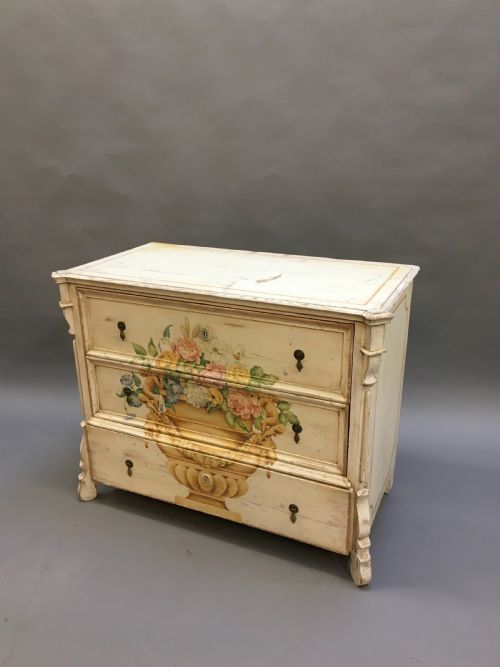
Cabinetmakers constructed these chests using solid timbers like oak and walnut, alongside decorative veneers such as kingwood arranged in parquetry patterns. Surfaces frequently received layered paint finishes to achieve the characteristic provincial aesthetic, sometimes complemented by hand-carved details on the wood framework.
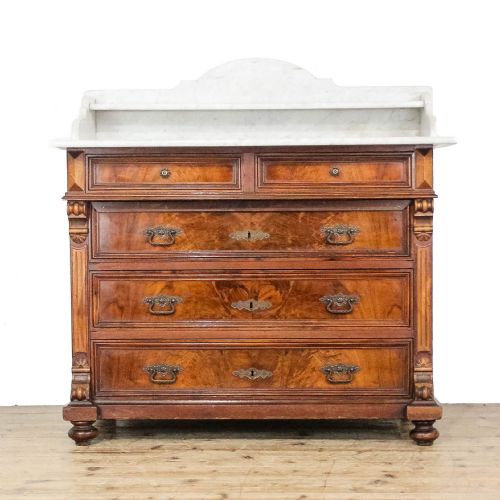
Heavy marble slabs form the tops of numerous pieces, providing durable working surfaces that sit atop the timber carcase. Metalwork components, including brass and ormolu handles, keyplates, and mounts, secure the drawer fronts and accentuate the curved contours of the commodes.
The listings span from the eighteenth century through the 1930s, featuring painted wood, marble, and kingwood across bedside chests and commodes.
Assessing Craftsmanship and Finish
Quality reveals itself in the structural integrity of the timber carcase and the precision of the drawer joints, which determine how smoothly the drawers operate within the frame. The application of the painted finish and the crispness of any carved detailing also separate standard utility furniture from finer workshop production.
The choice of secondary materials marks another distinction, particularly the thickness and figuring of marble tops and the weight and casting quality of brass or ormolu mounts. Finer examples maintain original hardware and undamaged parquetry, preserving the integrity of the piece across centuries of domestic use.
The French Chateau Chest Drawers Glossary
- Commode
- A low chest of drawers, often highly decorative, originating in France during the seventeenth century. These pieces typically feature multiple drawer tiers and substantial surface space.
- Bombe
- A descriptive term for furniture with an outward-curving or bulging front and sides. This swelling profile defines specific eighteenth and nineteenth-century Continental commodes.
- Serpentine
- A furniture front or edge shaped with a central concave curve flanked by two convex curves, creating a gentle undulating line. This contour appears frequently on better quality commodes.
- Parquetry
- A geometric mosaic of wood pieces used for decorative surfaces on furniture. Cabinetmakers arrange contrasting veneers to form patterns across the top and sides of the carcase.
- Ormolu
- Gilt bronze mounts applied to furniture for decorative effect. These cast metal elements accent the corners, legs, and drawer pulls of grander pieces.
French Chateau Chest Drawers: Frequently Asked Questions
How do I care for marble tops?
Clean marble surfaces using a soft cloth dampened with warm water and mild, pH-neutral soap. Avoid acidic cleaners, vinegar, or citrus products that etch the polished stone.
Pots and moisture should be kept off the surface by using coasters and mats. Periodic sealing helps protect the porous stone from stains.
Where should I place a commode?
These chests function well as bedroom storage for clothing and linens, or as bedside tables in larger sleeping quarters. Their decorative fronts also suit hallways and living rooms as focal points.
Ensure the placement accounts for the substantial depth and width of pieces like bombe commodes. Keep them away from direct heat sources to protect the historic timber and painted finishes.
Are painted finishes original?
Many pieces retain historic or period paint applications that show natural wear appropriate to their age. Later decorative repainting also occurs frequently on provincial furniture.
Examining the paint layers under magnification helps determine whether the finish matches the period of the wood carcase. Subtle craquelure and worn edges often indicate genuine age in painted surfaces.
What is the difference between a commode and a chest of drawers?
A commode specifically denotes a low, decorative French or Continental cabinet with drawers, typically dating from the eighteenth or nineteenth century. The term implies a higher level of ornamentation than standard utilitarian storage.
General chests of drawers encompass a broader range of utilitarian storage furniture from various origins and periods. Continental commodes often feature more pronounced curves and marble surfaces.