


French Catholic Pendant
A french catholic pendant offers a small devotional miniature in gold, enamel, or mother of pearl.
French Catholic Pendant
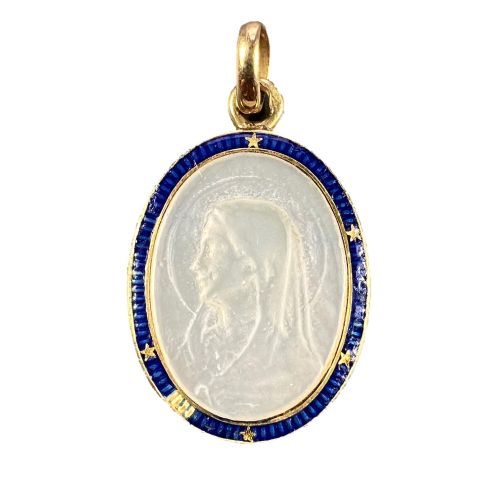
A french catholic pendant takes the form of a small devotional medal, charm, or cross worn as jewellery. These pieces depict subjects such as the Virgin Mary, the Madonna and Child, Saint Christopher, and the Sacred Heart. Most examples on this page date from the late nineteenth century through to the mid-twentieth century, spanning periods from eighteen-ninety to nineteen-fifty.
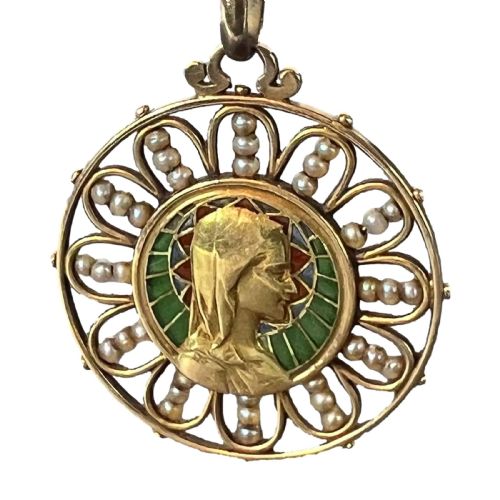
The format ranges from simple oval medallions to intricate charms with floral motifs and pierced borders. Many incorporate specific iconography like the Miraculous Medal or Notre Dame of Lourdes. Collectors encounter both yellow gold and rose gold settings, frequently paired with decorative elements.
Materials and Techniques
Goldsmiths constructed these pieces primarily in eighteen-carat yellow, rose, and white gold. This metalwork often frames central plaques carved from mother of pearl or cast in gold with detailed engraving. Surface decoration relies on traditional enamel work alongside gold components.
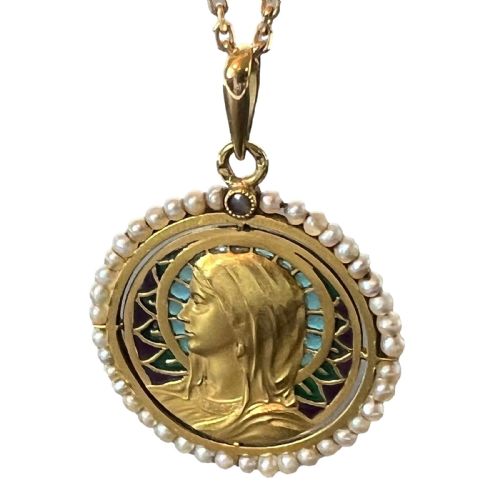
A significant subset utilises plique-à-jour enamel, a technique resembling miniature stained glass where enamel is suspended within gold cells without a backing. Seed pearls and standard pearls appear alongside this enamelling to accent the borders and halos of the devotional figures.
The selection spans from eighteen-ninety to nineteen-fifty, featuring eighteen-carat yellow, rose, and white gold alongside mother of pearl and enamel.
Design and Execution
In enamelled examples, the clarity and preservation of the plique-à-jour or opaque work determine the standard. Pieces bearing identifiable artist signatures or workshop hallmarks command attention through documented authorship and superior finishing.
Emile Monier·Mazzoni·Pageli Perriat·Dropsy·Guilbert·Vernon·Sellier·Tairac·Becker·Pageri Perroud
The French Catholic Pendant Glossary
- Plique-a-Jour
- An enamelling technique where transparent enamel fills open cells in the metal framework, allowing light to pass through. This method creates a stained-glass effect within the pendant body.
- Miraculous Medal
- A specific devotional medal design depicting the Virgin Mary based on apparitions reported in eighteen-thirty. It includes standard inscriptions and symbolic imagery on the reverse.
- Medal Pendant
- A wearable religious medallion fitted with a suspension loop for a chain. These objects served both devotional and personal adornment purposes.
- Mother of Pearl
- The iridescent internal layer of mollusc shells used as a carved background for relief figures. It provides a luminous surface behind gold depictions of saints.
French Catholic Pendant: Frequently Asked Questions
What do these pendants typically depict?
These pieces generally portray sacred figures from Catholic tradition, most frequently the Virgin Mary, the Madonna and Child, or specific saints such as Saint Christopher and Saint John the Baptist. Other common motifs include the Sacred Heart and the Holy Dove.
Craftsmen rendered these subjects in high relief upon gold backgrounds, often framing them with enamel work, pearls, or engraved floral borders.
How can I date a french catholic pendant?
Dating relies primarily on stylistic clues, workshop signatures, and metal standards, with the majority originating between eighteen-ninety and nineteen-fifty. Art Nouveau influences appear in pieces from the turn of the twentieth century, characterised by flowing lines and plique-a-jour enamel.
Later pieces from the nineteen-twenties to the nineteen-fifties often adopt cleaner geometric framing or distinct mid-century devotional imagery. Maker marks stamped on the gold suspension rings also assist in establishing a specific period.
How were these religious medals worn historically?
Owners typically suspended these medals from gold chains to wear them close to the heart as a personal expression of faith. They functioned as daily devotional objects as well as protective amulets for travellers.
Some examples were designed as charms to be attached to bracelets alongside other religious mementos. Their dual role as jewellery and sacred items made them popular gifts for significant life events.
What is plique-a-jour enamel?
Plique-a-jour is a delicate glass-firing technique where enamel is applied to open wirework cells without a solid backing plate. When held to the light, the translucent colours glow like miniature stained glass windows.
This method required exceptional skill from the jeweller to prevent the enamel from cracking during the cooling process, making it a hallmark of finer nineteenth and early twentieth-century pieces.