


French Bronze Wall Girandoles
French bronze wall girandoles combine reflective glass and candle branches to cast layered candlelight across a room.
French Bronze Wall Girandoles
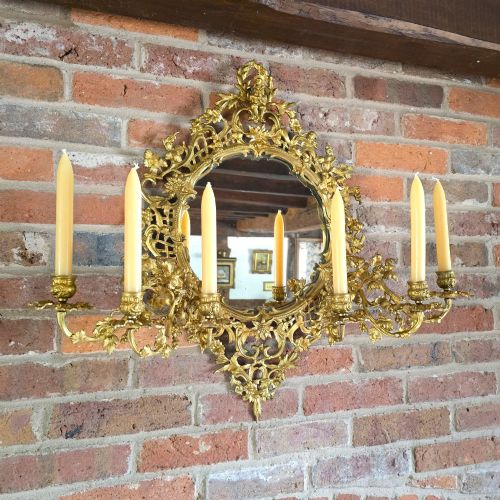
French bronze wall girandoles are decorative wall-mounted lighting fixtures designed to hold multiple candles in front of a reflective glass plate. When someone searches for french bronze wall girandoles, they are looking at ornate lighting that serves as both a functional sconce and an ornamental wall mirror.
The pieces appearing on this page span the nineteenth and early twentieth centuries, drawing on historical aesthetics such as Rococo Revival, Second Empire, Neoclassical, and Louis XVI styles. Buyers frequently encounter matched pairs featuring cast metal frames and multiple branch candelabra.
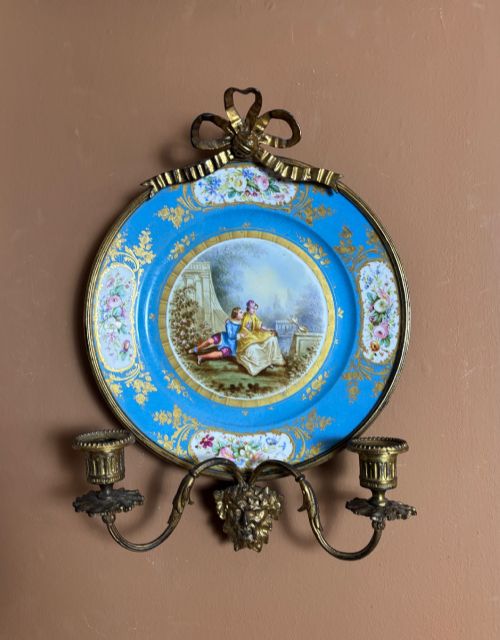
Forms range from single-branch sconces to large mirrored wall lights fitted with crystal drops and porcelain mounts. These objects originate from French workshops and utilise materials typical of nineteenth-century decorative metalwork.
How they were made
Makers constructed these girandoles using cast bronze, ormolu, and brass, often applying a gilt finish to highlight intricate decorative motifs. Metal components were cast in sections and joined to support the weight of protruding candle branches and glass inserts.
Reflective surfaces consist of mirror glass or bevelled mirror panels set directly into the metal frames. Many examples incorporate additional decorative elements such as porcelain plaques, glass crystal droplets, and hand-chased surface details.
Some nineteenth-century makers stamped their work with mysterious initials and serial numbers, hiding a Paris workshop identity behind cryptic codes like five-twenty-five.
What varies in quality
Quality in these fixtures rests on the crispness of the bronze casting and the depth of the chasing work on the metal surface. Finer examples display sharp relief in their scrollwork and foliage, whereas lesser pieces show softer, shallower detailing from worn moulds.
The integration of the mirror glass and the rigidity of the multi-branch candelabra also set pieces apart. Superior construction ensures that heavy candle arms remain stable and aligned with the backplate.
E.G Paris
The French Bronze Wall Girandoles Glossary
- Girandole
- A branched wall-mounted candlestick or candelabrum incorporating a mirror to multiply the reflection of the light. They were designed to hang in pairs or sets along reception room walls.
- Ormolu
- Gilt bronze produced by applying a mercury-gilding mixture to a cast bronze base. It provides a durable, warm metallic finish characteristic of French decorative arts.
- Rococo Revival
- A nineteenth-century design style reviving the asymmetric scrolls, shell motifs, and naturalistic curves of the eighteenth-century French Rococo period. This aesthetic dominates many nineteenth-century lighting mounts.
- Napoleon III
- A French design period spanning the mid to late nineteenth century, known for eclectic revivals of past royal styles combined with heavy ornamentation. Pieces from this era often feature rich gilding and mixed media.
- Candelabra
- A branched candlestick holder designed to support multiple candles from a single base or wall mount. In wall lights, these arms extend forward from the mirror plate.
French Bronze Wall Girandoles: Frequently Asked Questions
How were french bronze wall girandoles used?
These fixtures hung on drawing room and salon walls to illuminate spaces by reflecting candlelight from glass panels. Their reflective surfaces helped brighten candlelit interiors before the advent of electricity.
They were typically positioned in pairs around fireplaces, doorways, or above furniture to create balanced illumination and decorative symmetry.
How do I live with them?
Mounting these fixtures securely is essential due to the weight of the cast bronze and glass components. They suit traditional living spaces, hallways, or dining rooms where their reflective qualities enhance ambient light.
Care involves gentle dusting of the metal and glass without harsh chemical cleaners that might strip the original gilt surface.
How do I tell periods apart?
Nineteenth-century pieces often display distinct stylistic markers, such as the exuberant curves of Rococo Revival or the formal symmetry of Neoclassical design. Examining the casting technique and the style of the chasing provides clues to the era of manufacture.
Later nineteenth and early twentieth-century examples sometimes incorporate machine finishing alongside traditional hand-chasing methods.
What materials are used?
Construction primarily relies on cast bronze, brass, and gilt ormolu, frequently paired with flat or bevelled mirror glass. Some versions integrate decorative elements made from Sevres porcelain or hanging crystal glass prisms.
Each material contributes to the overall weight and visual richness of the fixture.