


French Brass Hooks
French brass hooks bring functional elegance to domestic spaces, offering sturdy wall storage shaped by continental design.
French Brass Hooks
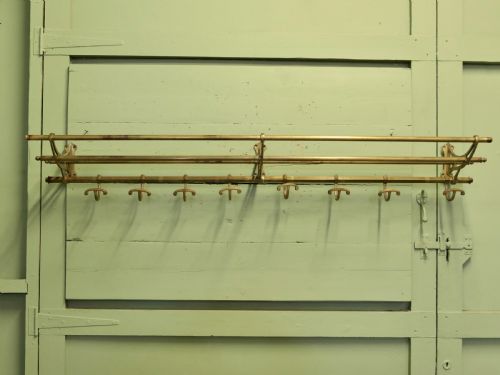
French brass hooks encompass a varied selection of wall-mounted hardware, ranging from single hat hooks to long entrance hall racks and portmanteaus. Buyers seeking french brass hooks frequently encounter items designed for practical garment storage alongside decorative window furnishings.
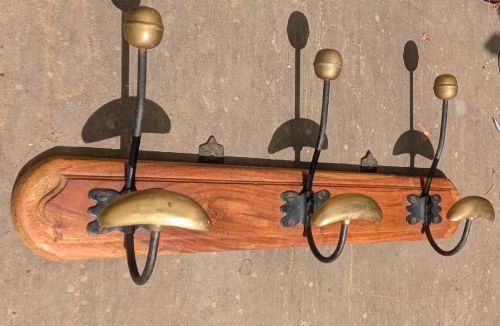
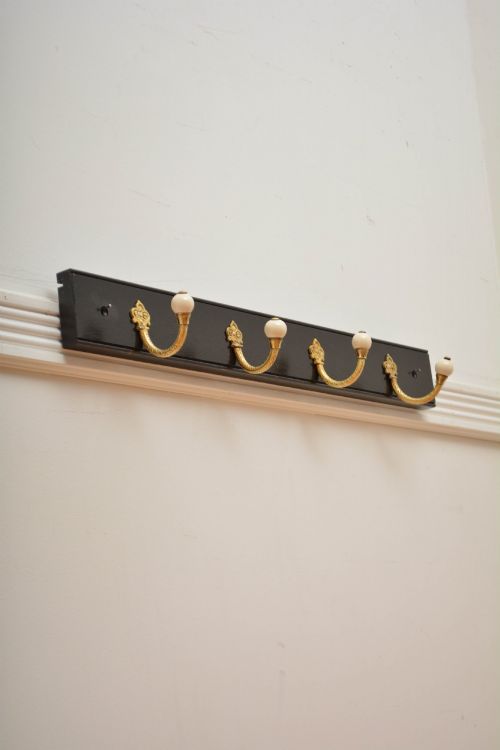
The material selection spans from cast brass and chased brass to rich ormolu and gilt bronze. Many pieces integrate secondary materials, combining brass with mahogany, ebonised wood, ceramic or porcelain knobs, and original mirror plates.
Dating conventions stretch across the eighteenth, nineteenth, and early twentieth centuries. Surviving examples reflect distinct historic periods, including Georgian, Victorian, Art Deco, and French Rococo Revival styles.
Materials and Construction
Makers utilised casting techniques to produce chunky mounting plates and robust brackets, often finishing surfaces with detailed chasing. Gilded bronze and ormolu applications provided high-status decorative elements for interior schemes.
Timber backboards in mahogany or ebonised wood frequently support multiple brass hooks on long racks and hall stands. Attachment points sometimes incorporate enamel, porcelain knobs, or ceramic inserts to soften the metalwork.
Gothic dragons carved in gilt brass keep a watchful, fierce eye over hanging coats.
Judging Quality
Quality rests heavily on the crispness of the casting and the depth of hand-chasing on the mounting plates and hooks. Superior items display purposeful weight, robust structural integrity, and well-preserved gilding or original surface patination.
Henri Picard
The French Brass Hooks Glossary
- Ormolu
- Gilded bronze produced by applying a finely ground high-carat gold-mercury amalgam to a bronze object. This historic technique creates a rich, warm golden surface finish.
- Portmanteau
- A combined wall-mounted rack featuring hooks for hats and coats, frequently incorporating a central mirror plate. These items served as functional hallway furniture.
- Chasing
- The manual metalworking technique of indenting, shaping, and texturing the surface of brass or bronze with hammers and punches. It adds fine decorative detail after casting.
- Tie Back
- A decorative wall-mounted hook or holder used to secure curtain drapery away from a window. They often appear in matched pairs cast in brass or gilt bronze.
French Brass Hooks: Frequently Asked Questions
How were these hooks originally used?
French brass hooks served multiple domestic functions across hallways, bedrooms, and reception rooms. Single hooks and multi-bracket racks held hats, coats, and garments near entryways.
Smaller paired hardware functioned as curtain tie backs, gathering heavy drapery beside windows. Larger portmanteaus combined storage hooks with integrated mirrors for final appearance checks before leaving the house.
How do I date a brass hook?
Dating relies on observing stylistic markers, manufacturing techniques, and accompanying materials. Eighteenth-century examples often exhibit baroque casting details, while nineteenth-century items frequently show revival influences like Rococo or Gothic motifs.
Later pieces from the early twentieth century lean towards cleaner geometric lines associated with Art Deco design. Screw types, mounting plate thickness, and backboard timbers also offer clues to age.
Are these hooks strong enough for daily use?
Solidly cast antique brass and bronze items possess substantial structural strength suitable for everyday garment hanging. Heavy mounting plates and robust brackets distribute weight securely against wall surfaces.
Care should be taken during installation to anchor fixings into wall studs or utilise appropriate wall plugs to support heavy items like portmanteaus and multi-hook racks.
How do I care for antique brass?
Maintenance requires minimal intervention to preserve the historic surface patination accumulated over decades or centuries. Gentle dusting with a soft dry cloth prevents the buildup of grime.
Harsh chemical polishes should be avoided because they strip away desirable ageing and delicate surface gilding, particularly on ormolu and fire-gilded bronze pieces.