


French Boulle Marquetry Clock
A french boulle marquetry clock brings dramatic tortoiseshell and brass ornamentation into a room, offering the intricate craftsmanship of nineteenth-century revival design.
French Boulle Marquetry Clock
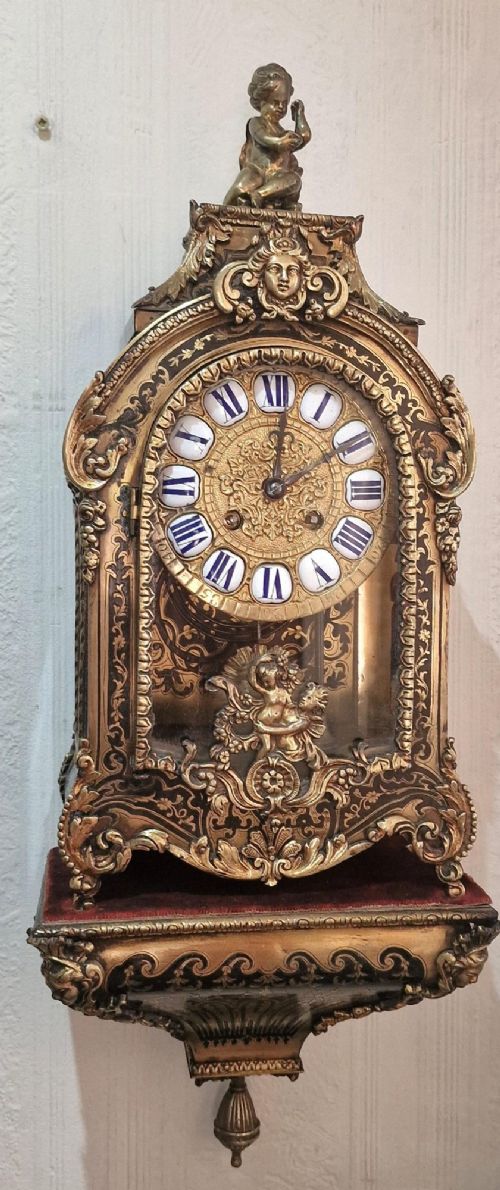
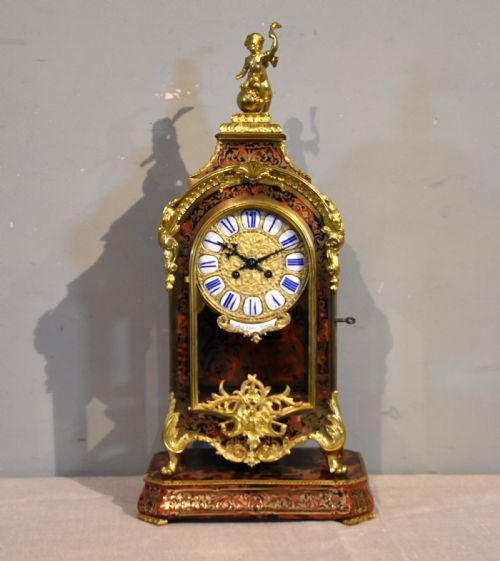
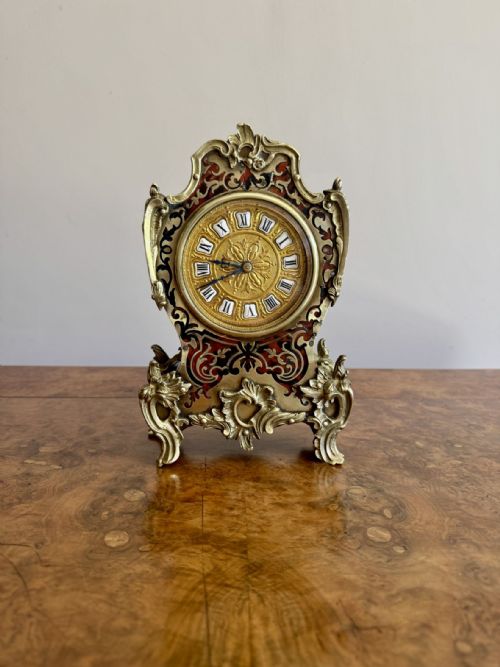
When buyers search for a french boulle marquetry clock, they encounter striking timepieces decorated in contrasting patterns of metal and shell. Mantel clocks and bracket clocks dominate the selection, frequently accompanied by matching wall brackets.
The objects span the nineteenth century, with strong representation from the Victorian era and the Napoleon III period. Revival styles such as Louis XIV and French Rococo shape the heavy architectural forms of these pieces.
Most examples take the form of table or mantel clocks, though taller longcase clocks and wall-mounted versions also appear. Green tortoiseshell variants provide an alternative to the traditional red or dark amber ground.
How they were made
Maker workshops combined thin sheets of brass and tortoiseshell, cutting them together in stacked layers to produce matching positive and negative marquetry panels. Ebonised wood formed the dense structural core that supported these delicate surface veneers.
Casters shaped rich ormolu and gilt bronze mounts to accent the corners, feet, and bezels of the clock cases. Enamel cartouches on white dials displayed the numerals, protected beneath heavy curved glass doors.
Listings feature materials including brass, ormolu, tortoiseshell, enamel, glass, ebonised wood, gilt bronze, and stained horn.
What varies in quality
The precision of the brass and shell inlay defines the standard of the execution, separating tightly fitted marquetry from simpler surface decoration. Heavier, more deeply chased gilt bronze mounts indicate superior workshop production.
The inclusion of a matching original wall bracket elevates the completeness of a bracket clock assembly. Movement reliability and the presence of maker signatures on the dial or backplate distinguish workshop output.
Henri Marc of Paris·Samuel Marti
The French Boulle Marquetry Clock Glossary
- Boulle marquetry
- A method of inlaying brass and tortoiseshell developed by André-Charles Boulle, where two contrasting sheets are cut simultaneously to create opposing patterns.
- Ormolu
- Gilded bronze used for decorative mounts and feet, cast and finished by hand to highlight surface details.
- Bracket clock
- A portable timekeeper originally designed to sit on a wall bracket or a dedicated shelf.
- Enamel cartouche
- Individual white enamel plaques inscribed with numerals and pinned to the clock dial face.
- Ebonised wood
- Timber treated and stained to imitate genuine ebony, providing a dark contrast to the metallic inlay.
French Boulle Marquetry Clock: Frequently Asked Questions
What is a boulle clock?
A boulle clock is a timepiece encased in wood veneered with tortoiseshell and brass marquetry. These decorative items reflect seventeenth-century French court styles revived during the nineteenth century.
They serve as focal points on mantels and desks, combining mechanical timekeeping with elaborate surface ornamentation.
How do I wind the clock?
Most of these clocks utilise an eight-day movement driven by a spring mechanism. You wind the arbours on the dial face using a matching key.
Care is required not to overwind the mainspring to preserve the historic gear train.
Where should I place it?
These clocks require a stable, level surface away from direct sunlight and fluctuating temperatures. Sunlight can damage the tortoiseshell veneer and fade the stained horn or wood.
Bracket clocks perform best when secured firmly to a wall bracket designed to support their weight.
How do I identify the period?
The materials, mounting styles, and dial construction indicate the era of manufacture. Victorian and Napoleon III pieces often adopt Louis XIV or Rococo revival aesthetics.
Maker signatures on the brass movement backplate provide precise clues to the workshop and date.