


French Bonheur De Jour
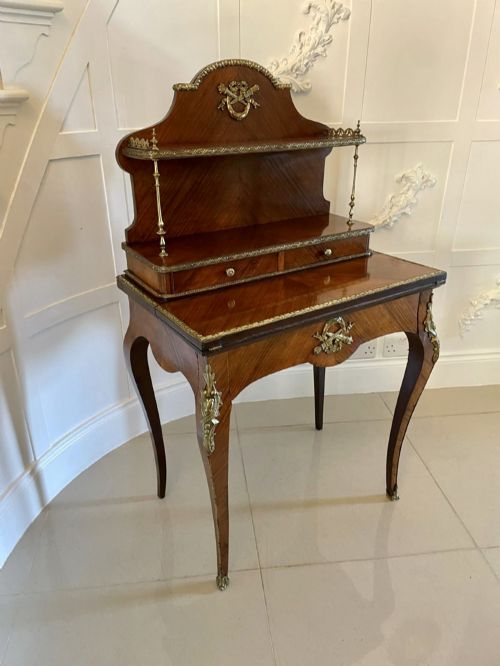
A french bonheur de jour offers a refined ladies writing desk with raised superstructure, combining compact proportions with intricate marquetry and gilt mounts.
French Bonheur De Jour
A french bonheur de jour sits at the intersection of a writing table and a cabinet, designed specifically for correspondence and small valuables. These elegant writing desks appear most frequently from the nineteenth century, including Victorian interpretations and revival pieces.
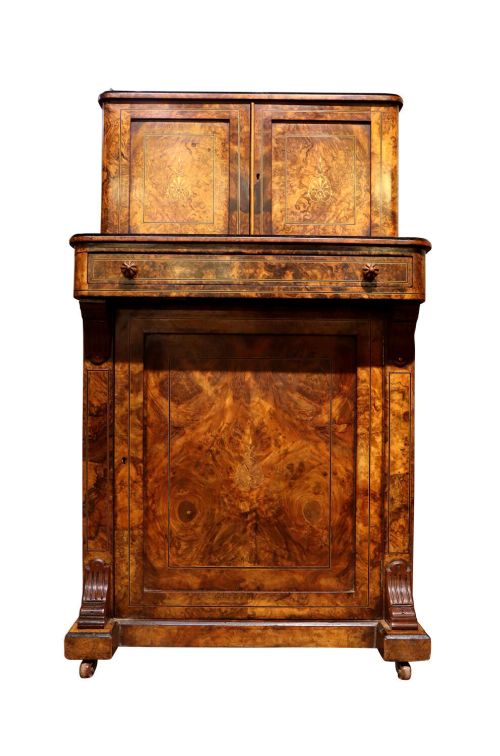
The form typically incorporates a writing surface above which sits a superstructure of small drawers, shelves, or a cupboard enclosed by a door. Walnut, kingwood, and burr walnut dominate the examples found here, often shaped in the Louis XV revival style.
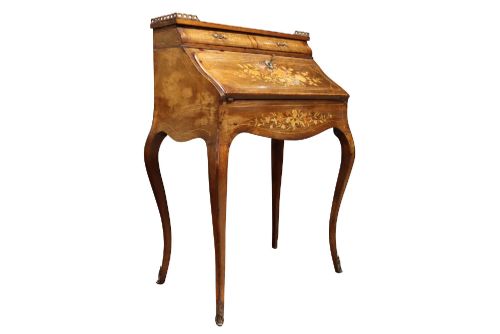
Makers adapted the historic French form during the Victorian era for British and continental drawing rooms, resulting in diverse interpretations ranging from serpentine bureau de dame desks to oak writing tables.
Materials and Construction
Cabinetmakers utilised exotic timbers such as kingwood, amboyna, and satinwood over carcase woods, applying intricate marquetry inlay and geometric parquetry. These decorative surfaces frequently combine with brass stringing and gilt bronze or ormolu mounts framing the edges and legs.
Many iterations incorporate inset porcelain plaques, such as Sevres style ceramics, set directly into the fall front or the upper cabinet doors. Traditional construction methods involve dovetailing for the small drawers housed within the superstructure and hand-fitted brass hardware.
Listings feature woods including walnut, burr walnut, kingwood, mahogany, satinwood, amboyna, and oak, paired with ormolu and porcelain.
Judging Quality and Execution
The distinction between standard production and superior execution rests upon the depth of the marquetry and the crispness of the gilt bronze mounts. Finer examples display meticulous matching of burr walnut or kingwood veneers across curved surfaces and bombe fronts.
Detailing on the interior fittings, such as secret compartments within the superstructure and hand-tooled leather writing inserts, signals greater craftsmanship. The quality of the cast ormolu mounts and the integration of porcelain plaques elevate individual pieces above simpler walnut writing desks.
Paul Sormani
The French Bonheur De Jour Glossary
- Bonheur de jour
- Daytime delight. A light writing desk featuring a small cabinet or set of drawers on top, popular in the eighteenth and nineteenth centuries.
- Bureau de dame
- Lady's desk. A term frequently used interchangeably with a small writing desk or bonheur de jour.
- Ormolu
- Gilt bronze. Finely cast bronze mounts finished with gold leaf or mercury gilding, used to adorn the corners, legs, and frames.
- Marquetry
- Inlay technique. The art of applying pieces of veneer to a structure to form decorative patterns, often depicting floral motifs.
- Kingwood
- Tropical timber. A dense, heavily figured violet-brown wood with darker stripes, prized for high-end cabinetmaking.
French Bonheur De Jour: Frequently Asked Questions
What is a french bonheur de jour used for?
These pieces served as light writing desks for correspondence, storing stationery, and keeping private letters within the upper drawers or cabinet.
They stood in ladies boudoirs or drawing rooms as decorative furniture that also offered a practical surface for writing.
How do I date a bonheur de jour?
Dating relies on identifying the revival style, such as Louis XV or Louis XVI, combined with wood choices like burr walnut or kingwood.
Most surviving examples date from the nineteenth century and the Victorian period, though occasional eighteenth-century pieces appear.
Are these desks suitable for daily use?
The compact writing surfaces accommodate modern laptops or notebooks, though the delicate veneers and antique leather require careful treatment.
Many retain original folding or sliding mechanisms that function smoothly when maintained with proper care.
What is the difference between a bureau de dame and a bonheur de jour?
Both terms describe ladies writing furniture, but a bureau de dame often implies a sloping fall-front desk rather than an open writing table with an upper tier.
In practice, makers and dealers used these designations interchangeably during the nineteenth century.