



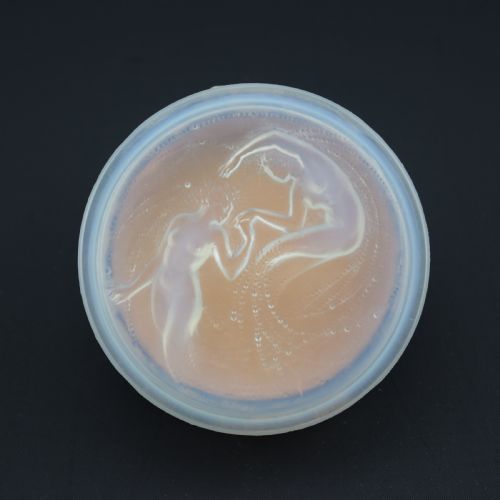
French Art Glass Box
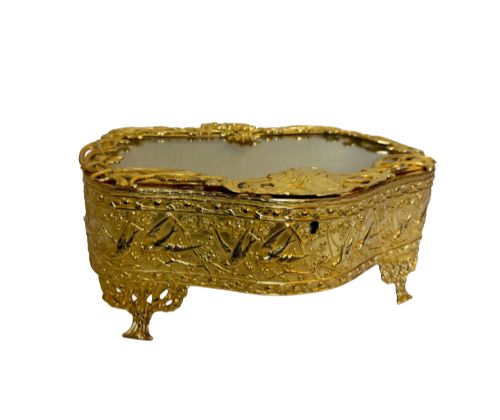
A french art glass box brings colour and tactile form to a dressing table, combining moulded glass with mounts of gilt bronze or brass.
French Art Glass Box
When you search for a french art glass box, you encounter pieces intended for vanity use, such as powder boxes, trinket boxes, and jewellery boxes. These items serve to hold small treasures while acting as decorative objects in their own right.
The versions most frequently met on this page date from the late nineteenth century and the early decades of the twentieth century. They encompass organic Art Nouveau designs alongside geometric Art Deco pieces.
Beyond traditional lidded boxes, the category extends to include devotional shadow boxes containing Nevers glass figures and perfume bottles housed in fitted containers. Each form reflects the changing tastes of French makers across different periods.
Materials and Techniques
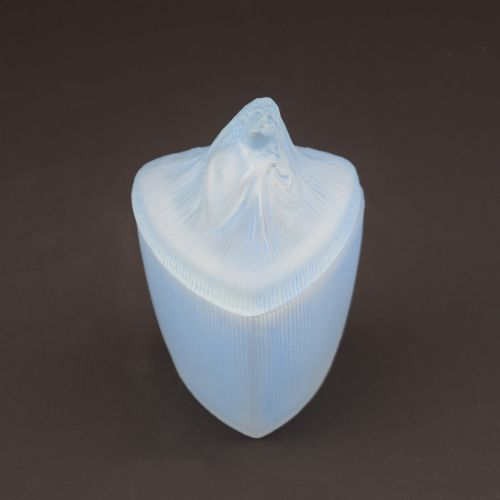
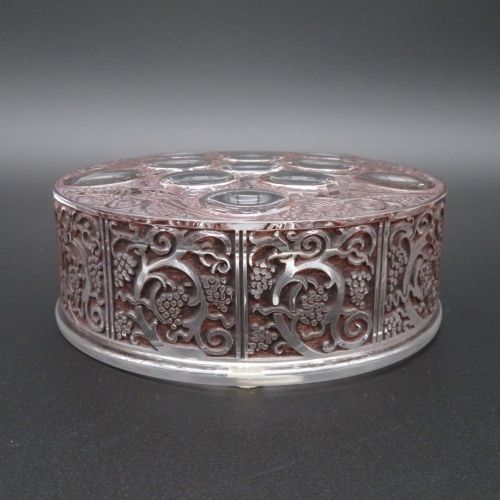
Makers utilised various forms of glass, including frosted, opalescent, and Pâte de Verre crystal, often working in moulds to achieve high relief and textured surfaces. Enamelling was frequently applied by hand to add coloured detail to the glass body.
Metal mounts in gilt bronze, brass, or silver provide structural support and framing for the glass panels and lids. Additional interior linings of silk or paper complete the construction of vanity and jewellery boxes.
Materials documented across the collection include glass, frosted glass, opalescent glass, crystal, paper, gilt bronze, giltwood, and silk.
Distinguishing Quality
Quality rests upon the crispness of the moulding and the depth of the relief work within the glass. Superior pieces display finely detailed figures or geometric patterns that remain sharp and well-defined.
The integration between the glass body and its metal mounts dictates the overall standard of a piece. Well-made boxes exhibit precise fitting and heavy, substantial mounts of gilt bronze or brass rather than light, flimsy metalwork.
Rene Lalique·Daum France
The French Art Glass Box Glossary
- Opalescent Glass
- Glass that diffuses light and shows milky or blue-white tones when lit from certain angles. This effect adds depth to moulded decorative motifs.
- Pâte de Verre
- A kiln-casting method involving glass paste fused within a mould to produce dense, translucent objects with mottled colour. This technique yields richly textured surfaces.
- Shadow Box
- A deep, glazed frame designed to display three-dimensional objects or figures under glass. Early examples often house delicate Nevers glass work.
- Gilt Bronze
- Bronze metal coated with a thin layer of gold or gold-coloured alloy to give a rich metallic finish. It appears frequently in mounts and frames.
French Art Glass Box: Frequently Asked Questions
How are these glass boxes cleaned?
Dust accumulates easily in the textured reliefs and around the metal mounts of these delicate objects. Use a soft, dry brush to clear away debris without disturbing any silk linings or fragile enamel.
Avoid liquid cleaners entirely, as moisture can seep beneath mounts or damage older paper interiors. A gentle wipe with a dry microfibre cloth suffices for smooth glass surfaces.
Can I store jewellery inside them?
Many of these pieces were originally constructed as trinket or jewellery receptacles and feature fitted interiors lined with silk or paper. They accommodate small rings, brooches, and pins safely.
Heavy or sharp pieces may scratch delicate interior surfaces or tear old fabric linings over time. Exercise care when placing metallic items directly against antique glass or aged internal fabrics.
What caused the frosted glass effect?
Frosted glass is achieved by treating the surface through acid-etching or sandblasting to create a matte, translucent texture. Makers used this technique to contrast against polished clear areas and highlight moulded details.
This finish scatters light softly across the surface, enhancing the depth of low-relief figures and decorative patterns. It remains a hallmark of high-grade decorative glass from the early twentieth century.