




French Architectural Pendulum Clock
A french architectural pendulum clock brings monumental presence to a mantelpiece, blending classical form with precise horology.
French Architectural Pendulum Clock
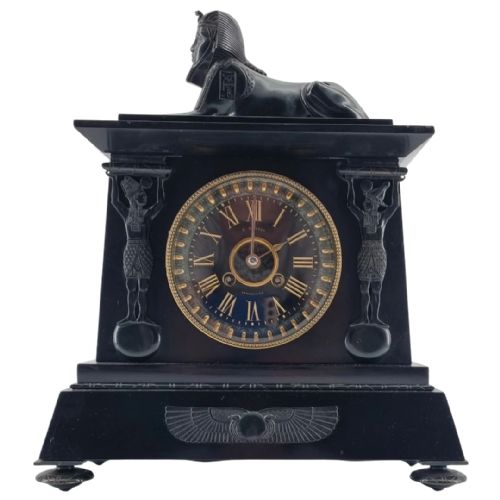
A french architectural pendulum clock takes its cue from monumental masonry, often scaling down temples, portals, and porticos into domestic mantelpieces. These pieces reflect diverse aesthetics ranging from Charles X symmetry to Egyptian Revival grandeur.
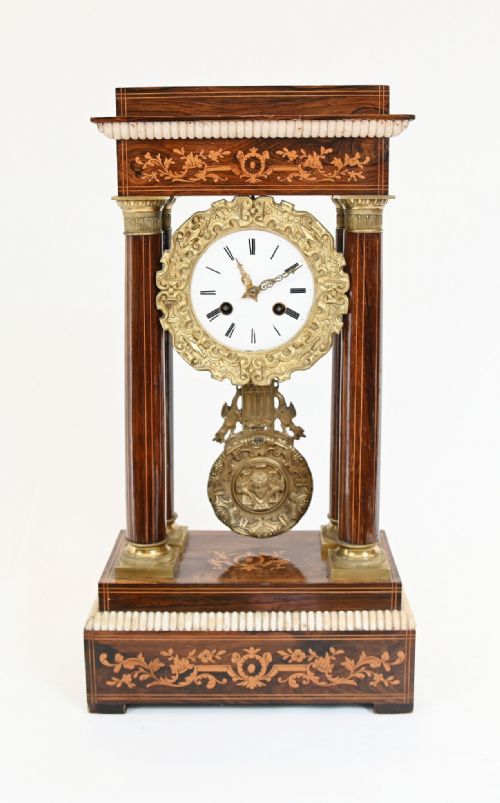
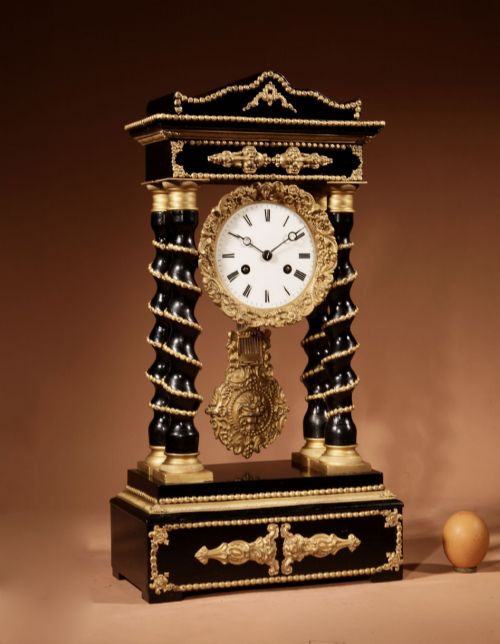
The version most commonly encountered on this page is the portico clock, characterised by four slender columns supporting a central entablature that houses the dial and pendulum. Makers also utilised solid marble and slate to construct heavier, architectural garnitures during the Victorian era.
Objects span from the early nineteenth century through the late eighteen-eighties, capturing shifting tastes in European design. Whether executed in rosewood, mahogany, or gilt bronze, each example serves as a functional timepiece wrapped in miniature structural design.
Materials and Construction
Horologists and cabinetmakers built these structures using dense timbers such as rosewood and mahogany, frequently enhanced with contrasting inlay or satinwood. Ormolu and gilt bronze mounts provided metallic contrast to polished wood surfaces.
Stone structures relied on heavy blocks of black slate and sienna marble, sometimes carved with classical motifs. Dial faces combined brass surrounds with white enamel, featuring fine black numerals and delicate metal hands.
Movements required sophisticated engineering, including knife-edge suspension systems for accurate timekeeping within a compact architectural frame. Glass panels protected delicate dials while allowing visibility of the swinging pendulum.
Listings feature periods spanning the eighteenth, nineteenth, and Victorian eras, alongside styles including French Empire, Charles X, and Egyptian Revival.
Assessing Quality and Execution
Quality rests in the crispness of the casting for ormolu mounts and the precision of veneer work on timber porticos. Superior examples feature well-defined architectural details such as fluted columns and intact fire-gilding.
The complexity and completeness of the movement dictate the upper tier of these pieces, particularly when paired with original garnitures or specialised suspensions. Heavier stone cases demonstrate refinement through clean bevels, tight joints, and harmonious marble selection.
Baby and Jannings·D. Munsey of Cambridge
The French Architectural Pendulum Clock Glossary
- Portico clock
- A clock case styled with freestanding vertical columns supporting an upper entablature. This form gained popularity during the early nineteenth century under Charles X and French Restoration styles.
- Ormolu
- Finely ground high-carat gold mercury-gilded onto a bronze object. It provides a bright, durable golden finish characteristic of high-end French decorative arts.
- Garniture
- A set consisting of a central clock flanked by matching ornamental pieces such as urns or vases. These arrangements were designed to sit symmetrically on a mantelpiece.
- Knife-edge suspension
- A delicate horological mechanism supporting the pendulum on a sharp pivot edge rather than a flat spring. This reduces friction and allows for precise regulation.
- Entablature
- The superstructure resting upon columns in classical architecture, which in these clocks houses the dial and movement bezel.
French Architectural Pendulum Clock: Frequently Asked Questions
What is a portico clock?
A portico clock is an architectural timepiece shaped like a classical temple or gateway with vertical columns supporting an upper section.
This distinct silhouette became a hallmark of French design during the early nineteenth century.
How do I wind an antique pendulum clock?
Winding typically involves inserting a key into the dial apertures to tension the internal springs or raise the weights.
Care must be taken not to overwind the movement, ensuring the pendulum remains undisturbed.
Where should I place a heavy marble clock?
These dense stone and slate timepieces require a sturdy, level surface capable of supporting significant weight.
Placing them on a secure mantel or heavy furniture piece prevents vibration and keeps the pendulum swinging evenly.
How do I distinguish Charles X from Victorian examples?
Charles X pieces frequently showcase symmetry, architectural porticos, and rich wood veneers like rosewood or mahogany with delicate inlay.
Victorian interpretations often lean toward heavier marble, slate constructions, and bolder classical revival motifs.