




French Allegorical Female Figure
A french allegorical female figure embodies classical virtues or natural forces, offering timeless elegance and decorative presence.
French Allegorical Female Figure
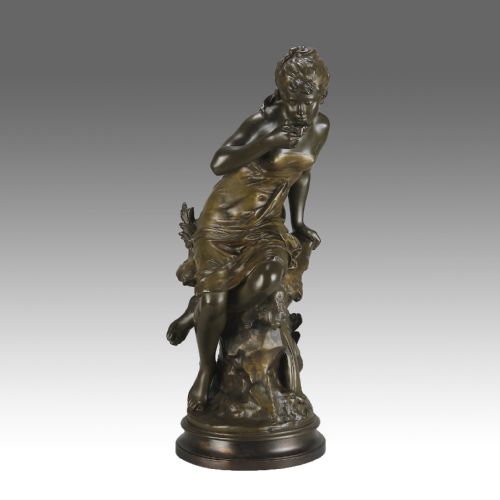
A french allegorical female figure represents personified concepts such as spring, peace, or nature through graceful sculptural forms. These pieces frequently appear as freestanding statues, table lamps, figural clock components, and decorative figurines.
The selections on this page span the nineteenth century into the early twentieth century, capturing distinct aesthetic movements. Collectors most commonly encounter works reflecting French Neoclassical, Victorian, and Art Nouveau sensibilities.
Makers utilised female personifications to convey moral, seasonal, or mythological themes in domestic interiors. These sculptures often double as functional lighting or timepiece mounts while retaining their sculptural narrative.
Materials and construction methods
Foundry artisans cast these sculptures primarily in bronze or spelter, frequently applying gilt finishes or ormolu mounts to enhance surface detail. Marble bases often anchor the metal figures, providing stable foundations and contrasting textures.
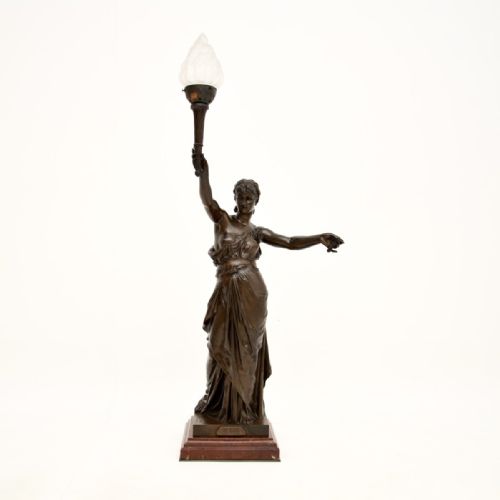
Detailed chasing and patination define the surface treatment of high-grade metal casts. Glass elements, such as frosted lamp shades, occasionally complement the metallic figures in lighting formats.
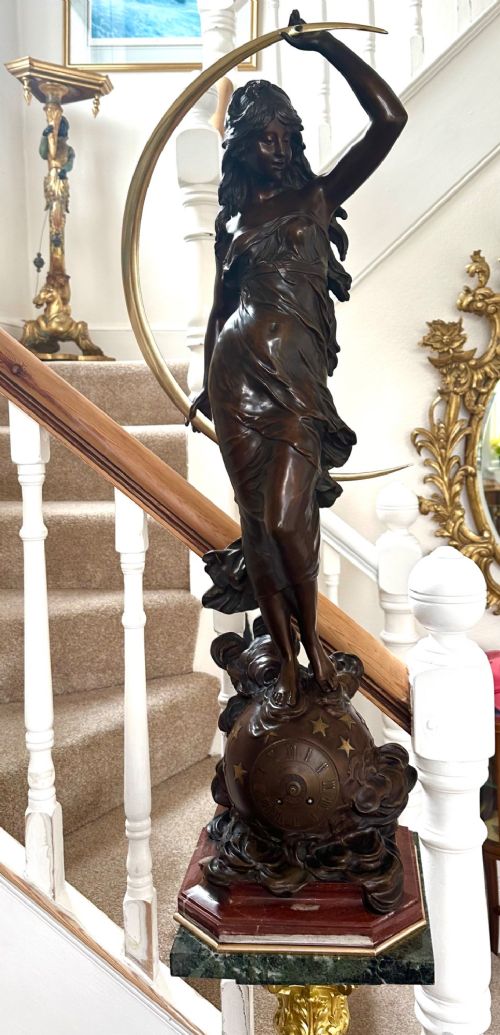
Aurora commands her chariot while chastity points sternly toward a font of holy water.
Assessing sculptural quality and execution
Superior examples demonstrate crisp definition in drapery, facial expressions, and anatomical modeling. Weaker castings lose fine textural details in hair and garments, often relying on heavy patination to mask softer definition.
The integration of the figure with its functional elements determines overall refinement. Clocks and lamps of higher quality feature harmonious proportions where the allegorical subject commands the composition rather than serving as an afterthought.
Auguste Moreau·Mathurin Moreau·Ernst Barrias·Jean-Jules Cambos·August Moreau
The French Allegorical Female Figure Glossary
- Spelter
- A zinc alloy frequently utilised as a cost-effective alternative to bronze in nineteenth-century decorative figures. It accepts metallic finishes well but possesses a lighter weight and softer surface.
- Ormolu
- A method of applying finely ground high-carat gold to a bronze object using a mercury amalgam. This technique produces a durable, rich golden surface finish typical of luxury French decorative arts.
- Patina
- The surface coloration and sheen developed naturally over time or applied artificially by the founder. It protects the underlying metal and highlights sculptural contours.
- Art Nouveau
- An international style of art and architecture prevalent from the late nineteenth century to the First World War. It is characterised by intricate asymmetrical lines inspired by natural forms and flowing plant motifs.
French Allegorical Female Figure: Frequently Asked Questions
What do these allegorical figures represent?
These figures personify abstract ideas, natural phenomena, or moral virtues such as peace, spring, and dawn. Artists drew upon classical mythology and romantic ideals to give visual form to intangible concepts.
Displaying these sculptures allowed nineteenth-century interiors to reflect cultural sophistication and philosophical themes through classical motifs.
How do I distinguish bronze from spelter?
Bronze exhibits greater weight, a resonant sound when lightly tapped, and sharper detail retention in the casting. Spelter feels noticeably lighter and softer, often revealing a greyish metal beneath worn areas of the finish.
Examining the underside or areas of minimal wear typically clarifies the base metal composition of the figure.
Where were these figures placed in homes?
Owners positioned these sculptures on mantelpieces, central tables, and pedestals as standalone decorative focal points. Many were integrated directly into functional objects like clock cases and lamp bases.
Their placement usually aimed to complement the formal reception rooms of nineteenth-century residences.
How do I identify Art Nouveau examples?
Art Nouveau figures feature flowing, whip-like lines, organic drapery, and motifs directly inspired by flora and fauna. The female forms often display naturalistic hair and poses tied to natural cycles.
This style breaks away from strict neoclassical symmetry in favour of dynamic, plant-like curves.