

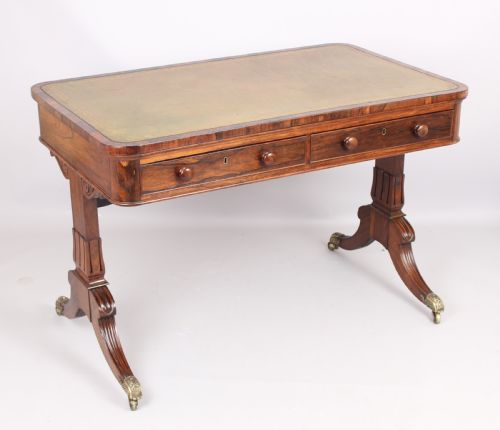


Free Standing Desk
A free standing desk stands away from the wall to show finished timber on every side.
Free Standing Desk
A free standing desk is designed to be viewed from all angles, allowing placement in the centre of a room rather than against a wall.
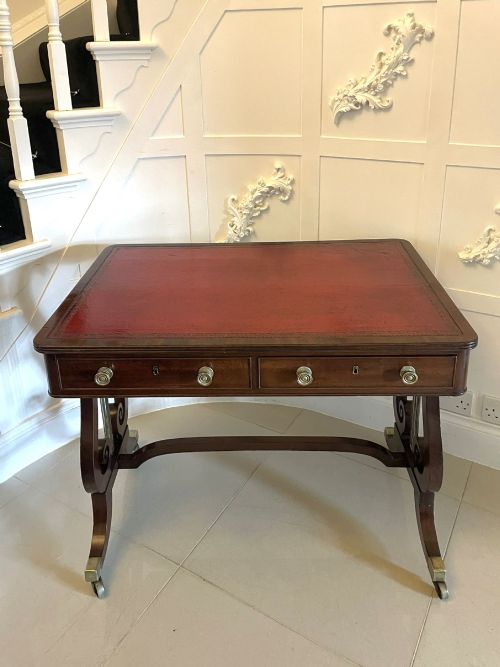
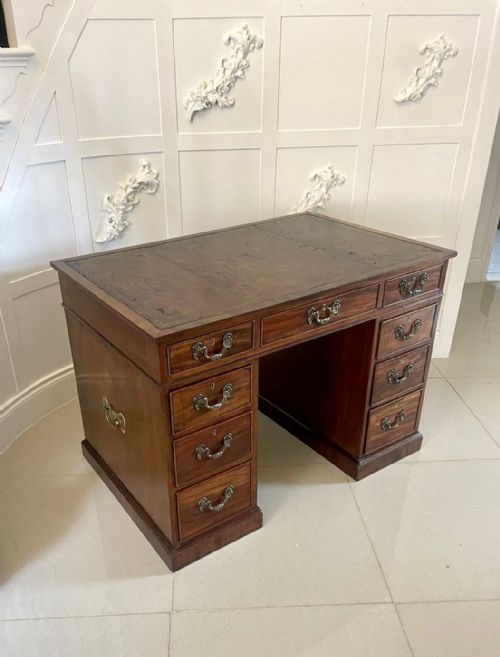
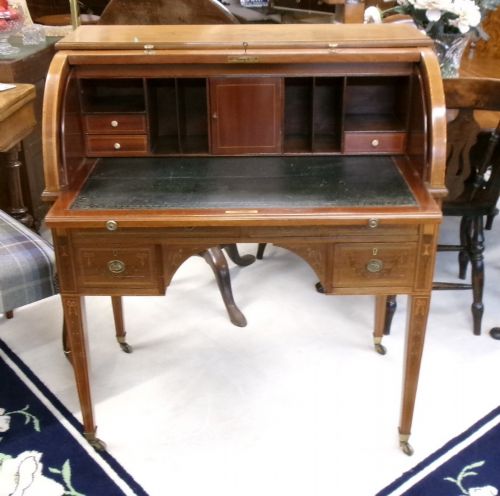
The selections span pedestal desks, partners bureaux, kneehole writing tables, and cylinder tops from the nineteenth and early twentieth centuries.
Mahogany and walnut predominate, often enriched with boxwood inlay, leather inserts, and ormolu mounts.
How they were made
Cabinet makers built these pieces using solid timbers and fine veneers of mahogany, rosewood, kingwood, and oak over robust carcases.
Surfaces frequently integrate fitted leather writing pads, brass handles, and intricate boxwood stringing or marquetry inlay.
Ormolu mounts and chrome details provide structural accent and decorative weight on specific nineteenth and twentieth century examples.
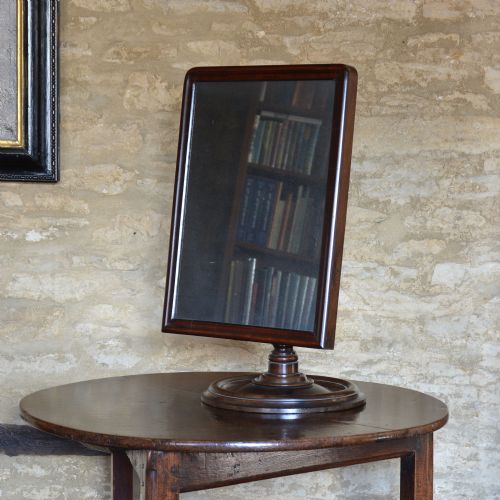
Several items designed for freestanding placement turned out to be picture frames rather than desks.
What varies in quality
The crispness of timber figuring and the precision of the boxwood inlay define the upper tier of construction.
Finished panel backs indicate genuine placement in open spaces, whereas lesser pieces reserve ornamentation solely for the primary facade.
Maple & Co.
The Free Standing Desk Glossary
- Kneehole desk
- A writing table featuring a central recess for the legs, flanked by pedestals of small drawers.
- Partners bureau plat
- A large flat-topped table designed for two people to work opposite one another, finished on all sides.
- Cylinder top
- A desk enclosing the writing surface beneath a rolling quarter-circle wooden cylinder.
- Ormolu
- Gilded bronze ornamentation applied to furniture, common on French-influenced nineteenth century pieces.
- Library table
- A large freestanding table utilised for reading and writing, finished with leather or plain timber tops.
Free Standing Desk: Frequently Asked Questions
Where should a free standing desk go?
These pieces belong in the centre of a room, away from the perimeter walls, because their rear panels receive the same finished treatment as the front.
Positioning them centrally allows proper appreciation of the timber grain and the craftsmanship on all four sides.
How do I identify a partners desk?
A partners desk provides drawers and workspace access from both sides so two individuals can sit opposite each other.
This double-sided design distinguishes them from standard single-pedestal writing tables.
What woods appear most often?
Mahogany and walnut form the structural foundation for the majority of these pieces, complemented by rosewood and kingwood veneers.
Boxwood stringing and mahogany inlays frequently provide contrast along the edges and drawers.
How do I clean leather inserts?
The leather writing surfaces require gentle dusting and occasional treatment with appropriate leather dressings to prevent drying.
Avoid excessive moisture and harsh chemical cleaners to preserve the original tooling and colour.