



Framed Village Landscape Picture
A framed village landscape picture brings the quiet character of rural streets and coastal harbours directly onto the wall.
Framed Village Landscape Picture
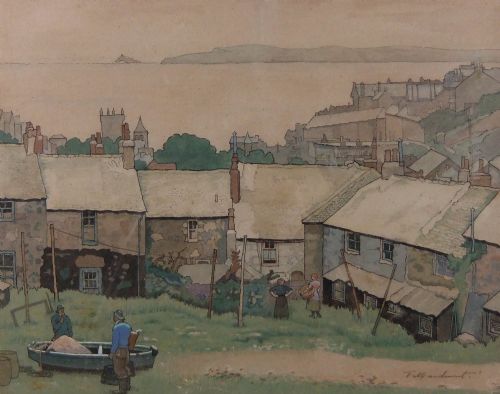
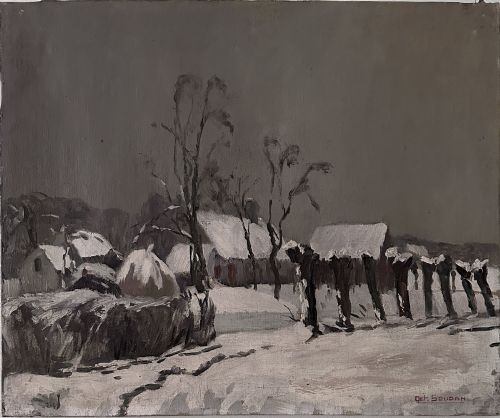
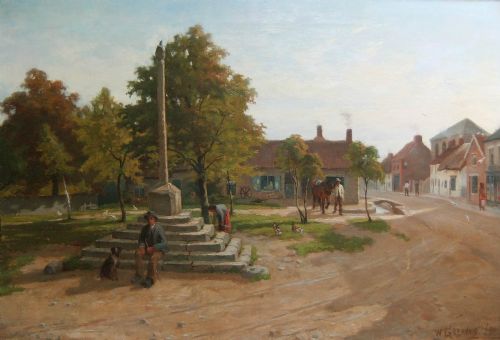
A framed village landscape picture captures rural settlements, coastal harbours and country streets across periods spanning the nineteenth and twentieth centuries. These works record identifiable locations such as Yorkshire, Cornwall and Suffolk alongside unrecorded English hamlets.
Buyers encounter subjects ranging from snow-dusted cottages and village inns to bustling harbour fronts and quiet river valleys. The selection includes works produced during the Victorian and Edwardian eras as well as mid-century interpretations.
Most examples take the form of original wall art, presented within protective wooden frames behind glass or stretched across canvas supports. They function as historical records of British topography and traditional rural life.
Materials and methods
Artists utilised watercolour pigment on paper or oil paint applied to canvas or wood panels to create these village scenes. Pastel drawings also appear among the selection, offering a softer textural quality.
Watercolour works typically combine fine washes with detailed ink or pencil underdrawing, protected beneath glass within timber mouldings. Oil paintings display varying brushwork from smooth academic application to heavier impasto on stretched canvas.
Several artists clearly preferred local village inns, painting multiple tavern scenes to capture the social heart of rural communities.
Distinctions in standard
Quality rests upon the artist's ability to capture atmospheric light and spatial depth within the village setting, distinguishing competent topographical recording from genuinely compelling composition. Stronger works demonstrate confident handling of perspective in stone cottages, winding lanes and harbour walls.
The integrity of the physical preservation also separates examples, notably the stability of the canvas or paper support and the clarity of the underlying pigment. Original frames that complement the period of the painting add considerable cohesion to the piece.
Thomas Maidment·William Greaves·Arthur Tucker·M. C. Hider·James Watson·John Edward Bale·Frank Wood·John McDougal·David Woodlock·Denys Garle·Walter Henry Sweet·John J. Hamer·David Heward·Joseph Hughes Clayton·Stephanie Cooper·John Holland Snr
The Framed Village Landscape Picture Glossary
- Watercolour
- A paint consisting of water-soluble pigment that produces transparent washes on paper. It allows artists to build delicate luminous effects particularly suited to British atmospheric conditions.
- Oil on Canvas
- Pigment bound in a drying oil applied to a woven fabric stretched across a wooden frame. This medium permits rich colour saturation and varied surface texture.
- Impasto
- Paint applied thickly to a canvas or panel so that it stands proud of the surface. It introduces a tangible physical dimension to the brushstrokes of village buildings or foliage.
- Pastel
- A dry medium formed of powdered pigment and a binder, pressed into stick form. It creates velvety matte surfaces that require protection behind glass.
Framed Village Landscape Picture: Frequently Asked Questions
What periods do these pictures span?
The available works primarily date from the nineteenth century through to the mid-twentieth century. Victorian, Edwardian and later periods are all represented.
Specific dates range from the mid-nineteenth century up to the nineteen-fifties and sixties.
Are these works original?
The listings consist entirely of original paintings, watercolours and drawings rather than modern mass-produced prints. Each piece was individually created by hand.
Signatures or inscriptions by the artists frequently appear on the works or their mounts.
How should I hang a watercolour?
Watercolours require placement away from direct sunlight to prevent the fading of delicate pigments on paper. Protection behind glass keeps atmospheric dust and moisture from damaging the surface.
Ensuring stable indoor humidity prevents warping of the paper and mount board.
Can I identify the specific villages shown?
Many pieces name specific British locations directly in their titles or inscriptions, ranging from Yorkshire and Cornwall to Suffolk and Scotland. Other works depict unrecorded English hamlets and rural lanes.
Local landmarks such as inns, castles and harbour quays often provide clues for identification.