
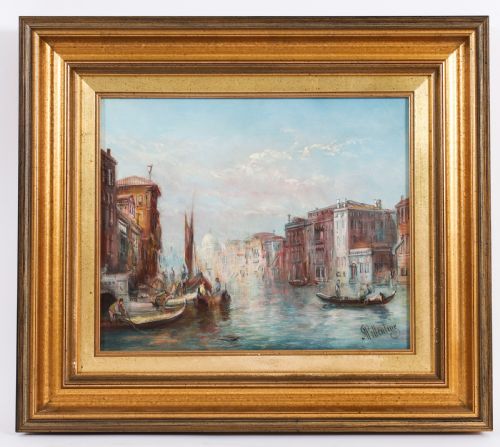
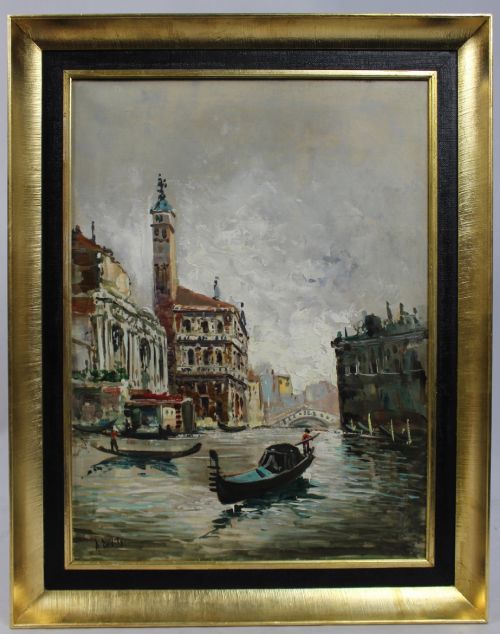
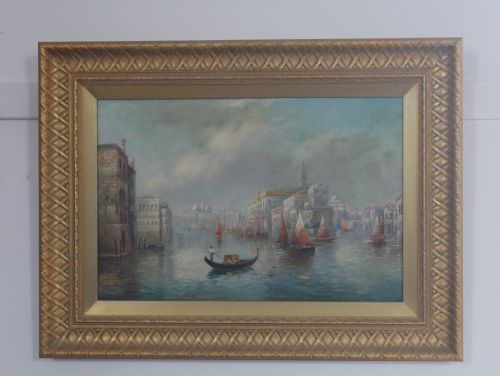
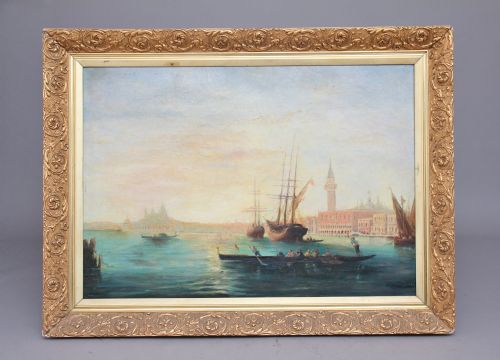


Framed Venetian Cityscape Painting
A framed venetian cityscape painting brings the architectural light and water of the lagoon straight into your interior.
Framed Venetian Cityscape Painting
When you search for a framed venetian cityscape painting, you encounter views depicting the Grand Canal, the Doge's Palace, and the Santa Maria della Salute. These works capture iconic landmarks from the water, often featuring gondolas, bridges, and historic palazzos.
The selections available range from nineteenth-century academic and romantic oils to mid-century impressionism and expressionism. You will also find watercolours and mixed media works spanning the Victorian era through the mid-twentieth century, typically secured behind wooden or giltwood frames.
Materials and Techniques
Artists create these cityscapes primarily using oil paint applied to canvas or board, alongside watercolours, pastel, gouache, and ink on paper. Canvases are stretched over wooden supports and paired with carved or moulded wooden frames, frequently finished with a gilt surface.
The application varies from the detailed architectural precision seen in nineteenth-century townscapes to the looser, atmospheric brushwork characteristic of Italian and French impressionist interpretations of the lagoon.
Several artists braved the Venetian waterways simply to paint the exact spot where a gondolier passes beneath the Bridge of Sighs.
Evaluating Quality
Quality rests in the handling of light on water and the accurate perspective of complex gothic and renaissance architecture. Stronger examples demonstrate confident brushwork that captures the specific atmospheric haze and reflections unique to the Venetian lagoon.
The integrity of the framing also contributes significantly to the overall piece, with period giltwood mouldings enhancing the visual weight and historical context of the canvas or paper within.
Alfred Pollentine·Antonio DeVity·Claude Jousset·Antonietta Brandeis·Jane Vivian
The Framed Venetian Cityscape Painting Glossary
- Grand Canal
- The main water-traffic corridor in Venice, lined with historic palazzos that frequently serve as the central subject for these paintings.
- Giltwood
- Wood that has been coated with a thin layer of gold leaf or gilt, commonly used for traditional picture frames.
- Impressionism
- An art style characterised by relatively small, thin yet visible brush strokes and an emphasis on accurate depiction of light.
- Lagoon
- The enclosed bay of the Adriatic Sea in which Venice sits, frequently depicted in these works as the viewpoint looking towards the city skyline.
Framed Venetian Cityscape Painting: Frequently Asked Questions
What periods do these paintings date from?
The works span from the nineteenth century through the mid-twentieth century, encompassing Victorian romanticism, early twentieth-century views, and mid-century impressionist interpretations.
This broad chronological range allows collectors to select pieces that reflect either traditional academic precision or more modern expressive brushwork.
How are these artworks framed?
Most pieces are housed in wooden frames, with many featuring decorative giltwood finishes that complement the period of the artwork.
These surrounds range from ornate nineteenth-century moulded designs to simpler mid-century profiles that match the canvas date.
Which Venetian landmarks appear most often?
Common subjects include the Grand Canal, the Doge's Palace, the Santa Maria della Salute, and the Dogana.
Artists frequently positioned their viewpoint from the water or the Molo to capture the iconic interplay of historic architecture and the lagoon.
Are all the works oil paintings?
While oil on canvas and oil on board are prevalent, the selection also includes watercolours, pastels, gouache, and mixed media works.
Each medium offers a distinct texture, from the luminous depth of oils to the delicate washes typical of nineteenth and early twentieth-century watercolours.